

Beatrice Kondo

Home Members Projects Publications Contact Us


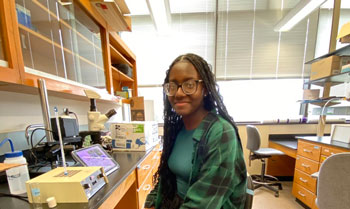
Beatrice Kondo
Baltimore/Black-Backed Breeding and Wintering Ranges

Research Interests:
Evolution of Plumage Sexual Dichromatism and Evolution of Migration

Research Abstract:

RECENT DIVERGENCE BETWEEN BALTIMORE ORIOLE (Icterus galbula) AND
BLACK-BACKED ORIOLE (Icterus abeillei)

Beatrice Kondo, Jason M. Baker, and Kevin E. Omland
UMBC Department of Biological Sciences

ABSTRACT - A recent phylogenetic survey of the New World Orioles (genus Icterus) suggested that the Baltimore Oriole (Icterus galbula, a long-distance migrant) and the Black-backed Oriole (I. abeillei, a short-distance migrant) are sister taxa.  That survey examined mitochondrial DNA (mtDNA) of only one individual from each species.  Here, we examine mtDNA sequences (925 bp of cytochrome b -- cyt b -- and 344 bp of the hypervariable Domain I in control region -- CR) from 15 Black-backed and 20 Baltimore Orioles. The two species appear to be very recently diverged, with average sequence divergences for both cyt b and CR indicating a probable late Pleistocene split.  All phylogenetic analyses clearly show that the two species are not reciprocally monophyletic -- another indication that divergence of the two species was recent, since there has not been sufficient time for complete lineage sorting.  The Black-backed Orioles seem to demonstrate less genetic variability than the Baltimore Orioles in both cyt b and CR.  Males of both species differ in numerous plumage characters. The molecular evidence of recent divergence leads us to conclude that male plumage characters have evolved much more rapidly between the Black-backed and Baltimore Orioles than they have between other New World Orioles. 

En Español:
RECIENTE DIVERGENCIA ENTRE ICTERUS GALBULA E ICTERUS ALBEILLEI
Un resiente estudio filogenetico sobre las Caladrias del Nuevo Mundo (Icterus) sugiere que la calandria de Baltimore (Icterus galbula, un emigrante de larga distancia) y la calndria de espalda negra (Icterus abeillei) son hermanas de taxa.  Ese estudio examino ADN mitocondrial de tan solo un individuo de cada especie.  Aquí, nosotros examinamos sequencias de ADN mitocondrial (925 pares de bases de cytocromo b -- cyt b -- y 344 pares de bases del Dominio I de la hipervariable región de control (RC)) de 20 I. galbula y 15 I. abeillei.  Las dos especies parecen averse diversificado recientemente, con sequencias de divergencias promedias de cyt b y RC que indican una particion al final del Pleistoceno.  Todos los análisis filogeneticos indican que las dos especies no son recíprocamente monofileticas -- otra indicación de que la divergencia de las dos especies fue reciente, puesto que no ha avido suficiente tiempo para completar la ordenación de lineajes. Icterus abeille parece demonstrar menos variabilidad que Icterus galbula en ambos, cyt b y RC.  Los machos de ambas especies son diferentes en varios caracteres de plumaje.  Evidencia molecular reciente de divergencia nos lleva a concluir que los caracteres de plumaje de los machos han evolucionado mucho mas rapidamante entre Icterus abeillei e Icterus galbula que entre las calandrias del Nuevo Mundo. 

Traducido por Christian Ruiz

Publications:

Omland, K. E. and Kondo, B. 2006.  Phylogenetic studies of plumage evolution and speciation in New World Orioles (Icterus), Acta Zoological Sinica, Proceedings of the 23 International Ornithological Congress. 52 (supplement). 320-326.

Kondo, B., Baker, J. M., Omland, K. E. 2004.  Recent divergence between the Baltimore Oriole (Icterus galbula) and the Black-backed Oriole (Icterus abeillei). Condor 106: 674-680.

(Poster presented at American Ornithologists Union Meeting, Seattle, WA, August 2001)

Baltimore/Black-Backed Control Region Unrooted Haplotype Network


Beatrice Kondo, current address
Biology Department
Cornell College
600 First St., SW
Mt. Vernon, IA 52314-1098
319-895-4387
bkondo@cornellcollege.edu


Home | Members | Projects | Publications | Contact Us

 For problems or questions regarding this website, contact omland at umbc.edu.

We are supported by the National Science Foundation CAREER DEB-0347083. Any opinions, findings, and conclusions or recommendations expressed in this material are those of the author(s) and do not necessarily reflect the views of the National Science Foundation.
Last updated: 08/28/2006