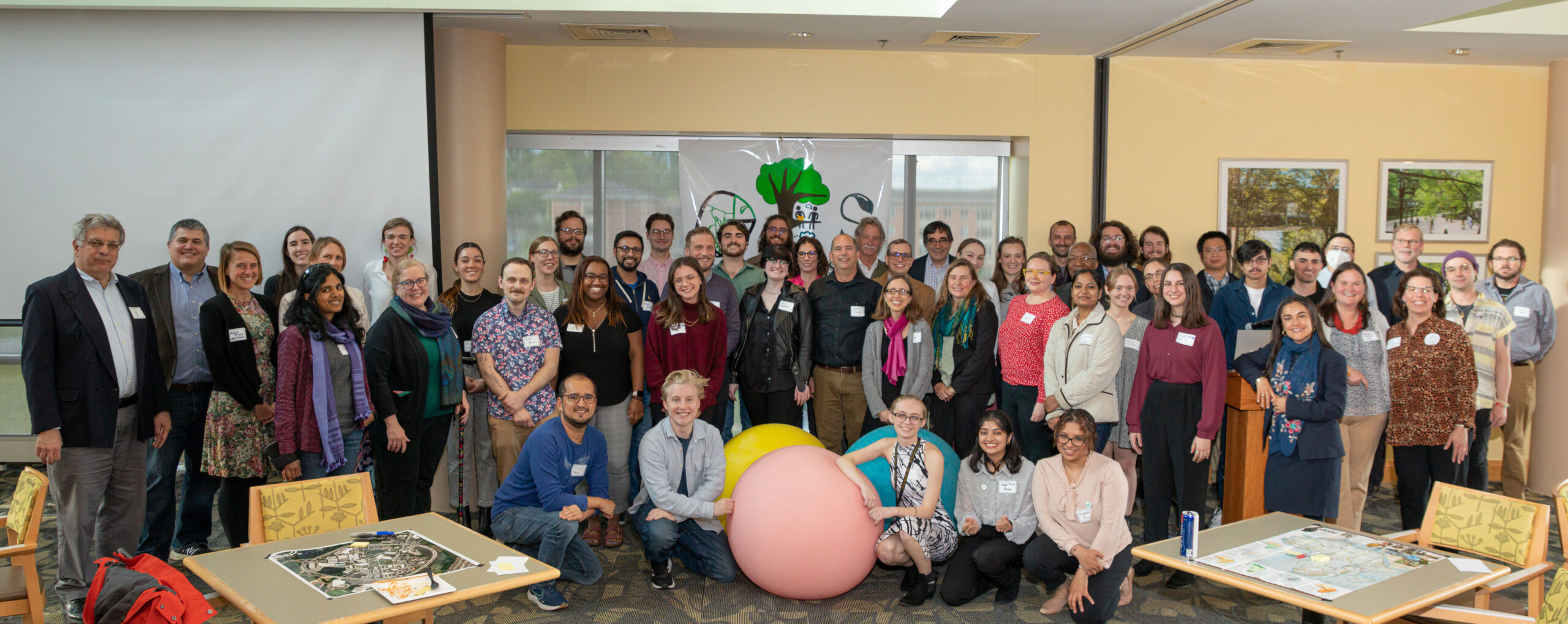
Welcome to the Department of Geography & Environmental Systems
In 2023, the Department of Geography and Environmental Systems (GES) celebrated its 50th anniversary of being at the forefront of geography and environmental science scholarship, cartographic production, and GIS analysis. The department is an integral part of the UMBC community which has grown into a world-class research university that continually ranks among Ivy-league institutions for best undergraduate education. Our faculty are engaged in cutting-edge research topics in earth systems science, ecosystem science, human geography and urban geography, and human dimensions of global change, with the application of geospatial technology to research questions across all areas of interest. The department’s strength lies in more than its faculty and students. We proudly host the field headquarters of the Baltimore Ecosystem Study (BES), the Center for Urban Environmental Research and Education (CUERE), the Goddard Earth Sciences Technology and Research (GESTAR) II, and the U.S. Geological Survey (USGS) Water Science Center for the MD-DE-DC region. We are honored by the incredible success and accomplishment of our graduates as they have moved on to influential and important work in government, industry, and academia – locally in Maryland and across the globe.
The department culture can best be described as a community committed to interdisciplinary scholarship, to high-quality teaching and mentoring of undergraduate and graduate students, and to mutual success and collaboration. Our faculty are active researchers and committed and talented educators. We are known on campus for excellence in mentoring and advising students, for engaging both undergraduate and graduate students in research (including authorship on refereed journal papers), and for preparing students for success in graduate school and professional careers. Five of our current and recent graduates (two graduate students and three undergraduate students) have received Fulbright fellowships for study abroad in the last few years.
See more about the department »
See our seminar series events »