

![]() |
This interdisciplinary course is designed to acquaint students with the status, roles, images and experiences of women. By examining these issues, students also will gain an understanding of the influence of gender on contemporary social organization and behavior, family, workplace, politics, sexuality and the media. Materials will be drawn from many fields, including literature, psychology, sociology and history, focusing particularly on writings by women. Attention will be paid throughout the course to the ways in which women's experiences are affected by such factors as race, ethnicity, nationality, sexual orientation and class. (SS) [3]
This course examines history and social theory to explain why and how social change occurs. Particular attention is paid to patterns of women's involvement in social change movements internationally, as well as to intersections of gender with race, ethnicity, class, and sexual orientation in social move-ments. Students then connect theory to practice through individual and group advocacy or community service projects.[3]
This course examines various lesbian and gay experiences in contemporary American society. Using an interdisciplinary approach, we will examine historical origins and precedents, theoretical frameworks and contemporary case studies to understand the issues affecting the social relations between American society and lesbians and gays. Our primary goals will be: to conduct a critical inquiry into the patterns of lesbians. and gays. subordinate status, to explain their origins and persistence and to consider various routes for changing these patterns. Throughout the course, special attention will be given to the diverse experiences of lesbians and gays based on race, class and disability. Also listed as AMST 210. [3]
This course will investigate the influence of gender roles in paid and unpaid work. Topics to be covered include gender in the labor market (job segregation, pay equity, affirmative action), the economics of housework and family care, women in poverty and the role of government. Also listed as ECON 250. Prerequisite: An introductory course in economics, sociology or women's studies. [3]
Drawing on historical and contemporary sources, this course critically examines the ways in which women and women's experiences have been ignored and explicitly and implicitly devalued in Western philosophy. It also seeks to uncover what, if anything, about the methods and central concepts of Western philosophy account for such exclusion and (apparent) contempt. More positively, we will evaluate new, feminist approaches to old philosophical questions, such as: What is knowledge? What is Justice? Also listed as PHIL 258. [3]
An examination of important issues in women's studies. Topics will be announced each semester. May be repeated for credit when topics vary. [3]
This seminar introduces students to the theory and practice of research in gender and women’s studies. The course examines the distinguishing qualities of feminist methodologies in the social sciences, humanities, and natural sciences. By reading and discussing examples of excellent and innovative gender and women’s studies research, students will acquaint themselves with both the practical details and the ethical issues involved. The course gives particular attention to the interdisciplinary focus of feminist research as well as questions of what distinguishes women's studies from other disciplines; how feminist research and community/political activism are related; how feminist research is changing the traditional disciplines and the methods used in research; and future directions of feminist methods. Prerequisite(s): GWST 100, or GWST 310 and GWST 200, or permission of instructor. [3]
An examination of the ways in which sex roles and gender relations are constructed and experienced in American society. The course explores the development of women's sphere, denoting women's position in the family and home; cultural definitions of femininity and masculinity through mass media, education and other agencies of socialization; the relationship between wage-earning and household work; and feminist consciousness and politics. Special attention is paid to the ways in which gender-based experiences are divided by other social relations, particularly those of class, race, sexual orientation and age. Also listed as AMST 310. (AH) [3]
This course offers students an overview of international films by female directors. Readings and class discussions will address pertinent questions of feminist film criticism and debates about the relationship of gender, race, sexuality, politics and visual representation. Films will include a selection of early cinema, avant-garde, shorts, documentary and contemporary feature films. Taught in English. Also listed as MLL 320. Prerequisite: Any course in the history and/or analysis of art, film, literature or music or any course in women's studies. (AH) [3]
This course will utilize films, television programs and theoretical, historical, and analytic readings to focus on the ways in which LGBTQ people and queer issues have been represented historically in film and television, and how issues of homosexuality intersect with issues of race and gender. Using material from before and after the modern LGBTQ rights movement, we will explore such themes and stereotypes as sissies, mannish lesbians, cross dressing/drag, AIDS, transgender, bisexuality, and others. (AH) [3]
In this course, we will define media and examine diverse and complex modes of communication. We will analyze images of women in the media in terms of race, ethnicity, sexuality and gender. As consumers and producers of media, we will become a critical media audience, increasing our media literacy. This course will explore careers for women in the media. We will utilize the media as tools for activism in empowering women on local and global levels, and we will research how others are using the media to create positive change for women. Also listed as AFST 347 and MLL 322. (AH) [3]
This course examines the changing roles of women in American society from colonial times to 1870 and covers such topics as family, work, rebellion, religion, sexuality, slavery, reform movements and early efforts for women's rights. Emphasis is placed on both the variety of women's experiences and the evolving concerns and position of American women as a group. Also listed as HIST 325. Prerequisite: Any 100-level social science course, junior/ senior status or permission of the instructor. (SS) [3]
A study of the changing roles of women in American society since 1870, focusing on such topics as work, higher education and the professions, social reform, the suffrage movement, war and peace, working-class and immigrant women, birth control and sexual freedom, and the rebirth of feminism. Emphasis is placed on both the variety of women's experiences and the evolving concerns and position of American women as a group. Also listed as HIST 326. Prerequisite: Any 100-level social science course, junior/senior status or permission of the instructor. (SS) [3]
This course traces the history of African-American women in the United States, beginning with their ancestors. history in pre-colonial Africa. Topics covered include work; family roles; activism; achievements and bouts with racism, sexism and poverty. Also listed as HIST 323, and AFST 354. Prerequisite: Any 100-level social science course, 200-level literature course, junior/senior standing or permission of the instructor. [3]
This course is an examination of significant current trends in women's political mobilization in the United States, including topics such as the .gender gap,. gender differences in electoral strategies, the impact of gender on political behavior, the status of women in public office, the history of women in public office and the history of women's political participation. Also listed as POLI 328. Prerequisite: One prior course in political science or women's studies. [3]
What do we and can we know about the lives of women in ancient Greece and Italy, and how did women and men interact? In this course, archaeological and written evidence will be examined to reconstruct the activities, status and images of Greek, Etruscan and Roman women and place them within their historical and cultural contexts. Attention will be paid to the way both ancient and modern views about women and men influence our understanding of the past and present. Also listed as ANCS 320. Prerequisite: One ancient studies course, one women's studies course or permission of instructor. (AH) [3]
The course focuses upon sociological forces that influence sexuality and govern its expression. Topics include the sexual socialization of children and adolescents; teen-age pregnancy; sexuality of single, married and older adults; and governmental and educational services related to sexuality, sexual orientation, pornography and sexual coercion. Also listed as SOCY 332. Prerequisite: SOCY 101 or consent of instructor. [3]
Norms and morés that sanction and regulate human sexuality exist universally, but their particular form varies widely from one society to another. This course examines theories that offer a sociological explanation for the variation of sexual attitudes and behaviors in both industrialized and non-industrialized societies. Also listed as SOCY 333. Prerequisite: SOCY 101 or consent of instructor. [3]
This course examines ways in which gender affects rights within the American civil and criminal legal systems. It explores the interrelationship between traditional attitudes and stereotypes concerning women's roles in society and the historical development of women's legal rights. The course focuses on the consequences of sex differences in shaping the rights of persons under the U.S. Constitution . statutory remedies to discrimination in employment and education, legal issues relating to reproduction and personal life, and the response of criminal law to issues affecting women, including domestic violence, rape and prostitution. Also listed as POLI 338. Prerequisite: One prior course in political science or women's studies. [3]
The course addresses gender issues in the local context of women's movements in several regions and countries around the world as articulated by feminist scholars within those countries. Taking a comparative perspective the course considers the diversity of issues and perspectives within women’s/feminist movements around the globe as well as the relationship between U.S. women and global feminist struggles. Interdisciplinary readings, including fiction and feminist theory, bring the gender perspective to global/international political and economic structures. Prerequisite: GWST 100, 200 or consent of instructor. (C) [3]
This course examines the issues of gender identification as they are presented through dramatic writing and theatre performance. Traditionally, the female in plays has been portrayed within the limited roles of wife, mother, whore and goddess. Contemporary women writers have challenged, expanded and redefined these roles. Plays by such writers as Euripides, Strindberg, Shaw, Lorca, Glaspell, Shange and Churchill will be studied through their historical, social and theatrical traditions to more fully understand what created a context for those earlier female images. Also listed as THTR 349. Prerequisite: Sophomore standing. (AH) [3]
This course examines important issues concerning women, gender, and information technology (IT).Students will consider such topics as the history of women's involvement with IT, how women are impacted by technology, how women and girls fare in the educational setting as well as online, and the way that gender intersects with IT in relation to other dimensions of women's experience such as race, class, and age. Students will connect issues relevant to women and IT to their own career choices, interact with women in the IT field, and utilize technology for research and presentation. Prerequisite: a prior course in computer science, information systems, or women's studies. Also listed as CMSC 352 and IFSM 352 [3]
Marriage and family as social institutions. Primary relationships in marriage: their development in courtship, formalization in marriage and extension to children. The course draws on materials from related disciplines as well as from sociology. Special emphasis on marriage and changing sex roles in modern societies. Also listed as SOCY 353. Prerequisite: SOCY 101 or ANTH 211. (SS) [3]
Women in society, social roles and socialization, women in the labor force, class and lifestyle differences among women as a minority group, women's social movement. Also listed as SOCY 355. Prerequisite: SOCY 101 or ANTH 211. (SS) [3]
GWST 356 Psychology of Sex and Gender
An examination of the psychology and biology of sex and gender differences The major focus of the course is an examination of the psychological and social factors that lead to the development of sex and gender differences and similarities in behavior. Sexuality and variations in sexual orientation will be discussed. Research on both sexes (biological construct) and gender (consequence of socialization) will be included. Diversity and variation on concepts will be explored. Also listed as PSYC 356. Prerequisite: PSYC 100 and one other Psychology course.
The course will discuss psychological models of the female personality (psycho-analytic, social learning, cognitive-development and gender schema perspectives), sexuality, gender roles, gender bias in psychological research, and psychological research on such topics as women's achievement, mental health and interpersonal relationships. Also listed as PSYC 357. Prerequisite: Seven credits in psychology or consent of instructor. [3]
Reading and analysis of literature by or about women. The course intends to familiarize students both with major women writers and with ways in which women have been portrayed in literature. Particular attention will be paid to issues of canonization, gender and genre, as well as to the development of a female literary tradition. Topics to be announced each semester offered. Note: also listed as ENGL 364. Prerequisite: any 200 level literature course with a grade of C or better. (AH) [3]
In this course students will read and analyze the first-person narratives of African and diasporan women to understand how women have used language to define and empower themselves in conformity to or in opposition to the social conventions and political ideologies of their societies. Personal narratives such as letters, diaries, memoirs, essays, journals and autobiographies will be read as literary texts . which are imaginative, reflexive and symbolic . and as social documents . which underscore the ways in which race, class, gender and sexual orientation affect the lives of black women. Texts will be examined within the framework of feminist, particularly black feminist, theory and practice. Also listed as AFST 360. Pre-requisite: GWST 100, GWST/AFST 370 or permission of instructor. [3]
This course explores the lives of black women in Africa and the United States through historical, cultural and socio-political texts and auto/biographies. The history of African women in antiquity, the colonial period and the 20th century is examined and compared with the history of African-American women from early slavery through Reconstruction and the present. A comparative survey of slavery, gender, sexuality and reproductive issues, political activism and economic development will be the context for the readings, oral and written reports and debate topics. The tension of racism and sexism that is at the center of black women's lives also will be addressed. Also listed as AFST 370. Prerequisite: AFST100, GWST100 or permission of the instructor. (SS) [3]
An examination of causes and incidence of female crime and the exploration of major theories from Freud to feminist. Community response to female crime and alternative forms of treatment are evaluated. Also listed as AFST 371. Prerequisite: AFST 271 or junior/senior standing. [3]
An examination of the role of women in European society from the Enlightenment and the Industrial Revolution through World War I. Because the approach will be from both a social and a cultural history perspective, readings will include contemporary descriptions of European women's roles, as well as visions of what those roles should (could) have been, autobiographies, biographies and historical fiction. Also listed as HIST 375. Prerequisite: Any 100-level social science, 200-level literature course, junior/senior standing or permission of instructor. [3]
An examination of the role of women in European society from the eve of World War I to the present. Because the approach will be from a political, social, economic and cultural history perspective, readings will include a women's history textbook, primary documents, autobiographical and biographical sketches, historical fiction and scholarly analysis of the role of gender in 20th century Europe. Also listed as HIST 376. Prerequisite: Any 100-level social science course, 200-level literature course, junior/senior standing or permission of the instructor. [3]
This course explores the impact of social welfare programs and policies upon women's lives, examines the assumptions and values that have gone into the formulation of these policies and discusses alternative approaches to dealing with women's concerns. Topics include women's economic circumstances (the feminization of poverty), traditional and alternative social services for women, and agendas for reform. Also listed as SOWK 377. [3]
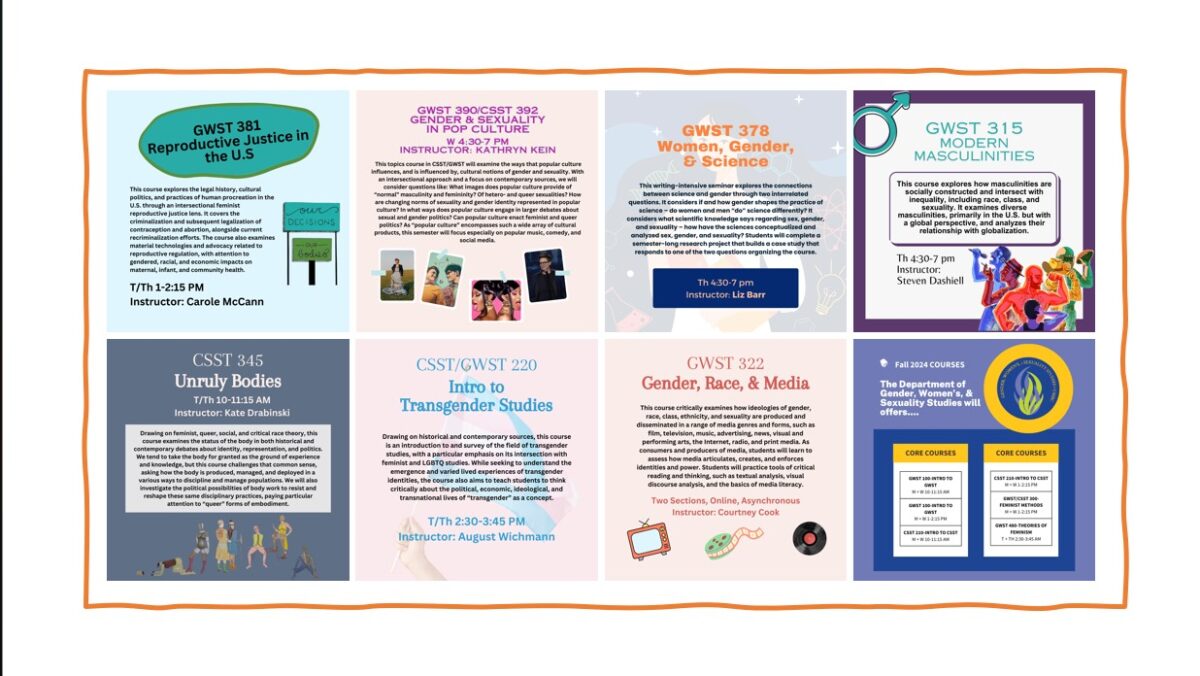
This course will explore connections between science and gender by turning our attention to two interrelated
themes. One focus will be on questions of how gender shapes the practice of science -- whether or not women and
men ‘do’ science differently. The other focus will be on how sex, gender, and sexuality are constructed by the
natural and social sciences – how have the sciences understood and analyzed sex, gender, and sexuality?
Throughout the course, science will be explored as activity and knowledge that is grounded in social and historical
contexts. Prerequisite GWST 100, a 100 level social or natural science course, or permission of the instructor. [3]
An examination of the role of women and gender in Japan, China and Korea since ancient times. Topics include the influence of gender roles in work, marriage, sexuality and birth-control practices. Scholarly analysis, historical fiction and film will be used. Prerequisite: Any 100-level social science course or permission of the instructor. Also listed as HIST 380. (C) [3]
The course investigates the history and cultural politics of U.S. population control policy, including 19th and early 20th century criminalization of contraception and abortion and restriction of immigration as well as the subsequent liberalization of those laws. Special attention is given to women's organizations and advocacy on population and birth control issues and to the influence of wider gender, racial, religious, and international politics on U.S. population policy. (AH) [3]
An investigation of family life in America in various historical periods and among different subgroups. Three themes or questions dominate the course: the relationship of the family to the social context within which it exists; the nature and cause of different forms of family life within various American subcultures, past and present; and the extent to which the family has changed and not changed over several centuries. Specific families examined include the colonial New England family; the 19th century, urban middle-class family; the ethnic family; the black family; and the contemporary family. Within each of these types of family experience, specific topics to be investigated include the role of women, relationships between women and men, attitudes toward children and modes of child-rearing, housing styles and others. As part of the course, students will examine their own family history. Also listed as AMST 382. (AH) [3]
A critical examination of selected issues in women's studies. Topics will be announced each semester. May be repeated for credit when topics vary. [3]
An examination of the philosophical aspects of human sexuality. Topics include theories of sexual desire and sexual activity; the concept of sexual perversion; the moral evaluation of sex acts; feminist analysis of the sexual relations between men and women; and the moral status of homosexuality, adultery, pornography and abortion. Also listed as PHIL 391. [3]
Intended for students who wish to study independently an aspect of women's studies not covered by regular course offerings. Note: May be repeated for credit. Prerequisite: Junior/senior standing, at least six prior credits in women's studies courses and written permission of the instructor who will supervise the project. [1-3]
Work and family relationships as affected by gender stratification. Topics include separation of work and family, division of household labor, gender-wage differences, occupational segregation, impact of government work, and family policies on women and men. Also listed as SOCY 433. Prerequisite: SOCY101 or GWST100, or Junior standing. [3]
This course examines the complex interactions of two critical social constructs: gender and the life course. Material will examine how these constructs have developed over time, how they vary across cultures and historical periods, and how they interact to construct very different lives for males and females in society. Specific foci of the course include demographic and biological underpinnings of gender and the life course, age stratification systems, and times of family and other life events by gender. Also listed as SOCY 434. Prerequisite: SOCY 101 or GWST 100, junior standing or consent of the instructor. [3]
This course offers practical work experience in businesses, agencies and organizations dealing with women's concerns (e.g., Maryland Commission for Women, Planned Parenthood, National Women's Health Network). Note: Repeatable to a maximum of six credits. GWST 450 does not count toward the 18 credits required for the women's studies minor. If completed in conjunction with GWST 495, one three-credit internship can be counted toward the women's studies certificate. Prerequisite: Sophomore standing, GPA of 2.5 or higher, at least six prior credits in women's studies courses and written permission of the program director. [1-3]
This seminar links women's studies scholarship with women's work experiences. It examines the social, cultural, and historical factors that shape women's work in contemporary society. Particular attention will be paid to the conflict and compromises between public leadership and private lives, and strategies for change in the gendered structures of the workplace. [2]
GWST 458 Advanced Topics In Feminist Philosophy
A detailed examination of some single field of feminist philosophy. Topics will vary from year to year but are likely to include the following: feminist ethics; feminist epistemology and feminist aesthetics. In each case, the class will focus on the theoretical and practical impact of feminist thinking on these traditional areas of philosophy. We will critically discuss the relevance of the lived experience of women for philosophical theorizing. Note: May be repeated once with the permission of the instructor. Also listed as PHIL 458. Prerequisites: Two of the following PHIL258, 350, 368, 371, 373, HIL 372, GWST480 or permission of instructor. [3]
This course examines the major theories of feminism considered in their social, historical and intellectual contexts. Particular attention is paid to feminist theoretical explorations of the intersections of class, race, ethnicity, nationality and sexual orientation with gender. Prerequisite: GWST 100, GWST/AMST 310 or permission of instructor. [3]
Advanced investigation of selected topics in gender and women's studies. Topics will be announced each semester. May be repeated for credit when topics vary. [3]
This WILL-only seminar provides the space to examine intersections of gender, race, class, sexual orientation and how these identities shape daily lives. Course readings and assignments provide a springboard for students to reflect on their life choices, the choices and constraints faced by women very different from themselves, and to develop strategies for both personal grown and civic engagement. [2]
The Colloquium provides an opportunity to integrate the subject matter and interdisciplinary methodologies of the major program by focusing on a significant problem in the study of gender and women’s issues and activism. Emphasis is placed on student involvement in both the process and the content of gender analysis. Written and oral reports and a research paper are required. Prerequisite: GWST 100, GWST 300, and GWST 480, or permission of instructor. [3]