We use cookies for analytics and, unless you opt out, advertising.
You can opt out of advertising at any time.UMBC uses essential cookies to run this site. With your permission we would also use analytics cookies (to understand how the site is used) and advertising cookies (to measure and target our ads on other platforms). Nothing else loads unless you accept. You can change your choice any time from Cookie Settings in the footer.Privacy Policy
EssentialRequired for the site to work (login, security, your cookie choice). Always on.
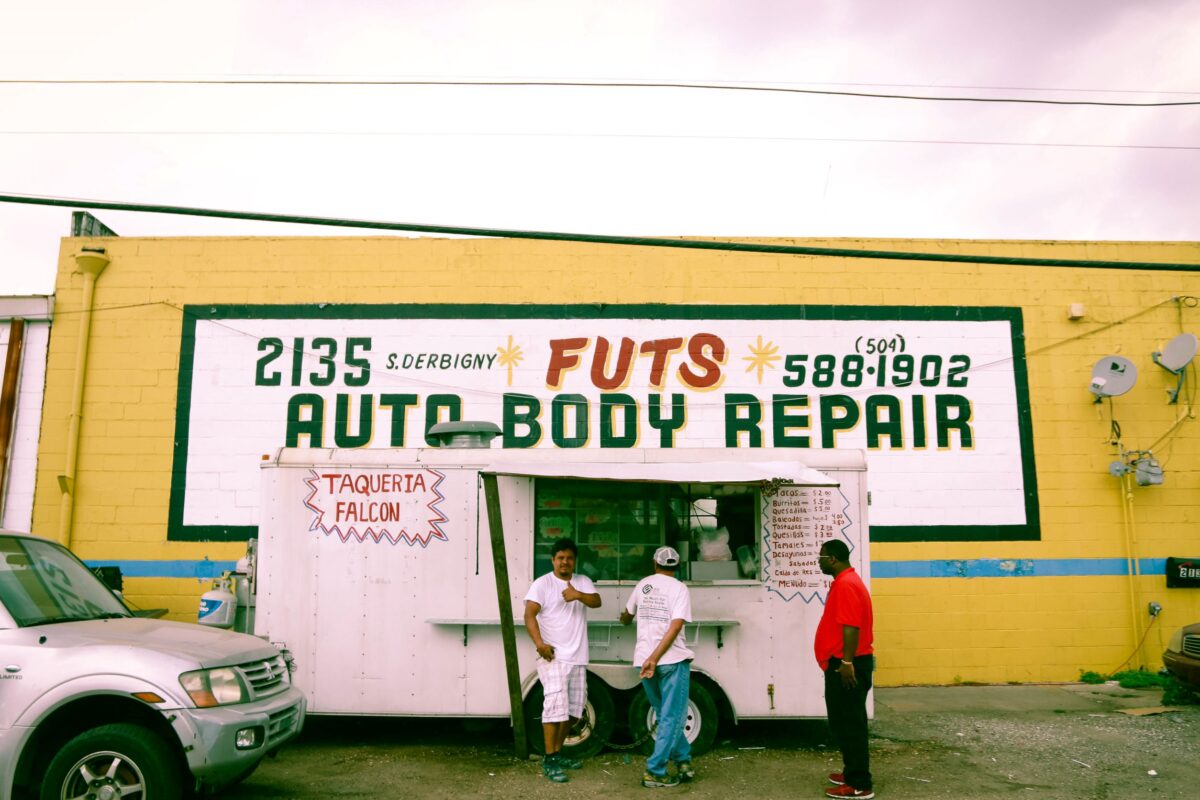
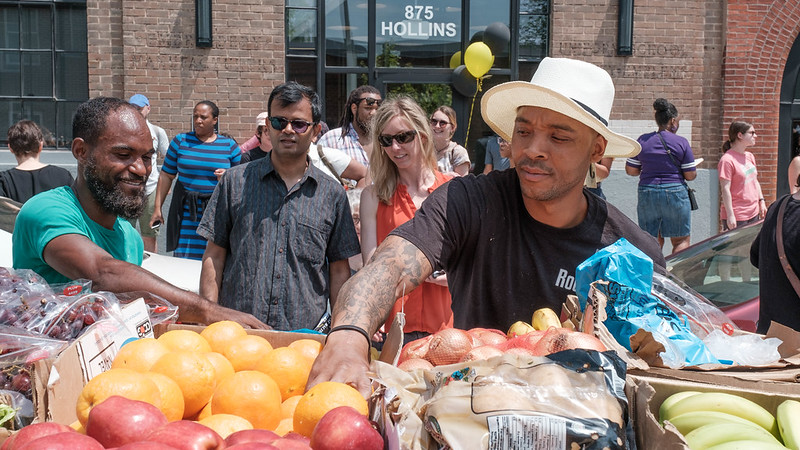
If you were looking for Sarah Fouts in New Orleans, chances are you would find her at one of the many taco trucks or pop-up food vendors across the city, chatting with locals. Relationship-building is at the core of her work, which focuses on the experiences of Black, Central American, and Mexican food industry workers in post-Katrina New Orleans.
Fouts is an assistant professor of American studies at UMBC who earned her Ph.D. in Latin American studies at Tulane University. For more than a decade, she has volunteered for, collaborated with, and supported the work of grassroots organizations in New Orleans. Now, she is working with long-time partners there on an exciting new project.
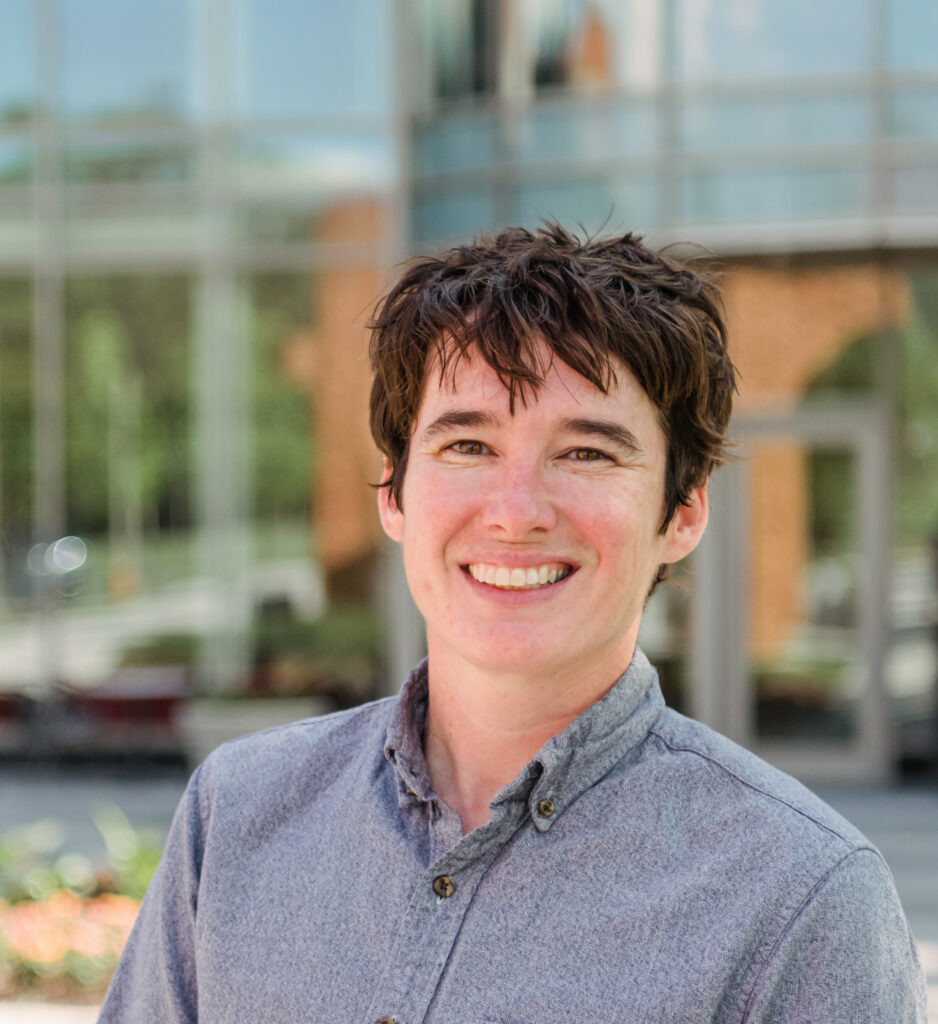
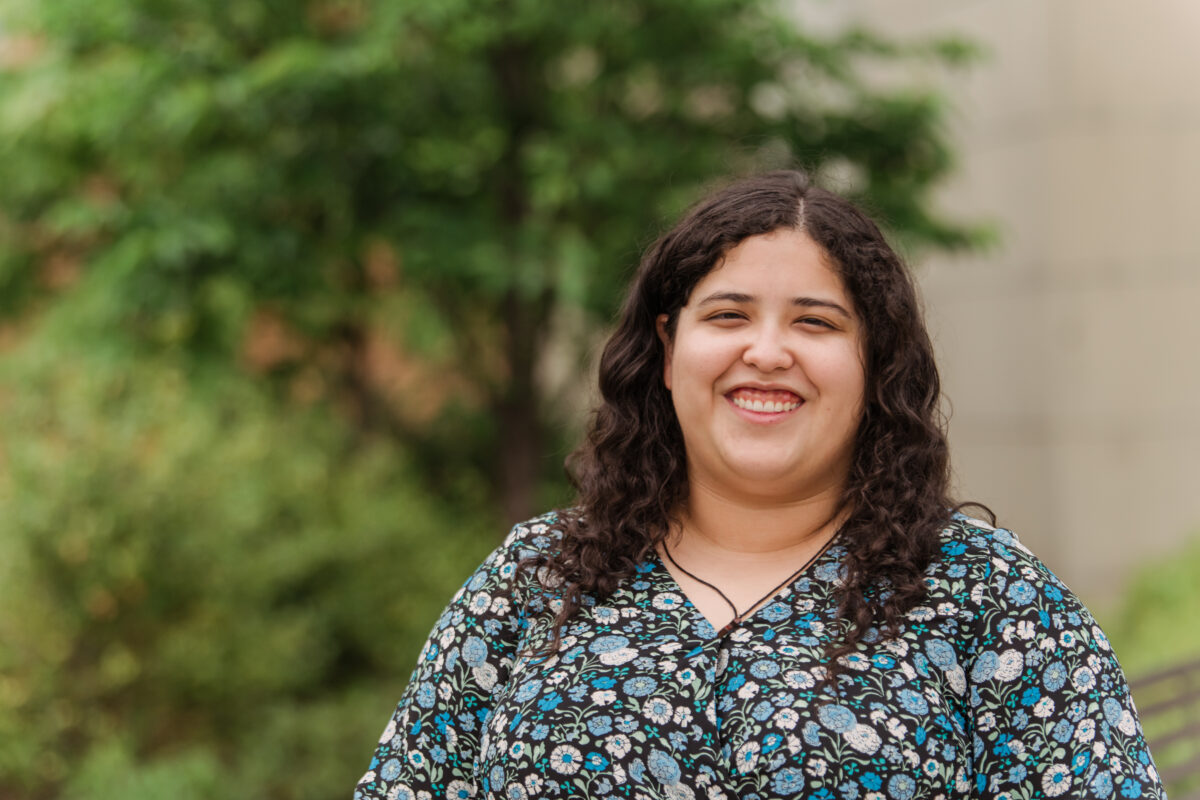
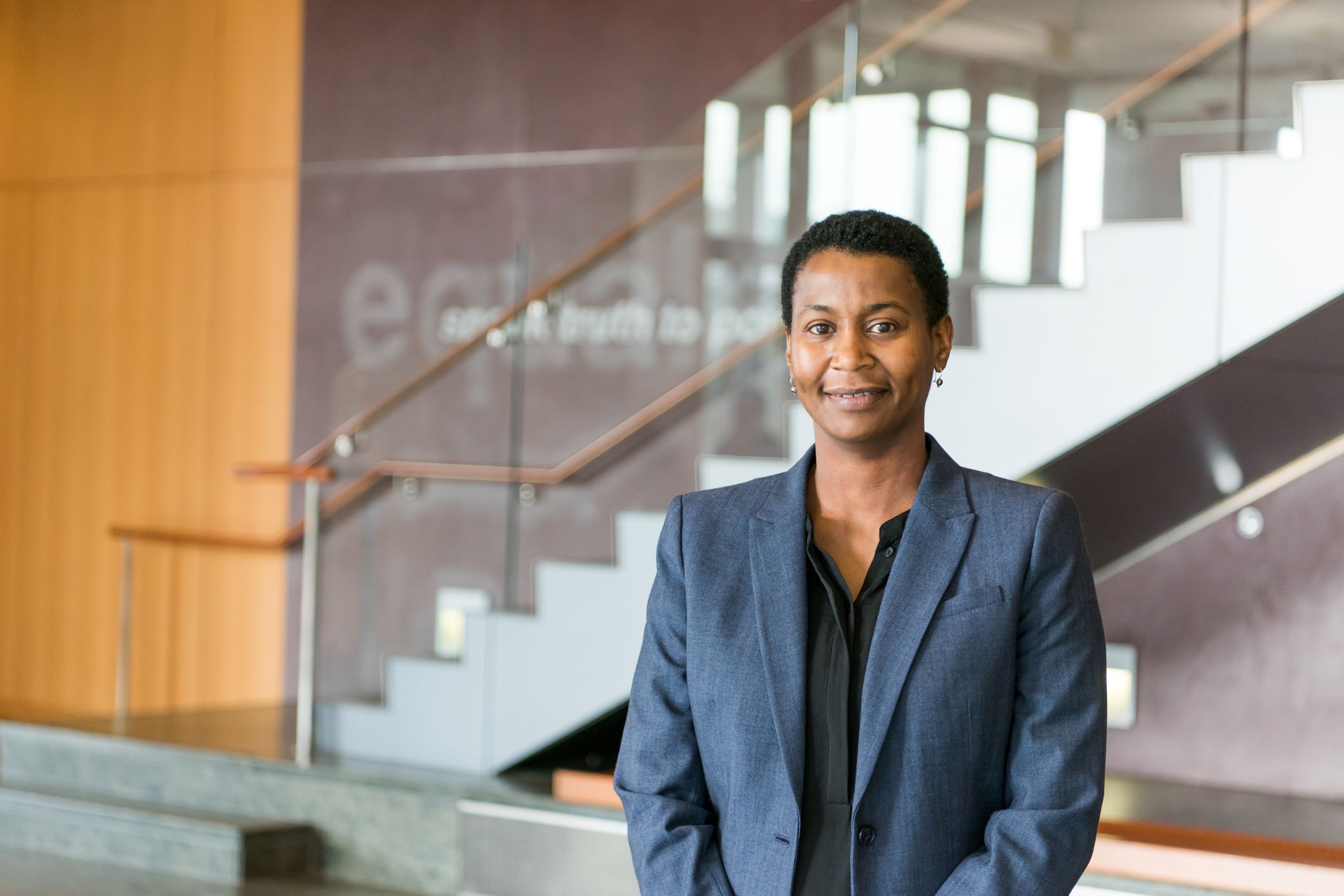
Sarah Fouts. (Marlayna Demond ’11/UMBC)
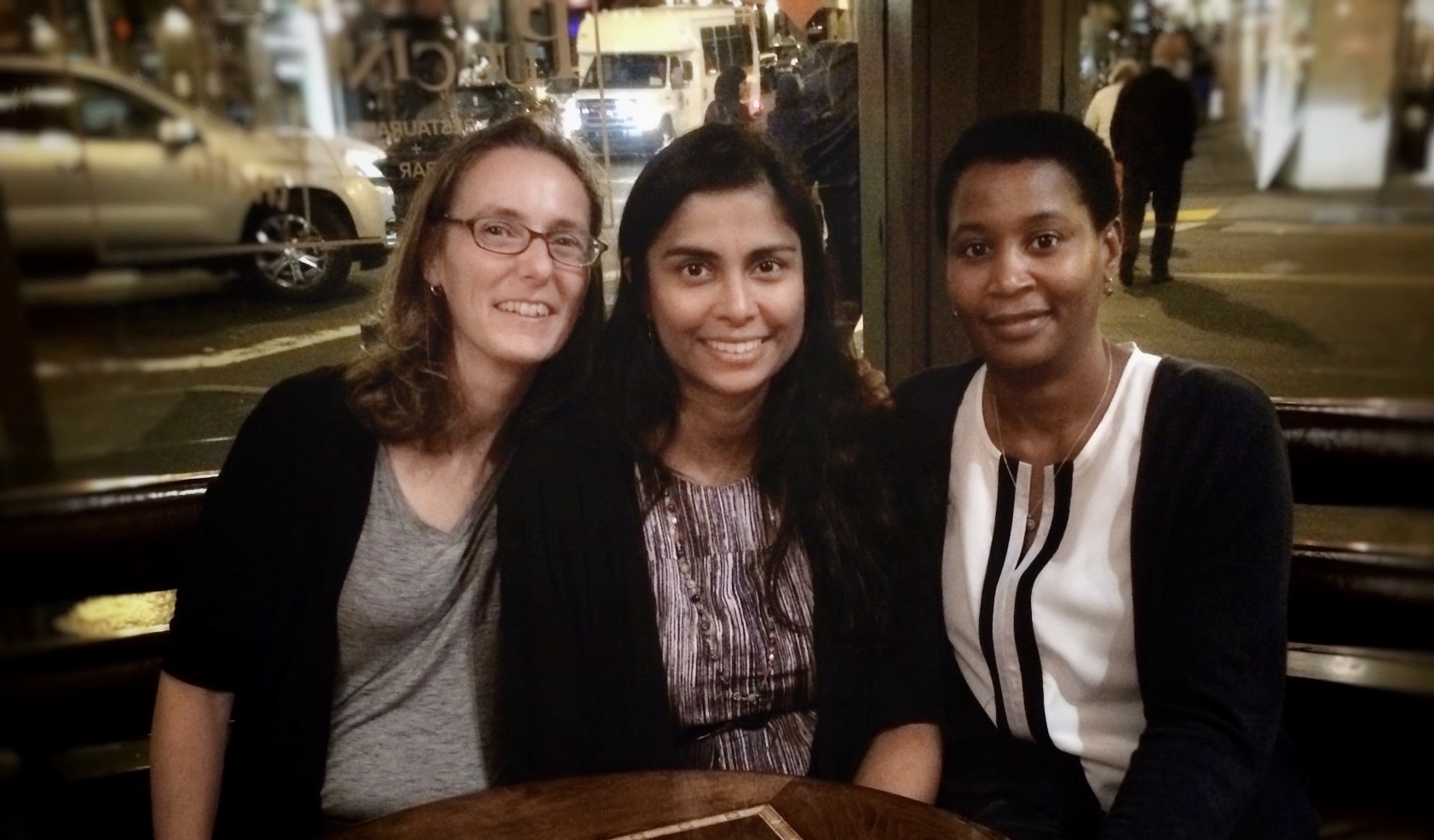
The Whiting Foundation has awarded a $50,000 Public Engagement Fellowship to Fouts along with local organizers Toya Ex Lewis and Fernando López to implement Project Neutral Grounds: At the Intersection of People, Street Food, and the Hustle. Lewis is the organizer of Project Hustle, born in New Orleans, and López is a Mexican-born documentarian. The three partners have worked together since 2013. Their latest collaboration will bring together Black, Brown, LGBTQ+, and immigrant food vendors in New Orleans to celebrate, share, and document their experiences and histories.
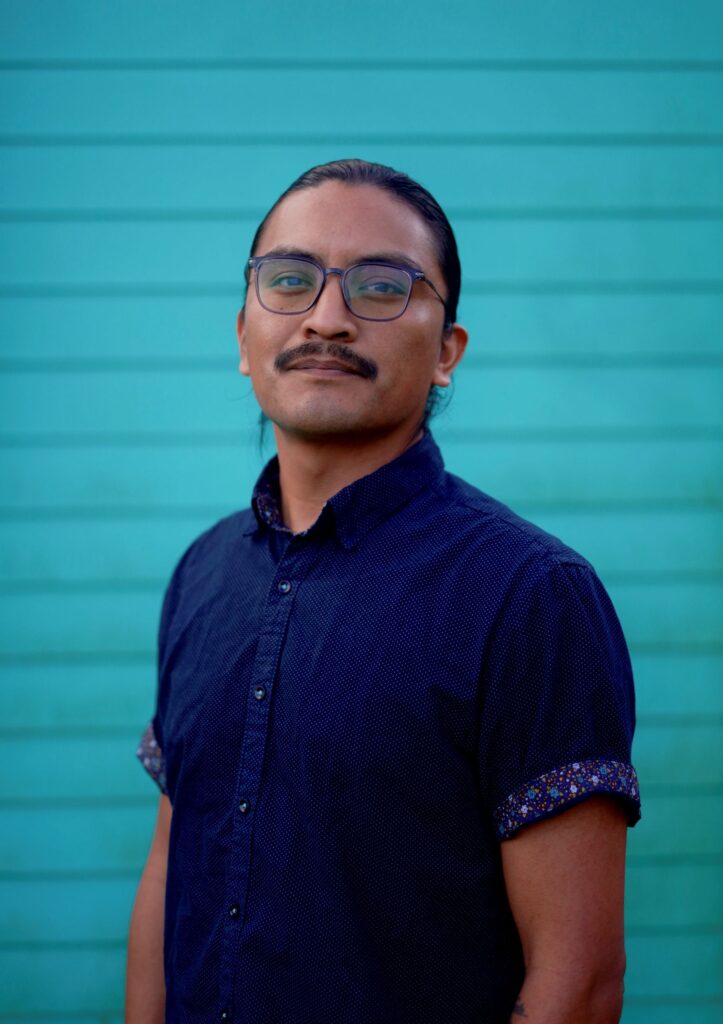
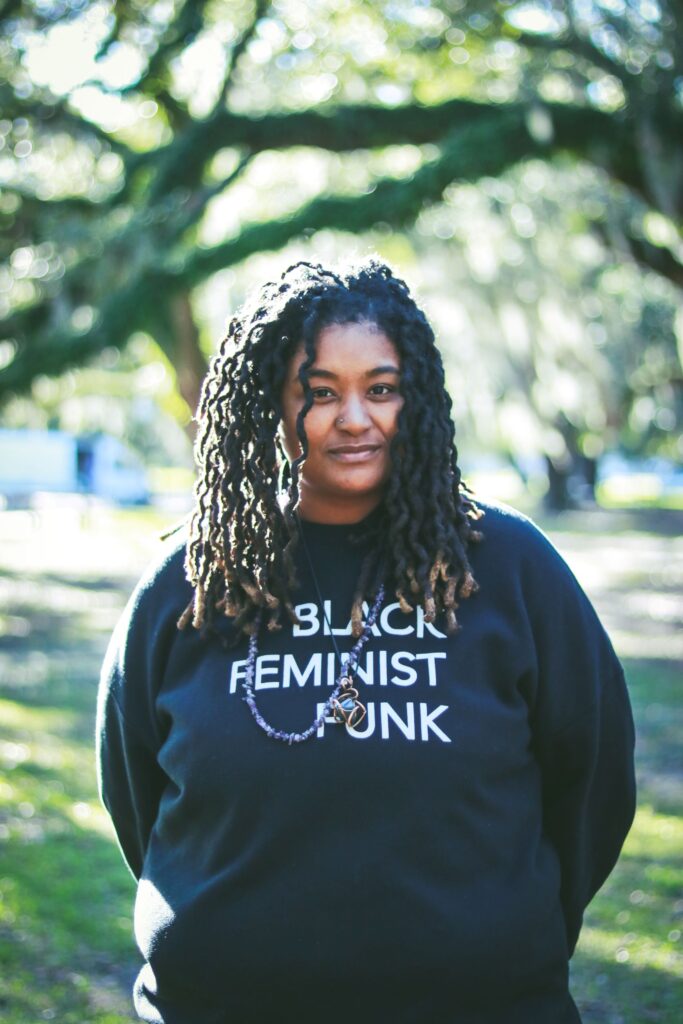
Fernando López. (Photo by López)Toya Ex Lewis. (Photo by López)
“In collaboration with Black and Brown food vendors, Project Neutral Ground will showcase the culture, complexities, and potential futures of post-disaster economies,” says Fouts. “We seek to dismantle barriers and foster dialogue to build networks across factors like race, gender, and class in order to foment an understanding of these vendors as they occupy and vie for city spaces.”
Sharing community history
New Orleans has a rich history and culture of street food vendors, particularly led by the city’s Black community. In 2005, Hurricane Katrina devastated New Orleans with wind speeds of over 100 miles per hour and a monumental storm surge that flooded 80% of the city. Many Black and Brown vendors were forced to leave their homes and businesses or find new ways to continue to live and work. Central American food vendors migrated to the city to help fill the void.
New Orleans taco truck. (Photo by Fernando López)
Now, almost 20 years after Katrina, New Orleans street vendor culture is a mixture of traditional and modern takes on Soul Food and Latin food representative of its burgeoning Black and Brown communities. The success of taco trucks and Soul Food pop-ups has raised complex questions about food truck regulation, worker rights, immigration issues, and local vs. tourist experiences that often pit these communities against each other.
The Whiting Foundation funding will help Fouts, the project director; Lewis, the organizing director; and López, the creative director, work in collaboration with the Southern Food and Beverage Museum to document and share the history, culture, cuisine, and personal journeys of ten food vendors in post-Katrina New Orleans food culture.
Collaborative storytelling
The team will first film and photograph the vendors cooking a dish of their choice at the Southern Food and Beverage Museum. A follow-up filming will document a “day in the life” of each food vendor. Finally, an audio recording will capture personal oral history interviews. Over the course of the year, López and Lewis will use the footage to develop ten mini-documentaries showcasing each vendor’s story.
(l-r): López with food vendor and Fouts filming at the Southern Food and Beverage Museum. (Photo by Fernando López)
Fouts, Lewis, and local artist SheRa Phillips will work with students in Fouts’s UMBC Public Humanities course in fall 2022 to convert these stories into a zine that highlights historic and contemporary vendor stories, maps of where street food vendors are, a historical timeline of street vending in New Orleans, and recipes. Vendors will also be able to give the zine to their customers, helping to share this important part of New Orleans history with new audiences.
“This is a way for native New Orleanians to have opportunities to tell our own stories,” says Lewis, “instead of the usual extractive way our stories get taken and told for us.”
The Project Neutral Grounds digital and physical collection of stories will be on exhibit and archived at the Southern Food and Beverage Museum to share with future generations of locals, vendors, visitors, and public humanities scholars.
Public humanities in Baltimore
Since joining the faculty of UMBC, Fouts has also connected with Baltimore communities. The American Council of Learned Societies has awarded Fouts; Nicole King, professor and chair of American studies; and Tahira Mahdi, adjunct professor of psychology, a public engagement grant of over $150,000 to support their innovative public humanities work. The award, supported by the National Endowment for the Humanities, will fund the development and implementation of the project Baltimore Field School (BFS) 2.0: Undoing & Doing Anew in Public Humanities at UMBC 2022 – 2023.
Fouts, King, and Mahdi will work with community members, UMBC graduate students, and faculty to continue developing frameworks for community engagement between local communities and academia that have long-term benefits for local communities in particular.
An arabber sells produce form a horse-drawn cart in Baltimore. (Bill Shewbridge/UMBC, Baltimore Traces project)
“This collaborative process takes a great deal of time, listening, and building trust,” King explains. “The people living and working in city neighborhoods and building grassroots organizations should be centered in the process of defining challenges and ways to address them in Baltimore and cities like it.”
West Baltimore street walking tour with Curtis Eaddy. (Bill Shewbridge/UMBC, Baltimore Traces project)
The award will broaden the reach of the Baltimore Field School (BFS), launched through a $125,000 grant from the Andrew W. Mellon Foundation in 2020. BFS creates a framework for faculty to collaborate with community organizations in building ethical and sustainable research and teaching projects focused on public humanities.
“ACLS is proud to support these outstanding examples of publicly engaged, community-centered scholarship,” says ACLS President Joy Connolly. “Direct engagement with communities beyond the walls of academia is essential to the continued creation of knowledge for the public good. At the same time, these programs will help in expanding our definitions of humanistic scholarship and in contributing to solutions for a brighter future for all.”
Eight recent UMBC graduates and alumni will soon travel to countries across three continents as 2022 Fulbright U.S. Student scholars. They include emerging leaders in education, astrophysics, cybersecurity, human rights, and more, and they are excited to explore difficult questions through fresh perspectives.
The Fulbright Program is the U.S. government’s flagship international exchange program. UMBC was named a Fulbright Top Producing Institution in 2019 – 2020. In the last decade, UMBC has received over 60 Fulbright U.S. Student Program awards for research and teaching placements in Africa, Asia and the Pacific, the Middle East, South America, and Europe.
Creating new paths
Caleb Jacobson. (Image courtesy of Jacobson)
This year marks UMBC’s first Fulbright awards to El Salvador and to the UK. Caleb Jacobson ’21, global studies, and M.A. ’23, sociology, will research human rights and the transition to peace in post-conflict El Salvador. Kaitlyn Keaton ’22, computer engineering, a Cyber Scholar in the Center for Women In Technology, will head to Newcastle University (NU) in North East England to complete a master’s in cybersecurity. NU is recognized jointly by the UK’s National Cyber Security Center and the Engineering and Physical Sciences Research Council as an Academic Centre of Excellence in cyber security research.
Keaton has focused on making the most of her college education by pursuing a wide range of learning experiences. She has held competitive software engineering internships at General Dynamics Mission and Systems and Northrop Grumman Mission Systems, and has participated in Capture the Flags cybersecurity competitions, but this will be her first learning experience abroad.
As a Cyber Scholar and Tau Beta Pi Engineering Honors Society member, Keaton is determined to further develop the skills necessary to be on the cutting edge of cybersecurity research. She is also committed to creating new pathways for more women and girls to be leaders in engineering.
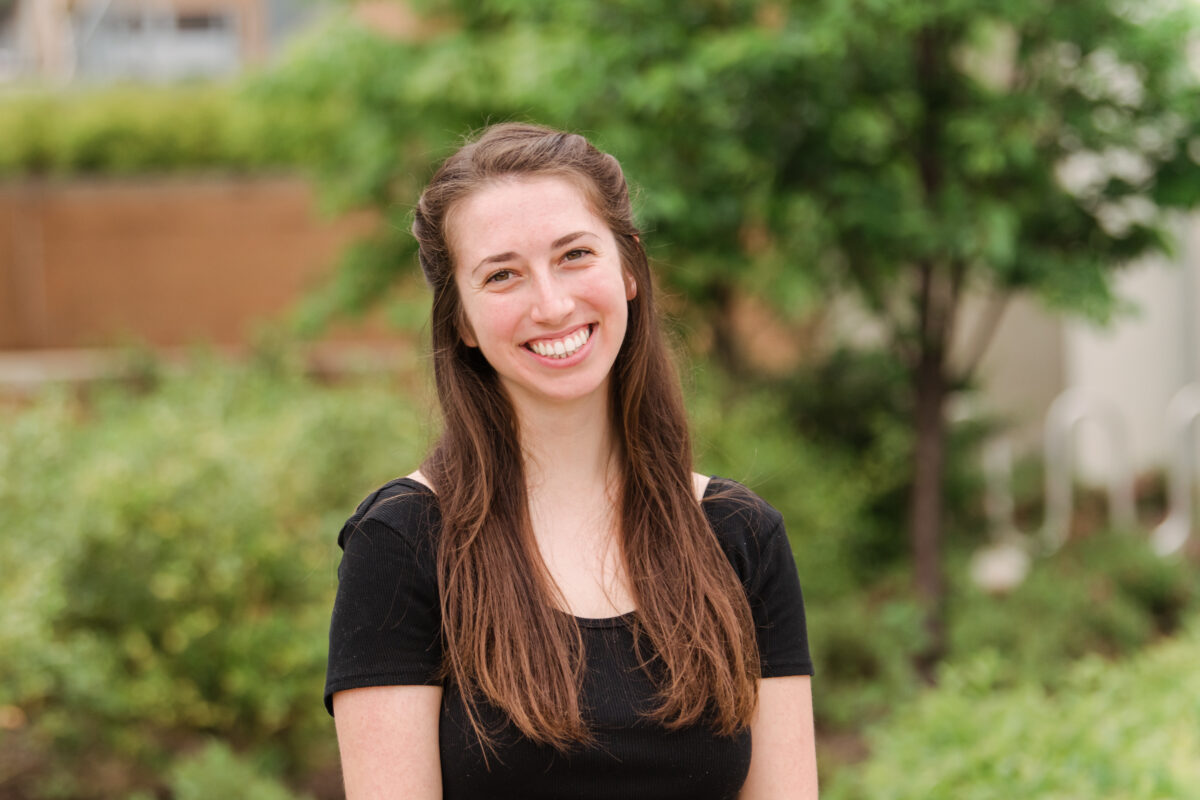
Kaitlyn Keaton. (Marlayna Demond ’11/UMBC)
“I want to inspire and encourage even more girls and young women to join the cybersecurity world,” says Keaton. “There is a critical need to get girls interested at younger ages to show them they can do it too.”
Intercultural understanding in medicine
Maryam Elhabashy ’21, anthropology, developed an interest in the process of healing early in her life while surrounded by a family of physicians. In high school, she shadowed a physician at a hospital and saw instances where patients’ cultural backgrounds sometimes conflicted with the physician’s concerns. She wondered if a lack of intercultural understanding in medicine can get in the way of good medical care, leading to health disparities.
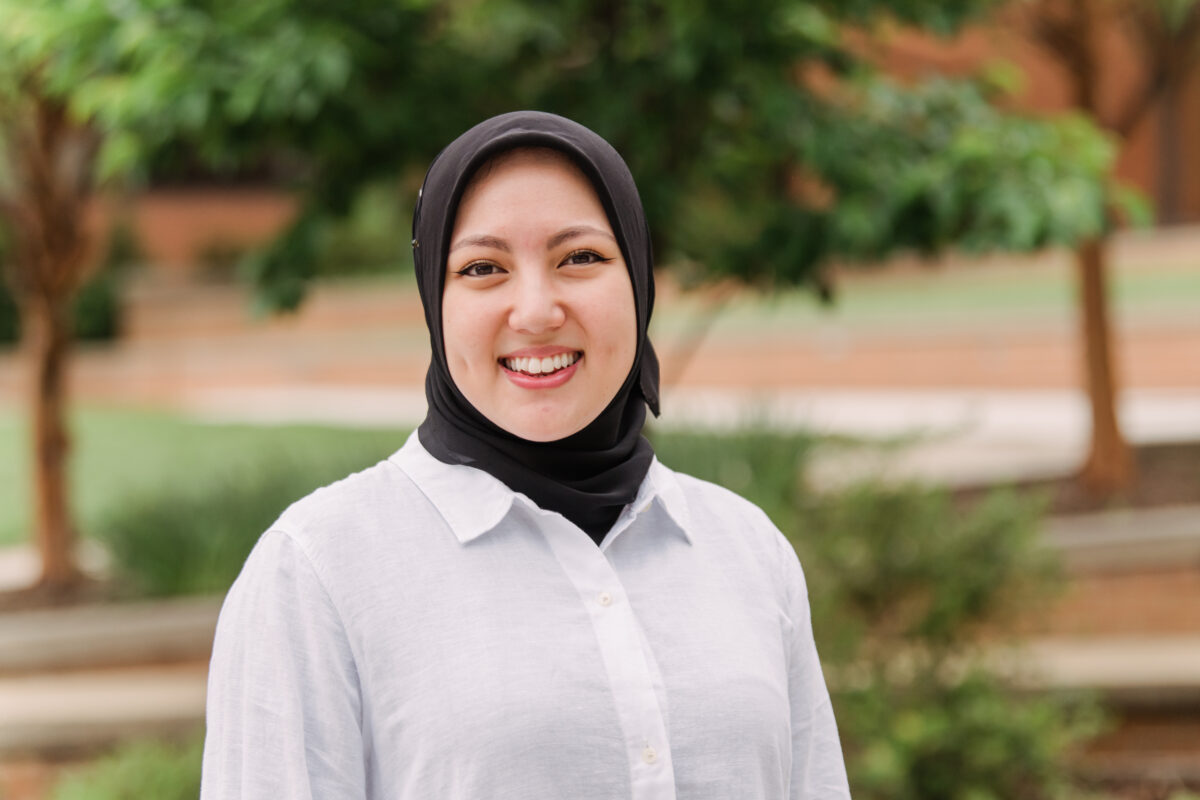
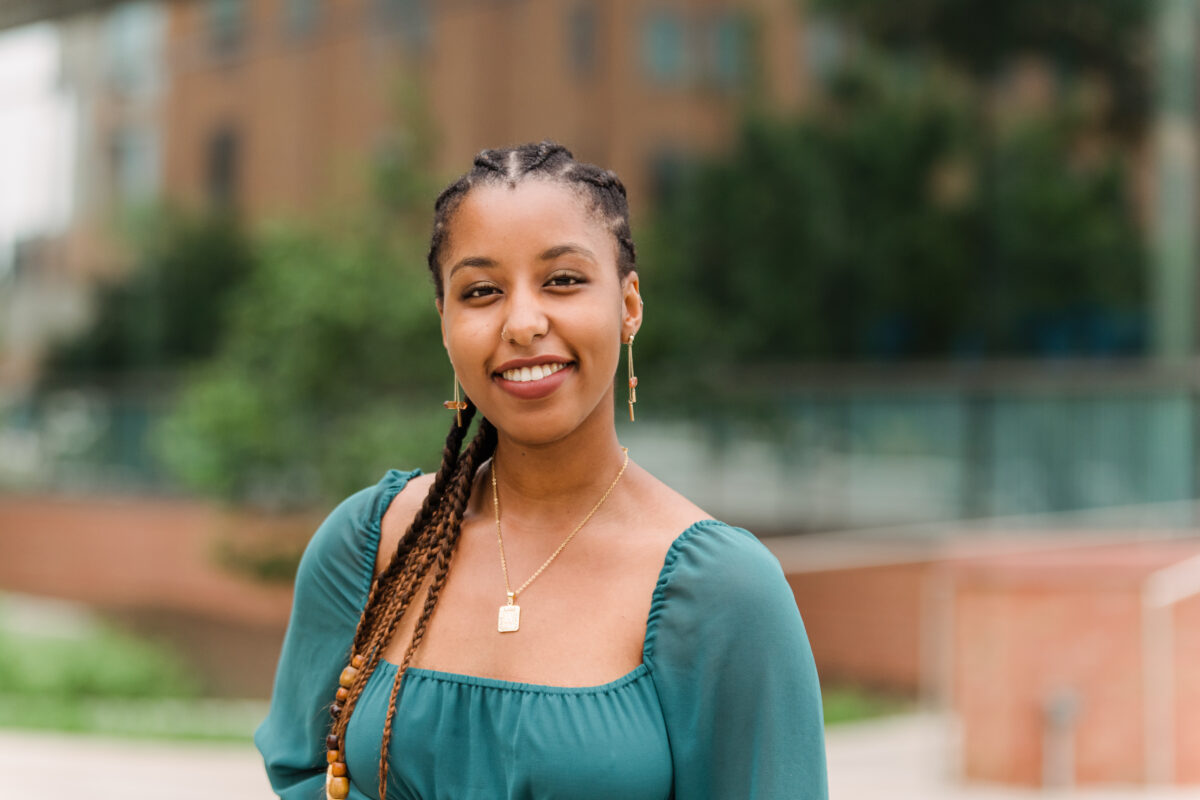
Maryam Elhabashy. (Marlayna Demond ’11/UMBC)
Elhabashy found an answer in listening to culturally diverse perspectives. As a student of anthropology with a focus on medical anthropology, she found that listening to people’s stories can help physicians develop empathy. This is one way to ensure patients feel heard, understood, and are able to navigate medical processes that can give them access to the best care possible.
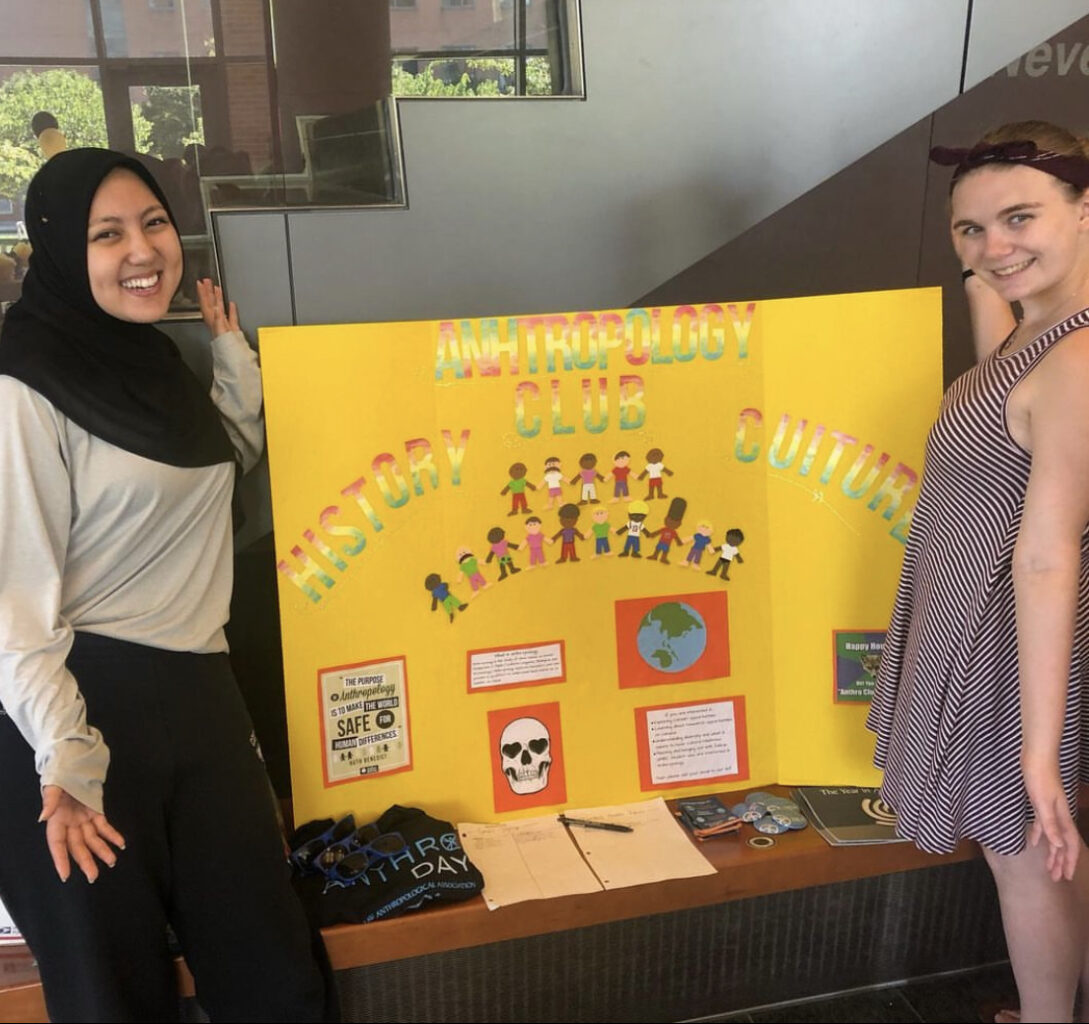
While at UMBC, Elhabashy received an Undergraduate Research Award to research “Cupping and Wellness Among Muslims In the Baltimore-Washington Area.” She also served as a research assistant in sociology, anthropology, and public health (SAPH), studying physical activity among older African Americans in Baltimore.
After graduating, Elhabashy worked at Rutgers University as a research assistant studying tobacco and e-cigarette use among minority populations. In the past year, she interned at the Amgen Scholar Program at the National Institute of Health, working with leading biomedical scientists to identify and address health disparities as a potential result of societal, cultural, and environmental influences.
During her Fulbright year, Elhabashy will live in Kuwait City to work on her research project at Kuwait University titled, “Faith, Family, Food, and Fitness: Exploring Trends of Obesity Amongst Kuwaiti Women.”
“I hope to one day be at the forefront of a movement towards truly personalized medicine that embraces individuality and intercultural communication as a foundational tenet of the field,” she notes. “I hope my experience in Kuwait will serve as a strong foundation for this work.”
Latine teachers needed
Adrianna-Marie Urbina-Ruiz ’21, mathematics, and M.A.T., secondary education, was raised in Montgomery County, Maryland, but her roots are in Venezuela. She remembers only having four Hispanic teachers growing up. All were Spanish language teachers and supported her academic and personal growth. However, Urbina-Ruiz felt some of her other teachers had lower expectations of her, limiting her opportunities, and she saw other Hispanic students struggle with this same experience.
“Many Hispanic students learning English and those who are bilingual have been seen as having limited academic knowledge, limited potential,” says Urbina-Ruiz. “I want to stop that narrative.”
At UMBC, Urbina-Ruiz met Bonny Tighe, a senior lecturer of mathematics, who encouraged her to become a math major and a math teacher through the Sherman STEM Teacher Scholars Program.
Urbina-Ruiz (in pink) with the Sherman STEM Teacher Scholar Program staff. (Image courtesy of Urbina-Ruiz)
“I will never forget walking into her office hours for the first time. She recognized me as having one of the highest grades in her Calculus I class,” says Urbina-Ruiz. “She and the Sherman staff had confidence that I would rise to any challenge. They built a strong foundation for my success.”
Urbina-Ruiz (standing row, center). (Image courtesy of Urbina-Ruiz)
Urbina-Ruiz also completed a master’s in teaching and earned a certificate in teaching English to Speakers of Other Languages while student-teaching at Lakeland Elementary/Middle School in Baltimore City, which serves many Hispanic families. “I want to have as many tools at my disposal to make my classroom as accessible as possible,” says Urbina-Ruiz. “I want to be the Latine STEM teacher I never had.”
Urbina-Ruiz will work towards creating her first Collaborative Online International Learning program during her Fulbright year. She will connect college students at the Universidad Industrial de Santander in Colombia with students in Maryland while teaching English. “Latine teachers are needed around the world,” says Urbina-Ruiz.
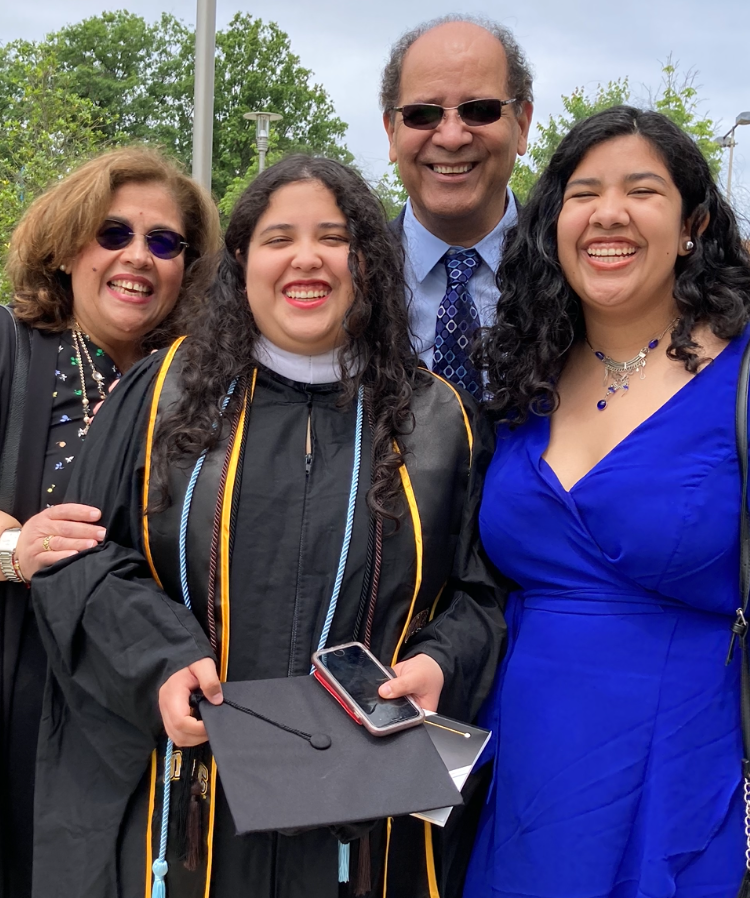
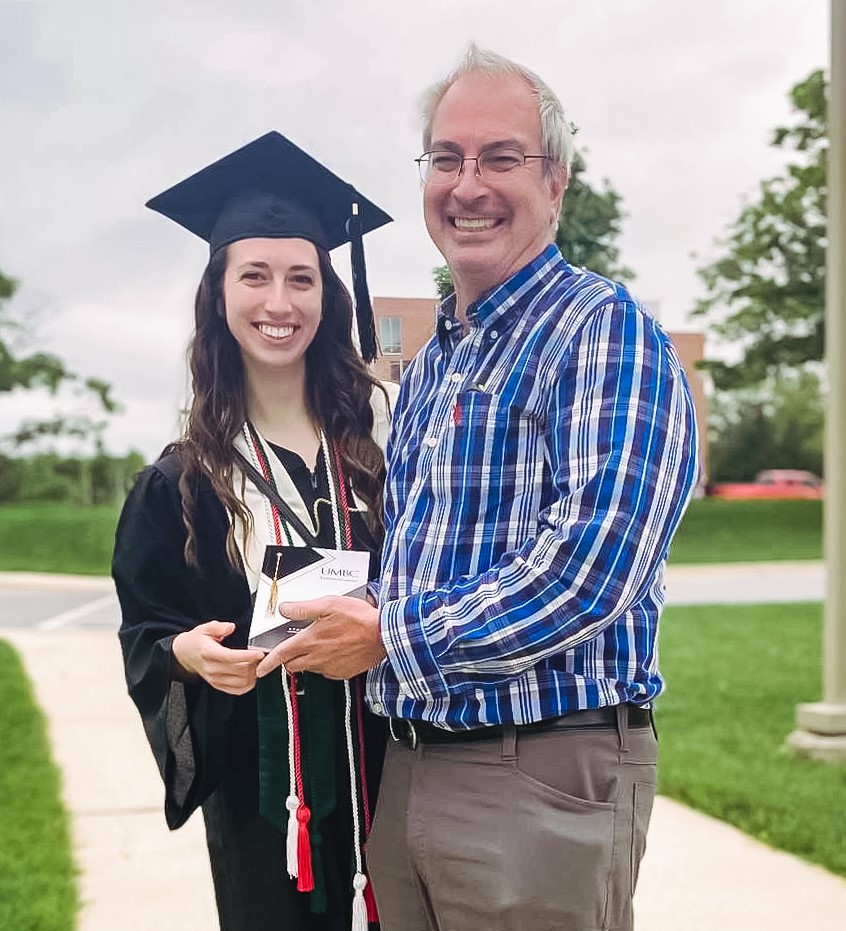
Urbina-Ruiz (wearing cap and gown) with her family at her master’s graduation. (Image courtesy of Urbina-Ruiz)
Urbina-Ruiz plans to return to teach in Baltimore City Public Schools where there is a high demand for bilingual Hispanic teachers.
Representation in science
Similar to Elhabashy, Maithily Diana Díaz ’21, biology and modern languages, linguistics, and intercultural communication, is pursuing a career focused on health equity. As a first-generation student, Díaz encourages other Latinos to go to college and to be ambitious even if it means they are in spaces where they are the only Latino, something she has experienced as a Latina in STEM.
“I’m usually the only Latina, but now it means something more,” says Díaz. “Now, it’s just the jump of saying Latinos can be scientists, researchers, physicians. If we believe in ourselves then someone else will too. And once that door is opened, then who knows how far we can go.”
Díaz recently moved to Tijuana, Mexico to work at a non-profit health clinic serving a largely refugee and migrant population. For the past school year she has been teaching science and medicine to predominantly Hispanic and African American K-12 students for Refugee Health Alliance in Harlem, while completing remote research in mental health at the Johns Hopkins School of Public Health.
During her Fulbright year, Díaz will complete a master’s in immunology and work on cancer research at the French National Institute of Health while mentoring undergraduate students at Sorbonne University. .
“It’s a dream come true that someone like me received a Fulbright at such prestigious institutions. My students were shocked,” says Díaz. “I want more and I intend to achieve it. But at the end of the day, this is for my community.”
While in France, Díaz will work with researchers seeking to identify more effective means of treating soft tissue sarcomas. The findings may reveal potentially novel immunotherapy targets for a variety of cancers.
As a linguist with proficiency in English, Spanish, French, Portuguese, and Russian, Díaz knows her ability to successfully communicate across multiple cultures and languages can lead to greater opportunities. She wants to show Latinos what can happen when they value their multicultural and multilingual lives as assets.
Following her Fulbright, Díaz plans to pursue an M.D., promoting equity in both research and healthcare.
Global education and disability
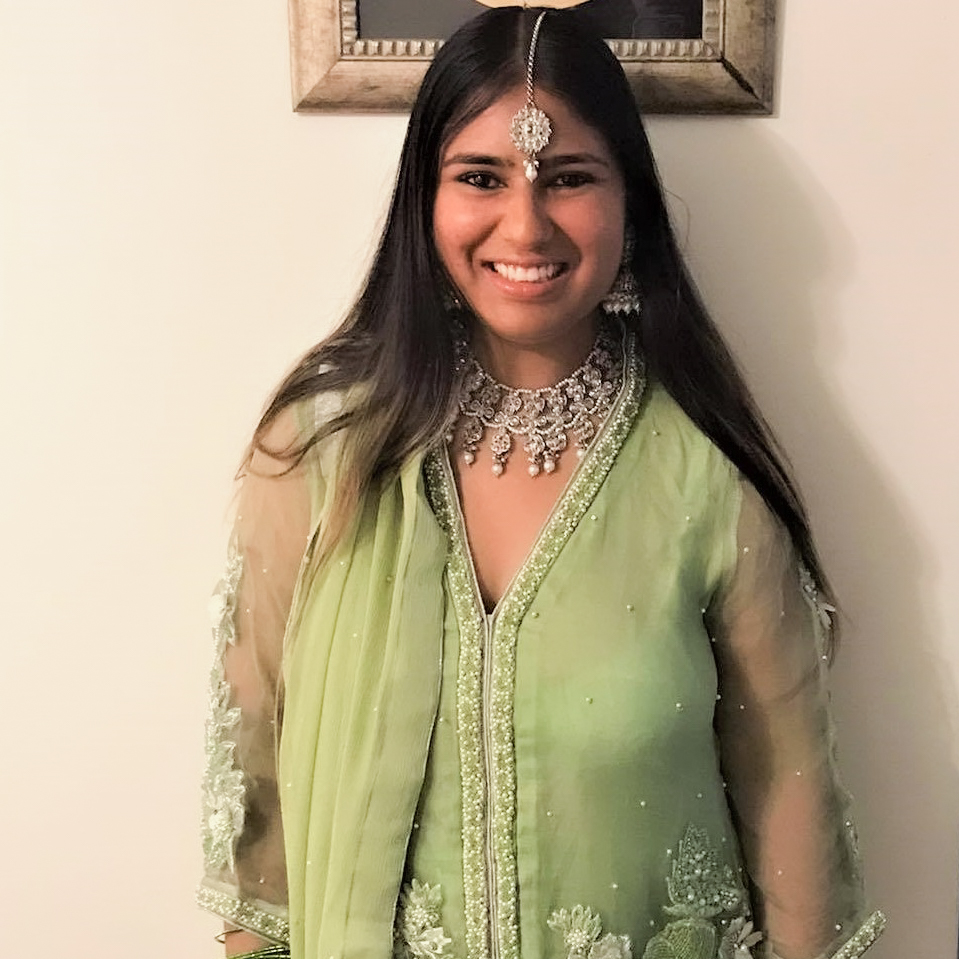
Mimi Yaldram in traditional Pakistani dress. (Image courtesy of Yaldram)
Mimi Yaldram ’20, history, is very familiar with the process of acclimating to a new culture and country. When she was seven years old, her family left their home in Karachi, Pakistan for the United States to seek better mental health services.
“We came in 1999 right before 9/11,” says Yaldram. “It was a lot to manage the racism towards my Muslim family while learning how to live, study, access services, and work in the U.S.”
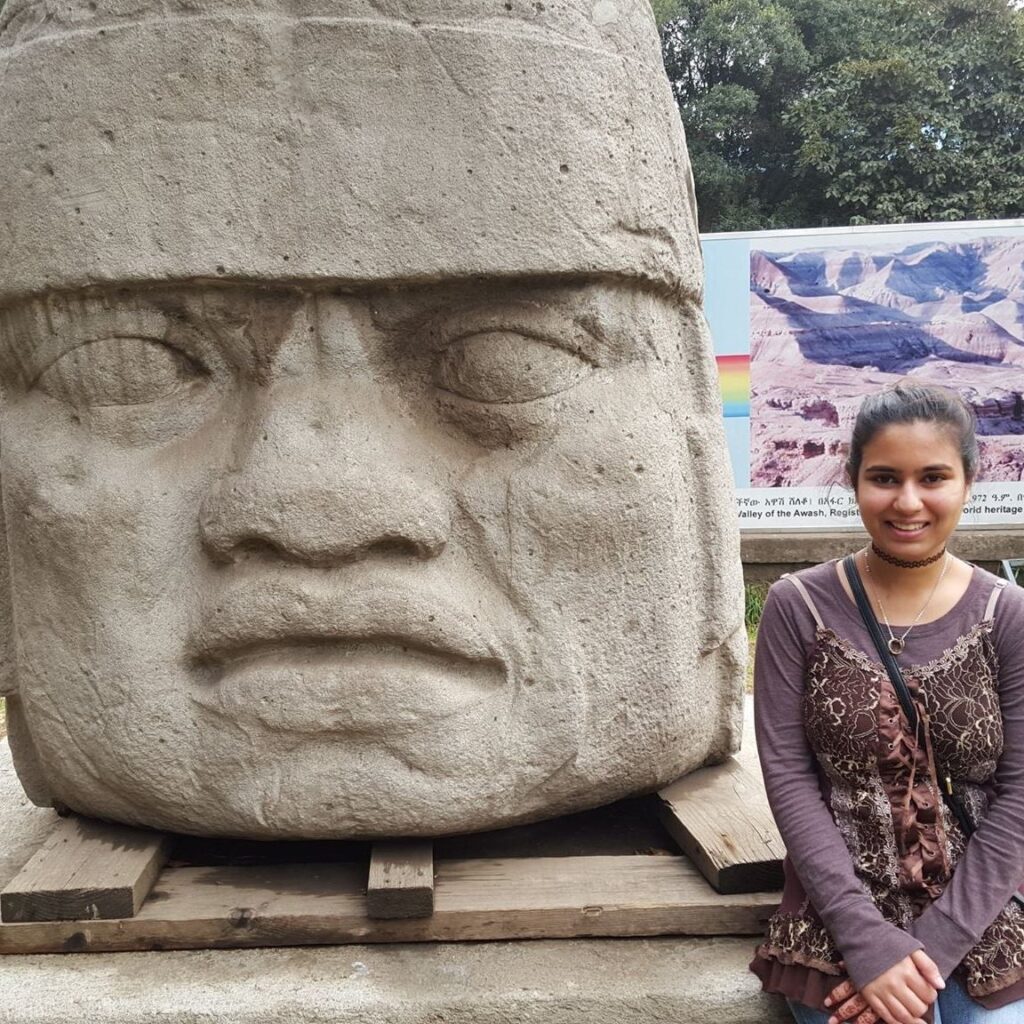
This experience inspired Yaldram’s passion for living and learning within multiple cultures, religions, and languages, which she began to explore at Montgomery College. There she held numerous executive student leadership roles and traveled abroad to Ethiopia, where she researched the influence of India on ancient trade routes and currency.
In 2017, Yaldram joined UMBC’s Shady Grove campus, embarking on new student leadership opportunities, including serving as president of the Student History Association and studying abroad in Denmark. She learned about Viking history and participated in a dance project focusing on Danish pop dances and Pakistani Bollywood dances.
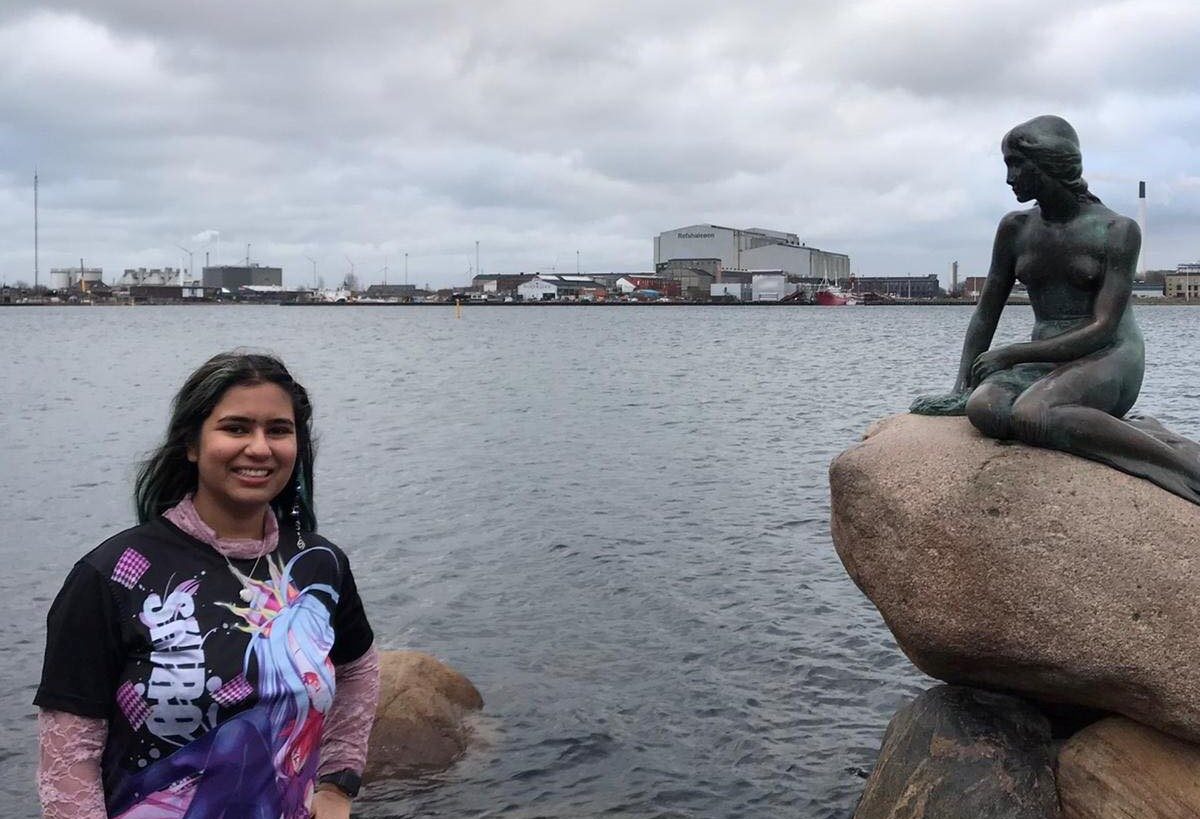
Yaldram next to a sculpture of the Little Mermaid in Copenhagen, Denmark. (Image courtesy of Yaldram)
Yaldram identifies as a student with a mental health disability, and she is passionate about advocating for and teaching other students with disabilities and neurological differences. For the past two years, she has tutored students with autism spectrum disorder on strengthening their writing, communication, and social skills.
Now that she has earned her both her Teaching English as a Second Language and mental health first-aid certifications, she is ready to spend her Fulbright year teaching English in Taiwan. She is excited to be part of Taiwan’s goal to become a bilingual nation by 2030 by raising English proficiency. She also looks forward to sharing her skills in disability education and services while teaching.
“My dream is to make a positive impact on immigrant communities by utilizing my own experiences and education,” says Yaldram. “I hope to make a difference and bring that to the Fulbright program in Taiwan.”
Yaldram plans on a career at the intersection of global education, social justice, and disability beginning with humanitarian work in Pakistan after her Fulbright experience.
Korean world influence
Chemutai Wangui Nganga ’21, global studies, comes from a Kenyan family in the United States. During elementary school, she lived in Kenya for four years where she improved her Swahili skills and learned more about her Kenyan culture. When she moved back to the U.S., her family settled in Howard County, Maryland, home to numerous international communities, especially a thriving Korean community. Nganga learned about the influence the Korean economy, cuisine, music, art, and technology have had on the world.
Living in a diverse community, led Nganga to major in global studies at UMBC. She gained a greater understanding of the opportunities and conflicts of globalization and decided to focus on international politics and French. Her Asian studies courses increased her interest in Korean culture, which led her to pursue a Fulbright year in South Korea.
“For me, Korea is a full step into a new world,” says Nganga, who will be teaching English. “It is another chance to push the boundaries of my worldview as well as serve others.” She plans to explore a career path in foreign service on her return to the U.S.
Stellar research
As a burgeoning astrophysicist, Kaitlyn Szekerczes ’22, physics, lives and breathes for exploring the infinite universe. She didn’t know that all those nights stargazing on her deck with her dad and discussing the plausibility of science fiction shows would lead her to pursue a career in space science research.
Kaitlyn Szekerczes. (Marlayna Demond ’11/UMBC)
“I was always fascinated by the questions we were not able to answer. We are not even close to knowing nearly everything when it comes to astronomy,” says Szekerczes. “My goal is to contribute to answering lesser-known big and challenging research questions.”
Szekerczes (l) with her dad. (Image courtesy of Szekerczes)
Szekerczes will lead a project on gravitational lensing of tidal disruption events at the Max-Planck Institute for Astrophysics in Garching, Germany. It will be the first study to apply the technique of gravitational lensing—the bending of light by gravity—to researching tidal disruption events, which are events that happen when a supermassive black hole tidally disrupts a star.
“My dream job is to work as an astrophysicist for NASA,” says Szekerczes. “UMBC was the perfect fit for me because I was encouraged to pursue my passion for tackling challenging unanswered questions. I was also given the resources and support to piece together the puzzle of how to work towards my goals.”
After returning from Germany, Szekerczes will begin a Ph.D. program in astrophysics at Penn State University in fall 2023.
Degree: M.P.S., Community Leadership Hometown: Baltimore, MD Plans: Work in social justice organizations
“Service is a pathway to opportunities for everyone if we allow it to be accessible to all. It is about leading through example and perseverance, and finding joy in completing innovative complex projects with a myriad of community members and organizations.”
Keenan Hickman, M.P.S. ’22, community leadership, has called many different places “home” at some point in his life. Born in Baltimore, he spent part of his childhood in Korea, served in Indonesia as a Peace Corps volunteer, and lived and worked in San Francisco.
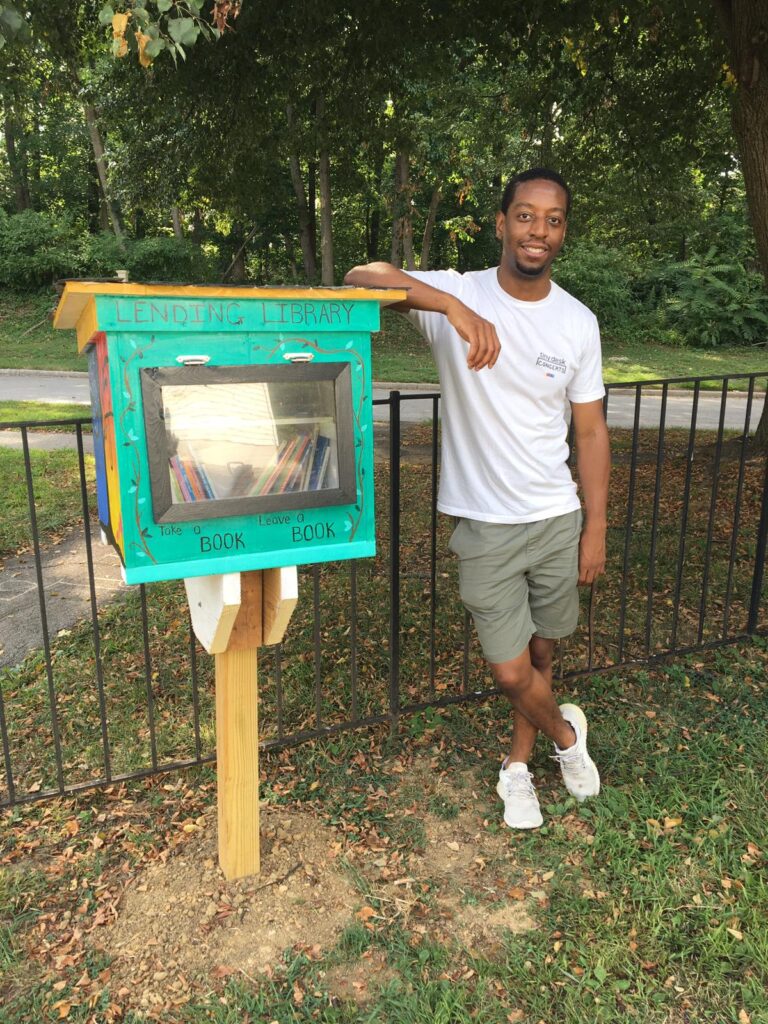
Hickman in Woodlawn, Baltimore next to the Free Lending Library he built during COVID restrictions as lead coordinator at the Walden Circle Community Center. (Image courtesy of Hickman)
Each place presented opportunities to support local communities. In Indonesia, he served as an English instructor while also facilitating trainings on diversity, inclusion, and belonging for local residents. In California, he served as a literacy tutor and a mentor in Big Brothers Big Sisters of the Bay Area Now, after having worked for three years at the U.S. Department of Homeland Security, Hickman is ready to focus on Baltimore.
During his master’s in community leadership at UMBC, he was a lead coordinator at the Walden Circle Community Center. Hickman designed and implemented youth programs, created a lending library, organized community events, and worked on fundraising campaigns.
Hickman sees the future of empowerment for disenfranchised communities at the intersection of leadership, technology, and innovation. He has a vision for moving forward a new model of social justice work focused on growing equitable, anti-racist communities, starting in Baltimore.
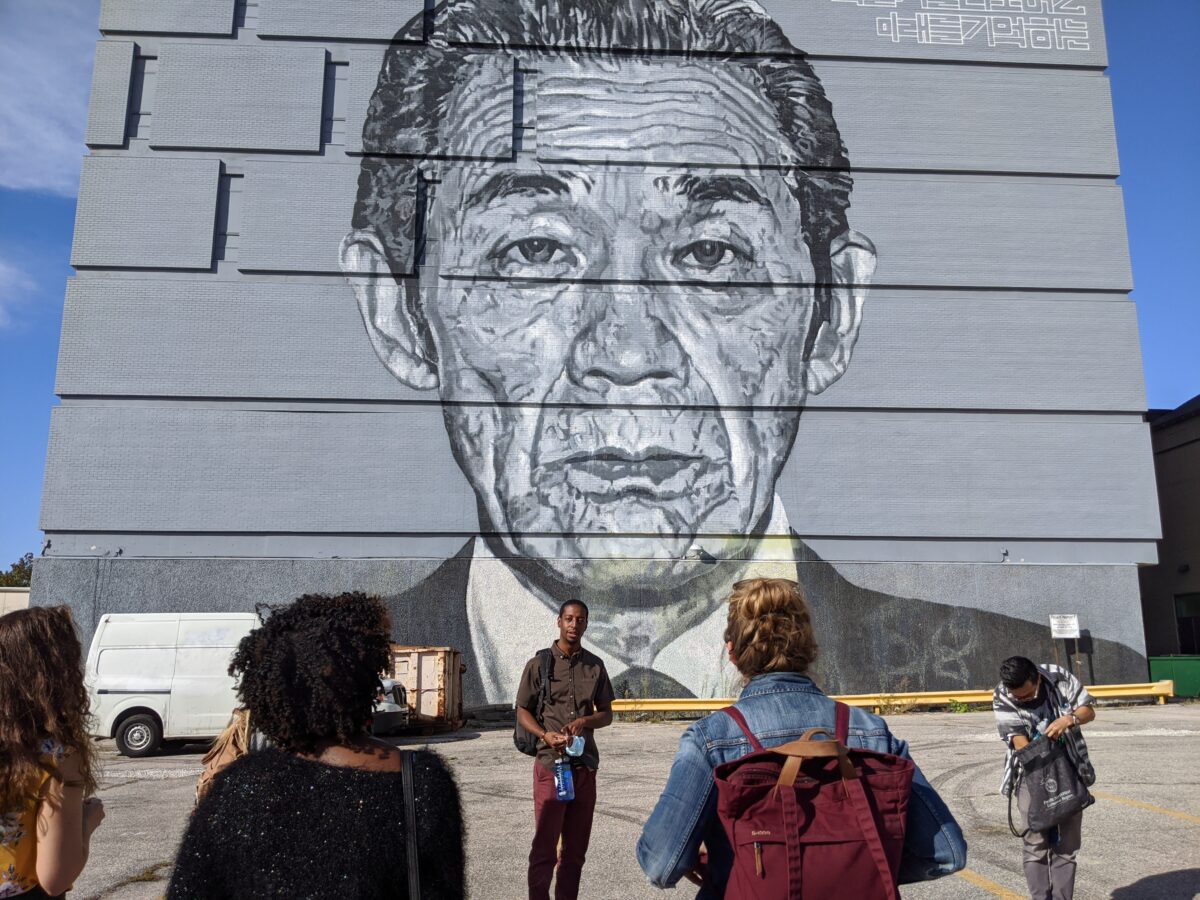
Hickman facilitating a community learning practicum on identity and placemaking in Baltimore’s historic Koreatown as a UMBC Peaceworker Program fellow. (Image courtesy of Hickman)
Degree: Ph.D., Geography and Environmental Systems Hometown: Longchamps, Buenos Aires Plans: Assistant professor in residence, Urban and Community Studies program, UConn Waterbury
“When I arrived in Spain as a teenager, my teachers did not expect me to go to college because I didn’t have the resources to access certain learning opportunities. Now, as a graduate student in the U.S., remembering my experience as a teenager helps me connect with the students I support and empathize with their lives.”
Melisa Argañaraz Gomez has lived and learned around the world. She was born in Argentina and moved to Granada, Spain, at the age of thirteen. There she earned a B.A. in sociology from the Universidad de Granada, before earning a master’s in sociology at the University of Amsterdam. From there she moved to the U.S. to pursue a Ph.D. in geography and environmental systems (GES) with Dena Aufseeser, assistant professor of GES, researching the experiences of Baltimore’s immigrant adolescents.
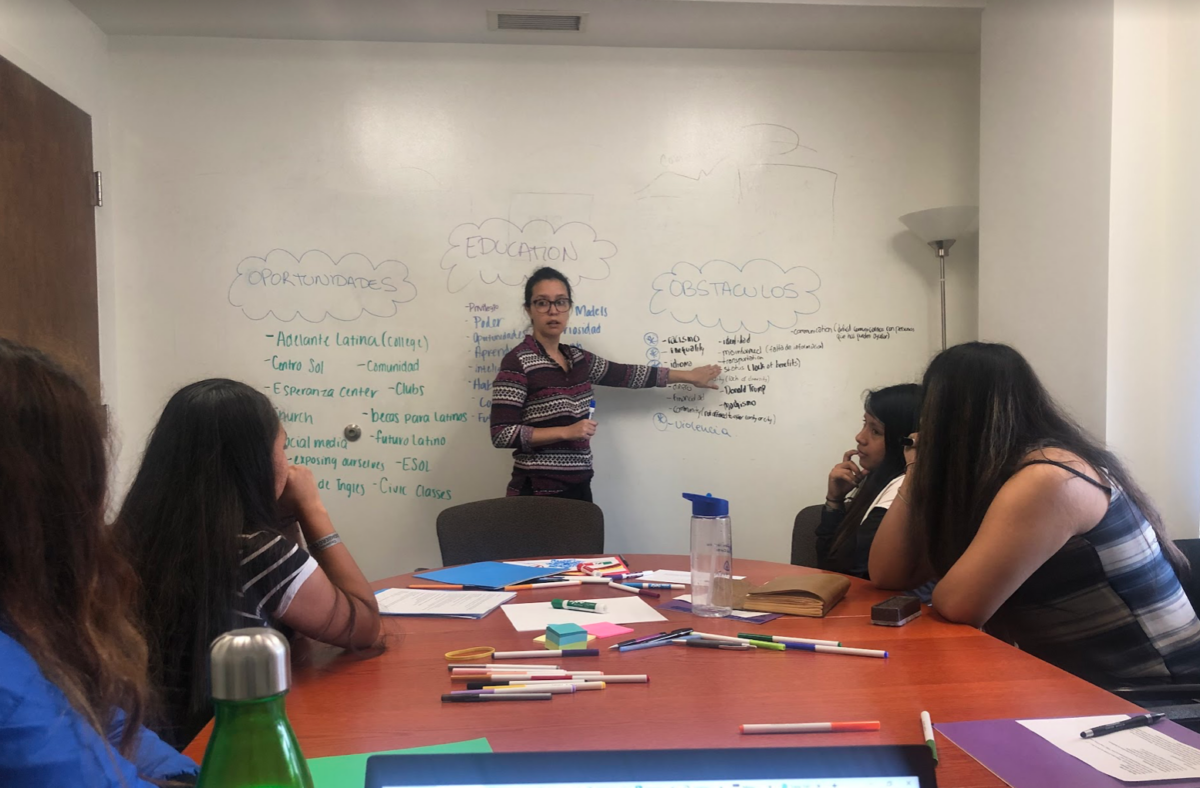
Melisa Argañaraz Gomez, leading a class at Centro Sol Summer Scholars Program. (Image courtesy of Argañaraz Gomez)
Argañaraz Gomez’s areas of research include urban and feminist geographies and migration studies, as well as race and ethnicity. She studies migrant children and youth narratives of inclusion and (un)belonging in Baltimore. One of her projects, “PARqueología Migrante,” in collaboration with Latinas al Rescate and CASA de Maryland, received the 1st annual Spirit of Community Geography Award from the Community Geography Collective.
The youth engagement project seeks to counter stereotypes of Latin American immigrant teens by amplifying their voices through public presentations to media, neighborhood organizations, and elected officials. It also connects students to city resources and builds communities of solidarity and care.
Argañaraz Gomez also collaborated in UMBC’s Baltimore Field school to help build public humanities projects. The Mellon Foundation-funded project connects researchers with community organizations in developing methods for ethical research and teaching projects focused in Baltimore.
Degree: B.A., Dance and Media and Communication Studies Minor: Political Science Hometown: Hyattsville, MD Plans: Public affairs mass communications specialist in the U.S. Army
“I am driven by knowing that I can help future generations of my family explore what the world has to offer. My work can open up opportunities for them and help them look at the world and their experiences in a different way.”
Joshua Gray dancing for the Association of Black Artists, (Image courtesy of Gray)
Dance is at the core of Joshua Gray’s life. Trained in different techniques of tap, ballet, modern, African diaspora styles, and jazz, Gray ’22, a Linehan Artist Scholar, finds that the discipline and dedication a dancer’s life demands have given him energy and purpose.
Gray is currently president of UMBC’s Student Government Association (SGA) and has served as a leader in other SGA roles including as vice president for student organizations, chief of staff, and executive vice president.
Gray is interested in expanding access to the arts and high-quality communications to marginalized communities. He will graduate with majors in both dance and media and communication studies, and a minor in political science. While this is an uncommon combination, he thrives on pushing the boundaries of his passions.
Gray (l) with prior SGA President, Mehrshad Devin ’21, biology, and M.P.S ’22, entrepreneurship, innovation, and leadership. (Image courtesy of Gray)
This is one of the reasons he enlisted in the U.S. Army as a crisis communications specialist. He wants to travel to places and do work that connects him to the world stage through service.
Readers of The New York Times opened their papers today to see a full-page announcement of the 2022 Andrew Carnegie Fellows, including UMBC’s George Derek Musgrove ‘97, history. Musgrove, an associate professor of history, is one of 28 scholars across the U.S. to receive the prestigious award this year, from nearly 300 nominations.
Meet the 2022 #CarnegieFellows! Through humanities and social sciences research, these scholars are helping us better understand the past, the enduring challenges we face, and how we can create a better future for us all. Congratulations, fellows! 🎉
— Carnegie Corporation of New York (@CarnegieCorp) April 26, 2022
“Dr. Musgrove’s selection for the Carnegie Fellowship is further confirmation of the great work happening in the humanities at UMBC,” says Kimberly Moffitt, dean of the College of Arts, Humanities, and Social Sciences. “We are appreciative of Carnegie’s recognition of his work and of the human experience during such a moment in history.”
The fellowship, from the Carnegie Corporation of New York, provides recipients with $200,000 to further their research in the humanities and the social sciences. The goal: to support the publication of a book or a study that tackles today’s most challenging problems. Musgrove’s forthcoming book will focus on the Black political mobilizations that rose in opposition to the economic recession of the early 1980s and the resulting rise in conservative politics—what he calls the “Black Power resurgence.”
Public impact research
“Receiving the Carnegie Fellowship is a real honor. It is also a powerful endorsement of the importance of exploring the Black political and cultural mobilizations of the 1980s and ‘90s,” says Musgrove. “We continue to live in the world those activists helped make and to fight the battles that those activists fought,” says Musgrove.
He shares that he is excited to continue his work on this important period of U.S. political and cultural history. “I am humbled that I will have the opportunity to do so in the company of the brilliant class of 2022 Carnegie Fellows,” he says.
The Carnegie Corporation of New York sought recommendations of fellows from more than 600 universities, nonprofits, think tanks, and other leaders nationwide. A distinguished panel of 13 jurors made the final fellow selections. This group included heads of some of the world’s preeminent institutions dedicated to the advancement of knowledge.
“This award speaks volumes about Derek Musgrove and the impact his work is having on our society,” says UMBC President Freeman Hrabowski. “He is both a UMBC alumnus and an esteemed faculty member here, and he represents the best of UMBC.”
Black power resurgence
Musgrove’s book project, “We must take to the streets again:” The Black Power Resurgencein Conservative America, 1980 – 1997, aims to provide an in-depth history of the years between the Civil Rights movement and today’s Black Lives Matter movement.
Musgrove has already devoted years of archival study to the project. He has spent hours examining documents from the National Black Leadership Roundtable, Southern Christian Leadership Conference, NAACP, and National Council of Negro Women. The fellowship will allow him to travel to additional archives and interview activists, community members, and political leaders.
Musgrove plans to engage fellow scholars and the community at large to explore these histories through several points of connection. These include speaking engagements, writing op-eds, building a project website with archival materials, and organizing a conference on the “Black 1980s.”
This commitment to sharing historical knowledge with the public has long been part of Musgrove’s approach to historical research and teaching. “Dr. Musgrove is a generous mentor and teacher, and active in service to the history department, UMBC, and the greater community,” says Amy Froide, professor and chair of history. “He does all this while teaching large undergraduate courses in African American and Civil Rights history and mentoring both graduate and undergraduate students. His scholarship, pedagogical ideas, and collegial service contribute so much to the history department and UMBC.”
D.C.’s place in history
This new work will also further Musgrove’s highly acclaimed research on African American history in the nation’s capital, completed over the past decade.
Last year, Musgrove createdBlack Power in Washington, D.C., 1961 – 1998, an interactive website that maps 185 major events and organizations of the Black Power movement and its resurgence in Washington D.C.
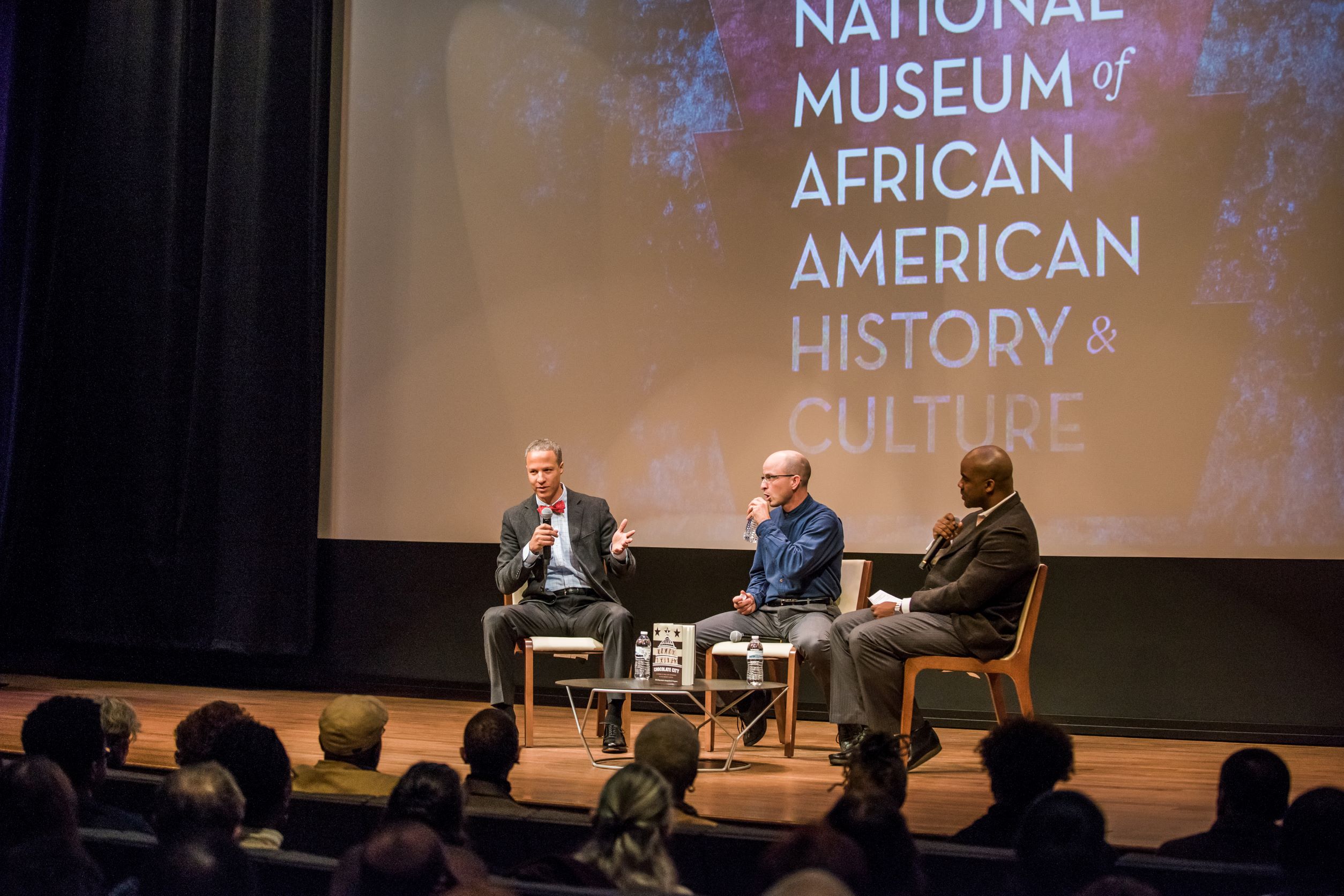
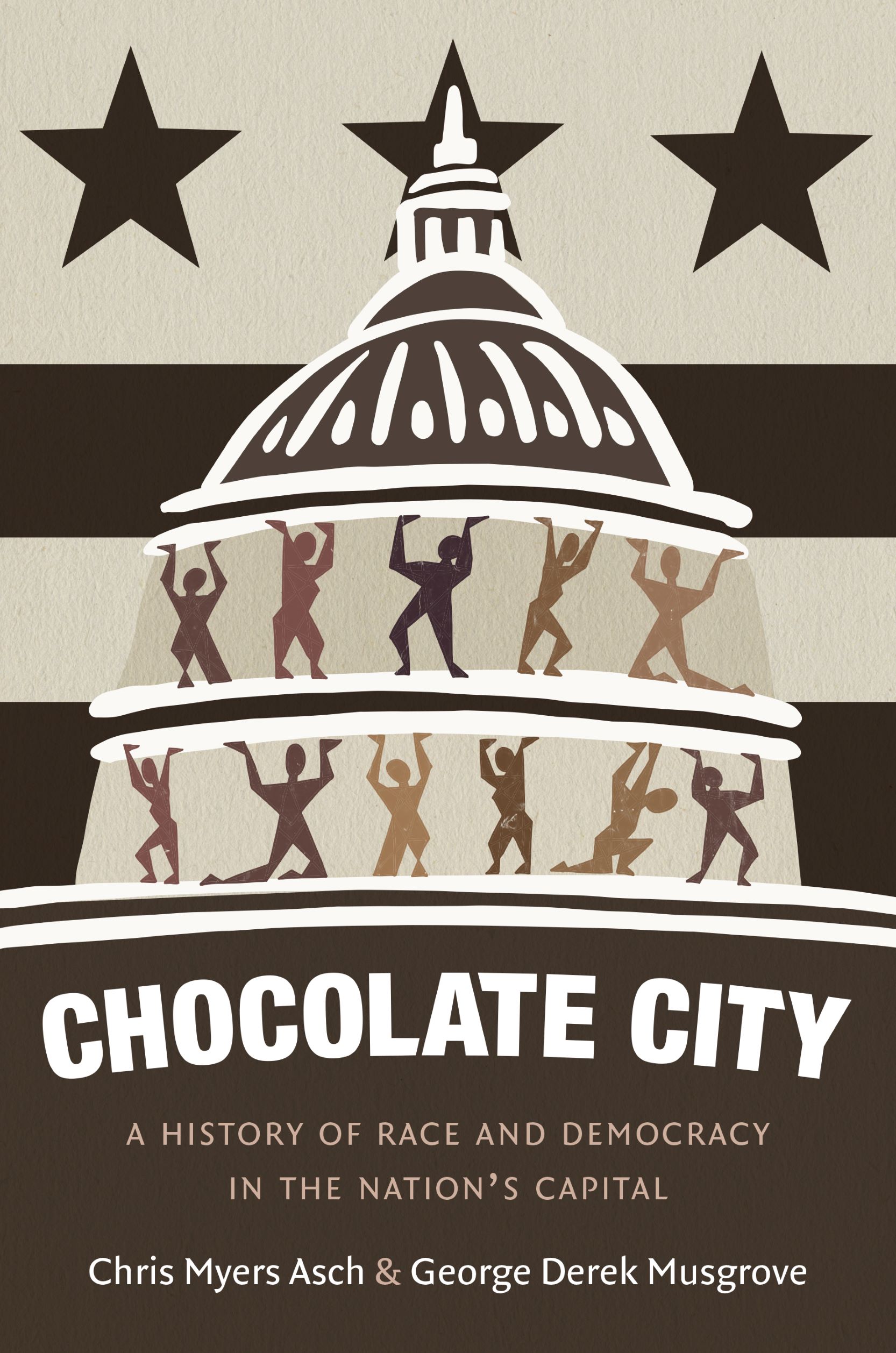
Derek Musgrove (l) and Chris Myers Asch (c) at the National Museum of African American History and Culture.Cover of Chocolate City from UNC Press.
Chocolate City garnered coverage in The Washington Post, NPR, C-SPAN, and other outlets. Black Power in Washington, D.C., 1961 – 1998 also received significant media coverage and inspired conversations about Black political communities in D.C.
“Chocolate City established Dr. Musgrove as one of the leading scholars of Black and urban politics in the post-Civil Rights era,” says Froide. She notes the book has appealed to a wide audience, is being read in public schools, and has attracted the attention of political and policy leaders alike. “He is a consummate historian who is also a trusted voice for political and policy action.”
Musgrove is UMBC’s second Carnegie Fellow, following historian Kate Brown, now a professor at MIT. She received a 2016 Carnegie Fellowship for nuclear disaster research.
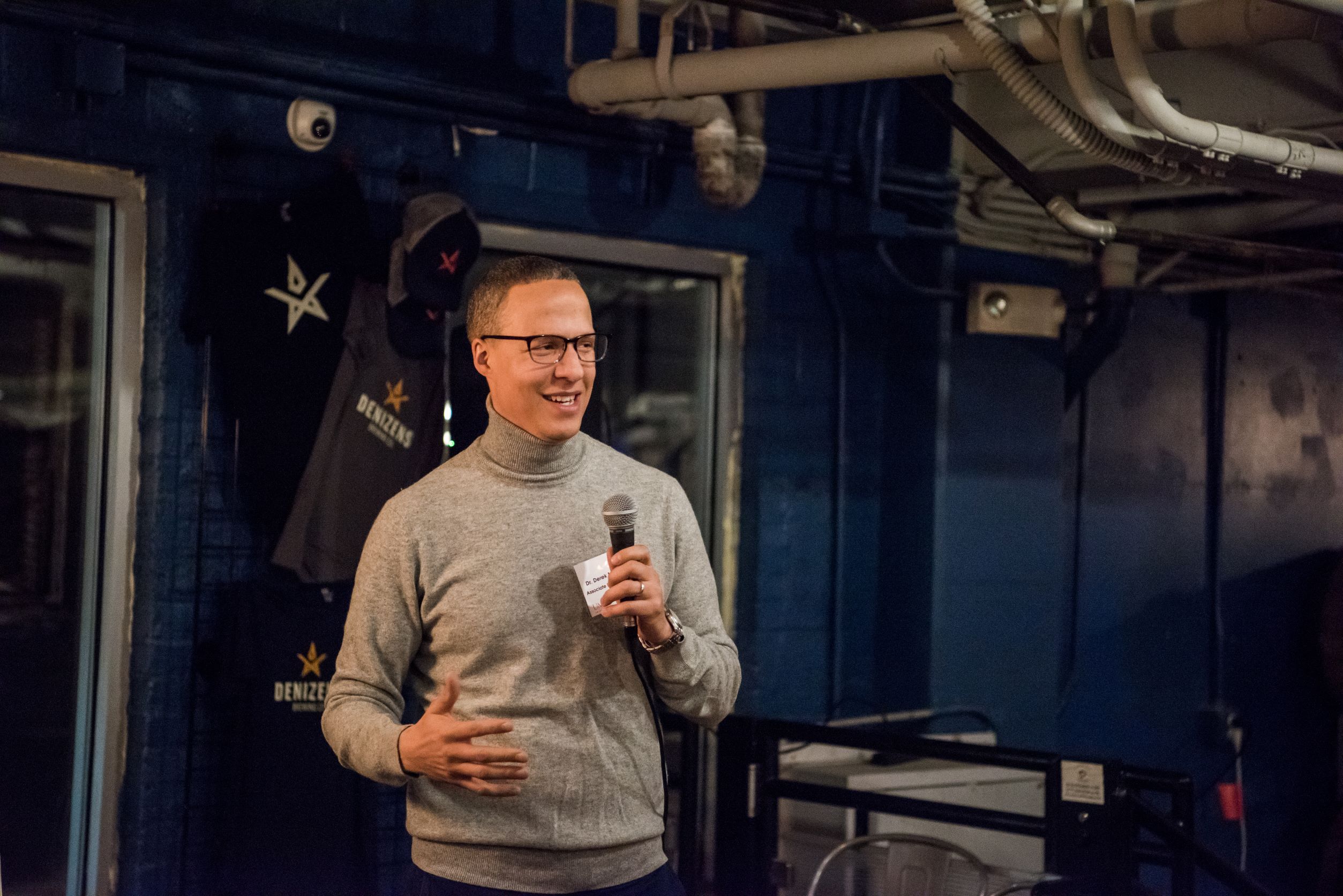
Feature image: Derek Musgrove. All photos by Marlayna Demond ‘11 unless otherwise noted.
The notion of the “American dream”—that hard work can lead to social and economic mobility—has existed in the United States for centuries, and it has been disputed for almost as long. Pamela Bennett’s new book, Parenting in Privilege or Peril: How Social Inequality Enables or Derails the American Dream (Teachers College Press, 2021), takes on this idea. Bennett, associate professor of public policy, explores some of the social, educational, and economic factors that impact the decisions that middle- and working-class parents make in hopes that their children can attain the “American dream.”
Bennett co-authored the book with Amy Lutz, associate professor of sociology at Syracuse University, and Lakshmi Jayaram, founder of the Inquiry Research Group LLC and research associate with the University of Central Florida.
“We designed a research project to investigate the role that culture and social inequality play in the educationally relevant parenting strategies of working- and middle-class parents,” explains Bennett.
L-R: Amy Lutz, Lakshmi Jayaram, and Bennett at an American Sociological Association meeting. Photo courtesy of Bennett.
After interviewing 50 parents from two public schools in a northern U.S. city, they found that middle- and working-class parents generally engaged in two types of parenting: defensive and strategic parenting.
Beyond the parent interviews, family survey data, census data, local police data, school climate data, and social network data provided further details about the economic resources parents had access to and the social conditions that impacted their wellbeing.
Defensive and strategic parenting
These two parenting approaches emerged when the researchers explored parents’ “values, orientations, and expectations” for their children’s educational journey as a pathway to achieve the “American dream.” Parents shared their lived experiences within their neighborhoods and schools, as well as work, social, and educational networks.
The data show both middle- and working-class parents share a goal of having college-educated children. However, the resources accessible to each group vary widely, as do the social conditions in which they live, which ultimately influence how the parents approach this goal.
Middle-class families with large social networks and economic resources were more likely to practice “strategic parenting” by making key decisions leading to their child’s academic improvement, new skill development, and variety of extracurricular activities. Their decisions were influenced by access to many choices and to safe neighborhoods and schools that helped parents nurture their children. This social context encourages adolescent independence and the personal growth needed to attend college.
Pamela Bennett.
On the other hand, working-class parents in the study had more limited access to financial, social, and enrichment resources. They also had to consider how their child would engage in a world where neighborhoods and schools contain serious safety concerns. These safety concerns lead some parents to heavily monitor their teenagers’ interactions with peers and other adults and to shield them against actions that might limit their opportunities.
In this way, working-class parents generally practiced “defensive parenting,” making decisions that protected their children from harm while also working toward their social mobility.
Public impacts
The researchers hope this study can inform education policy designed to close the gap between working- and middle-class families’ access to the “American dream.” One key way to achieve this, Bennett suggests, is increasing neighborhood safety and access to academic enrichment activities.
Recently, Bennett spoke about college access and affordability on Marketplace, a public radio show heard by more than 14 million listeners each week. She recommended hotlines for students and their families to ask questions about financial aid and direct support with completing FAFSA applications, particularly for first-generation college students. “The stakes are talent loss, frankly, for the country,” Bennett said.
Feature image: Pamela Bennett. All photos by Marlayna Demond ’11 unless otherwise indicated.
Haleemat Adekoya ‘23, political science, received a surprise phone call last Tuesday morning. On the line were both UMBC President Freeman Hrabowski and Valerie Sheares Ashby, who just one day earlier was announced as UMBC’s next president. They were calling together to share, with heartfelt congratulations, her selection as a 2022 Truman Scholar.
Adekoya has spent the last year preparing to apply for the renowned national scholarship focused on public service. After a series of rigorous interviews, the Harry S. Truman Scholarship Foundation announced Adekoya as one of just 58 students nationwide to receive the award. Adekoya is UMBC’s fifth Truman Scholar.
“I am incredibly proud of Haleemat. Her authenticity, sincerity and humility permeate everything she does,” says Carolyn Forestiere, professor of political science. “I feel very fortunate to have worked with this extraordinary young person as her professor at UMBC, and I know she will excel at whatever she decides to do with her future.”
The Foundation selected recipients from a pool of over 700 applicants who showed a strong record of public service and also submitted a policy proposal addressing a concerning issue in society. Scholars receive $30,000 to attend the graduate school of their choice, as well as access to public service programs, mentorship, and job opportunities within the federal government.
“It is an honor and a pleasure to know that I have been named a 2022 Truman Scholar. All I can say is Glory be to God and to my village, thank you forever,” says Adekoya. “I look forward to continuing to engage in my commitment to cultivate transformative learning spaces and elevating the voices of Black children and celebrating their brilliance.”
Two finalists
This year also marked the second time two UMBC students reached the final round of Truman Scholar selection.
“Having two finalists is a huge honor for UMBC,” says April Householder, director of undergraduate research and prestigious scholarships. “With only 58 winners selected, that means that our students are highly competitive for this award.” Other institutions with multiple finalists include Duke, Harvard, MIT, and Stanford.
Their steadfast commitment to personal growth in service to numerous communities made them strong candidates for the 2022 Truman Scholarship.
“This journey has only solidified what UMBC is all about: a community of care and ‘true grit’ towards transformative excellence,” he reflects.
“To have been nominated as one of the two Truman Scholarship finalists is an experience that still has me on cloud nine. Words cannot describe how grateful I am to have been able to experience the scholarship process with someone as incredible as Rehman,” says Adekoya. “I am confident that the better world we reimagine is more than possible because of revolutionary, compassionate, and devoted dreamers like him.”
Collective vision
When Adekoya reflects on her path leading to the Truman Scholarship she sees the combined hard work of Baltimore City and County Public School teachers and students, her UMBC family, and the Sherman STEM Teacher Scholars Program. Their collective vision for sustainable and intentional full-service community schools propels her to think of education reform as an everyday practice.
“Education is said to be the most powerful tool one can use to change the world. However, our current education system excludes many Black students from experiencing such a transformative tool,” reflects Adekoya. “As an education advocate for Black students, I hope to one day develop multi-faceted strategies that address the flaws within our education system.”
Driving change
With this goal in mind, Adekoya participated in the launch of UMBC’s Sherman STEM Teacher Scholars Program intensive virtual math incubator for 150 students at Lakeland Elementary/Middle School in Baltimore City during the first COVID summer. Concurrently, she served as an intern at the Maryland State Department of Education, with the Student, Family, and School Support Committee, in 2020 – 2021. The Maryland Higher Education Commission (MHEC) then chose Adekoya as student representative, serving on its Education Policy Committee and Outreach, Grants, and Financial Assistance Committee for 2021 – 2022.
Adekoya (r) with Josh Michael ’10, political science and education, director of Baltimore school partnerships for UMBC’s Sherman STEM Teacher Scholars Program.
In 2019, prior to joining UMBC, Baltimore County Government awarded Adekoya with the “Young Woman of the Year” award for her community-engaged work as a member of the Superintendent’s Student Advisory Council; a mentor in a STEM program for girls; a local coordinator for the From Prison Cells to PhD program; and as founder of Dare2Bee, an empowerment organization for girls ages 9 – 18.
“Haleemat is such a strong and compassionate leader. One of the things that inspires me most about her is her commitment to others,” says her mentor Jasmine Lee, director of inclusive excellence in UMBC’s Division of Student Affairs.
Adekoya (r) with Jasmine Lee.
“She’s not a leader because she’s ‘ahead of the pack’…but instead because she is concerned about everyone making it,” Lee shared when Adekoya was named MHEC student commissioner. “She seems to move from the front to the back, and throughout the middle, empowering everyone to move at their own pace.”
“This is a community that provides rich experiences for our students,” says Householder. “Those experiences spark their passions for becoming public servants and using their well-honed talents to help others.”
Featured image: Haleemat Adekoya. All photos by Marlayna Demond ’11 for UMBC.
“Educators genuinely want what is best for their students,” says Farah Helal ’24, the newly appointed 2022 University System of Maryland (USM) student regent. “Student representatives provide educators and policymakers with the perspective needed to ensure the student voice is valued and understood throughout the decision-making process.”
Governor Hogan announced Farah Helal’s appointment to the USM Board of Regents as a student regent in February and she was formally confirmed in March. She will serve as one of two USM student regents from July 1, 2022 through June 30, 2024, including as a voting member during her second year.
Helal will represent the USM student voice in meetings and committees working on issues that impact the system’s twelve institutions. Key topics involve setting tuition and fee rates, approving new degree programs, and approving capital and operating budgets.
Farah Helal, center, with members of UMBC’s SGA Government Affairs Committee. Photo courtesy of Helal.
“I recognize the value and impact of having accurate representation,” says Helal. “This appointment comes with a great deal of responsibility, but the value and benefit to my community makes it worth it.”
Focusing on structural changes
Helal is eager to represent Maryland college students at a time when students are in need of additional support and resources. In addition to focus areas guided by student input, there are three areas of improvement she would like to help address.
First, she wants to support initiatives that address how students have experienced the pandemic. This includes shifts in their learning experiences as well as evolving concerns regarding health and safety.
Like many of her peers, Helal is experiencing the pandemic during a heightened social justice movement. Her second focus area highlights college students’ commitments to challenging structural barriers to diversity, equity, and inclusion.
“My generation is proactive in creating the social change we want to see within our institutions,” says Helal. “This will require the university system to effectively address issues with curriculum and infrastructure that perpetuate inequalities on our campuses.”
Helal (center) with UMBC faculty and staff from the Sondheim Scholars Program, the Center for Democracy and Civic Life, and the Honors College.
Her third area of focus is student mental health and wellbeing. Helal notes that having grown up in an “electronically dependent society with the influence of social media” has created a culture of constant communication where every type of news is immediate. This constant flow of vast quantities of information is straining student mental health and wellbeing, she suggests, particularly when combined with work, academic, and personal stressors. Helal looks forward to collaborating with the board and community members to improve mental health resources on USM campuses.
Leading with experience
Helal is a Sondheim Public Affairs Scholar in UMBC’s Honors College, majoring in global studies and political science. She also holds a variety of leadership positions at UMBC that have helped her prepare for serving community needs.
Helal with her academic advisor, Julie Oakes, assistant director of curriculum and retention for the Honors College.
She also serves as director of the Government Affairs Committee for UMBC’s undergraduate Student Government Association. One of her roles is as chief lobbyist pursuing SGA’s county, state, and federal agenda.
“Farah consistently goes well beyond the requirements and makes meaningful contributions to all that she is involved in,” says Jessica Cook, associate director of the Sondheim Scholars Program. “Farah has breathed new life into SGA’s government affairs work and has earned everyone’s respect.”
Jessica Cook (l) with Farah Helal (r).
Helal notes the committee was able to bring a bill for consideration before the Maryland General Assembly to increase wages for the incarcerated people who are working for Maryland Correctional Enterprises. It is an issue many USM students care about and want to change, she says.
UMBC’s Candace Martinez-Doane, assistant director of leadership and governance for Campus Life, is Helal’s SGA advisor. She has seen Helal care deeply about those around her and strive to ensure their voices are heard.
“Part of that work has been to help her committee members refocus when their work stalls or hits roadblocks,” explains Martinez-Doane. “She does her research and works with kindness and tact in a way that has shown her maturity and skill.”
Beyond UMBC
On the USM Student Council, Helal advocates for student-led legislation as co-director of government relations. She also collaborates with USM institutions on their legislative agendas and coordinates the legislative activities of the Student Council within the Maryland General Assembly and the Office of the Governor.
Helal, center, with members of UMBC’s SGA Government Affairs Committee at the Maryland Senate. Photo courtesy of Helal.
Helal also remains dedicated to Howard County, where she is from, as a student representative on the Diversity, Equity and Inclusion Advisory Committee of the Howard County Public School System. The group is part of Howard County’s High School Advisory Council to the Superintendent.
Value of reflection
Helal’s focus on raising awareness about students’ mental health and wellbeing has been a longtime commitment. In high school she ran a two-year research project to study how academic stress impacts students’ mental and physical health and academic success.
The study helped Helal understand how important it is to stop and assess wellbeing before burning out. On a personal level, she learned that the quality of her work is dependent on how well she takes care of herself, and she encourages others to think about this connection.
Helal (center) with Romy Hübler ‘09, modern languages and linguistics, M.A. ‘11, intercultural communication, Ph.D. ‘15, language, literacy, and culture (LLC), left, and David Hoffman, Ph.D. ’13, LLC, right. As associate director and director of the Center for Democracy and Civic Life, they have provided Helal with guidance in her civic engagement work on and off campus.
Helal uses daily reflection exercises as a tool to help assess the impact of her work and her needs, and she encourages her peers to do so as well. She also notes the importance of enjoying life outside of school and work, to keep perspective. Spending time with her family, taking time to have fun, and being active in her Egyptian, Arab, and Muslim communities are all activities that reenergize her.
“I constantly reflect about the time, effort, and energy it takes to work towards something that is meaningful, impactful, and purposeful,” says Helal. “Pausing to reflect and take part in my community is how I ensure my work is aligned with my purpose and intentions, and stays consistent with what I initially set out to be—a student voice for positive change.”
Featured photo: Farah Helal. All photos by Marlayna Demond ’11 for UMBC unless otherwise indicated.
Kimberly R. Moffitt is the new dean of UMBC’s College of Arts, Humanities, and Social Sciences (CAHSS). Moffitt, a professor of language, literacy, and culture (LLC) and affiliate professor of Africana studies, has served as interim dean since August 2020, leading CAHSS through the challenges of COVID-19 while achieving several notable milestones.
As Provost Philip Rous shared in his announcement to the university community, “Moffitt has served with distinction as interim dean of the College by providing outstanding leadership during one of the most challenging times for our entire campus community.”
Dean Moffitt earned a Ph.D. in mass communication/media studies from Howard University and holds an M.A. in mass communication from Boston University and B.A. in political science from UNC-Charlotte.
Moffitt began her career at UMBC in 2006 as an assistant professor of American studies and she became director of the LLC program in 2018. She is UMBC’s first Black dean of a college. She brings an exceptional record of leadership in shared governance, having previously served as president and vice president of UMBC’s Faculty Senate, among other key leadership roles.
“The campus is delighted by the appointment of Dr. Moffitt as dean—in many ways, she represents the best of UMBC,” shares President Freeman Hrabowski. “Most importantly, she will be a strong voice for the arts, humanities, and social sciences, both on and off campus.”
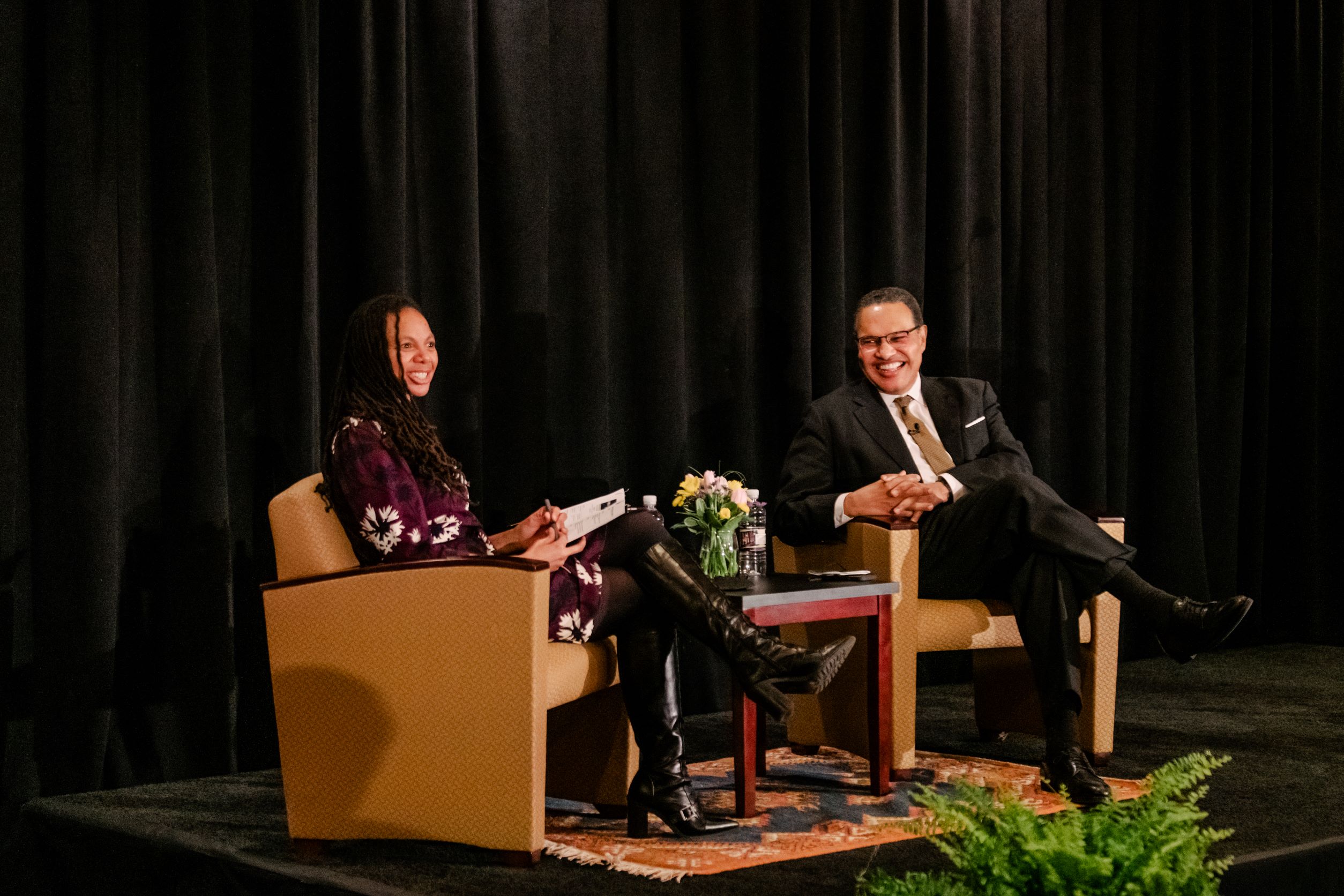
Dean Moffitt interviewing President Hrabowski at the 2022 RetriEVER Grateful Tour.
“I am excited about the opportunity to continue serving the College of Arts, Humanities, and Social Sciences,” says Dean Moffitt. “As a communication scholar I’m hopeful to use my expertise to elevate the great scholarship of our faculty colleagues and the initiatives carried out by our staff for all to see, learn, and experience.”
Dedication to CAHSS
As interim dean, Moffitt led a series of key projects to advance and support faculty and student research, teaching and learning, and development.
Moffitt and co-PI Patrice McDermott, vice provost for faculty affairs, received a $3 million grant from the Andrew W. Mellon Foundation to launch Breaking the M.O.L.D. (Mellon/Maryland Opportunities for Leadership Development) with partners Morgan State University and the University of Maryland, College Park. This program will develop a pipeline to higher ed leadership for scholars in the arts and humanities. It will focus on interested faculty members at the rank of associate and full professor, particularly women faculty and Black, Hispanic, and American Indian/Alaska Native faculty.
Dean Moffitt and Patrice McDermott, 2021.
Speaking of the project collaborators, Moffitt shared, “This experienced team of diverse senior leaders has an opportunity to create a structural answer to elevate diverse leaders from the arts and humanities. This will enable faculty to apply distinct knowledge, skills, and perspectives to address our communities’ needs as leaders at their respective institutions.”
Moffitt has long been committed to diversity, equity, and inclusion at UMBC and in Baltimore. Following the recent global call for social justice for Black lives and rise of anti-racist work Moffitt developed the “Looking in the Mirror” speaker series with Patricia Young, professor of education and special assistant to the dean for strategy and innovation. Over the past two semesters, UMBC faculty and staff have discussed topics related to microaggressions, mental health in academia, equity, and systemic racism to create strategies for moving forward as a college.
Additionally, she has led a redesign of the CAHSS website to better reflect the college’s vast range of majors, programs, and diverse student and faculty scholarship. In fall 2021 and spring 2022, Moffitt also spearheaded faculty media workshops to provide faculty with strategies and resources to share their work with the greater public.
Commitment to Baltimore
Moffitt is also known for her dedication to Baltimore. Her community-engaged work has benefited Baltimore families and community organizations.
In addition to being a board member of Maryland Humanities and the Greater Baltimore Cultural Alliance, she is a founding board member of the Baltimore Collegiate School for Boys. The school aims to “provide the finest liberal arts education possible to Baltimore’s next generation of young men, ensuring that they will become global citizens trained to learn, lead, and serve our community, our nation, and our world.”
Please join us in welcoming @MsKendraBrown and @MediaTzarina to our Board of Directors! Kendra serves as @Mastercard's VP of Public Policy, Federal Affairs & Moffitt is the Interim Dean of @UMBC_CAHSS.
As a frequent guest host on WYPR’s former TheMarc Steiner Show, she has spoken about race, politics, education, and culture in Baltimore. She has also shared her work through The Baltimore Sun and other local media outlets, reaching broad public audiences.
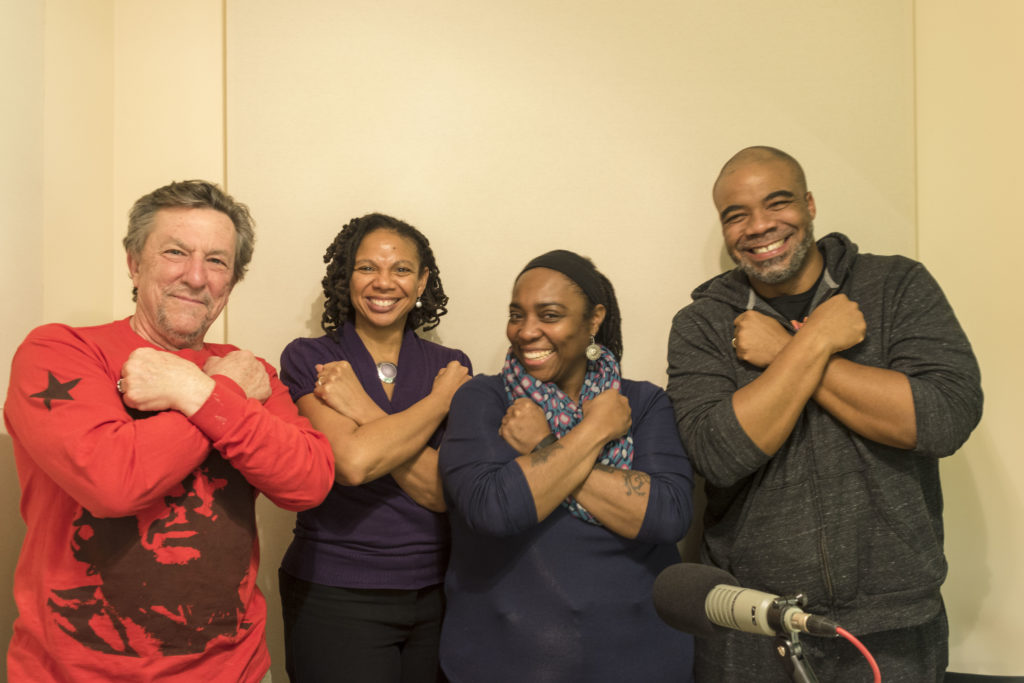
(L-R) Marc Steiner; Kimberly Moffitt; Kalima Young, assistant professor of electronic media and film at Towson University; and Nathan Connolly, the Herbert Baxter Adams associate professor of history at Johns Hopkins University, on “The Black Panther: Academic and Visceral Readings” episode. Photo courtesy of The Marc Steiner Show.
National engagement
In conjunction with her collaborations in Baltimore, Moffitt has also taken her scholarship to national audiences. This includes her work on mediated representations of marginalized groups as well as the politicized nature of Black hair.
This February, she launched ColorStuck? a podcast interrogating color and hair politics among Diasporic Black women.
My latest venture. Come listen as we drop our inaugural episode of ColorStuck? tomorrow. This is both a professional and personal journey asking folks to come together to heal. #JoinUs#colorismhttps://t.co/31oRHNhgfv
The largest gift in UMBC history will go toward educational research, teacher preparation and partnerships with Baltimore city schools. https://t.co/BRZoguot3J
Also, with Moffitt as interim dean, UMBC established its first endowed professorship in economics, with a $1 million gift plus a $1 million Maryland state match in memory of Fred and Virginia Pausch. Moving this work forward will be a priority.
Dean Moffitt with Tim Gindling, professor of economics, and Denise Meringolo, associate professor of history and acting director of UMBC’s Dresher Center for the Humanities.
“On behalf of our faculty, staff, students and the UMBC leadership team I would like to take this opportunity to thank Dean Moffitt for her hard work and commitment as interim dean and welcome her to her new permanent position,” says Provost Rous.
“I look forward to being a part of UMBC’s bright future as a newly-designated R1 institution that has much to offer higher education and our students,” says Moffitt.
Featured image: Kimberly Moffitt. All photos by Marlayna Demond ’11 unless otherwise noted.
The largest gift in the history of UMBC—a $21 million donation from the Sherman Family Foundation—will dramatically expand the reach and impact of the university’s K-12 and early childhood education work. The transformational gift will provide funding to launch the Betsy & George Sherman Center as a national model to advance excellence in urban schools. This new center will expand and integrate UMBC’s work in teacher preparation, school partnerships, and applied research focused on early childhood education and improving learning outcomes for Baltimore’s students.
“If universities are to be major contributors to the development of society, they have to be involved with the schools and with neighborhoods and with communities,” says UMBC President Freeman Hrabowski. “Betsy and the Sherman Family Foundation have provided us with invaluable resources to make this collaborative work possible.”
“This gift represents a clear and bold commitment to developing teachers that can better support future generations of students in Baltimore City, especially in early learning and STEM,” said Sonja Brookins Santelises, chief executive officer of Baltimore City Public Schools. “It also expands the research partnership between City Schools and the university in ways that will further enhance teaching and learning in our community. We are excited about this next great step.”
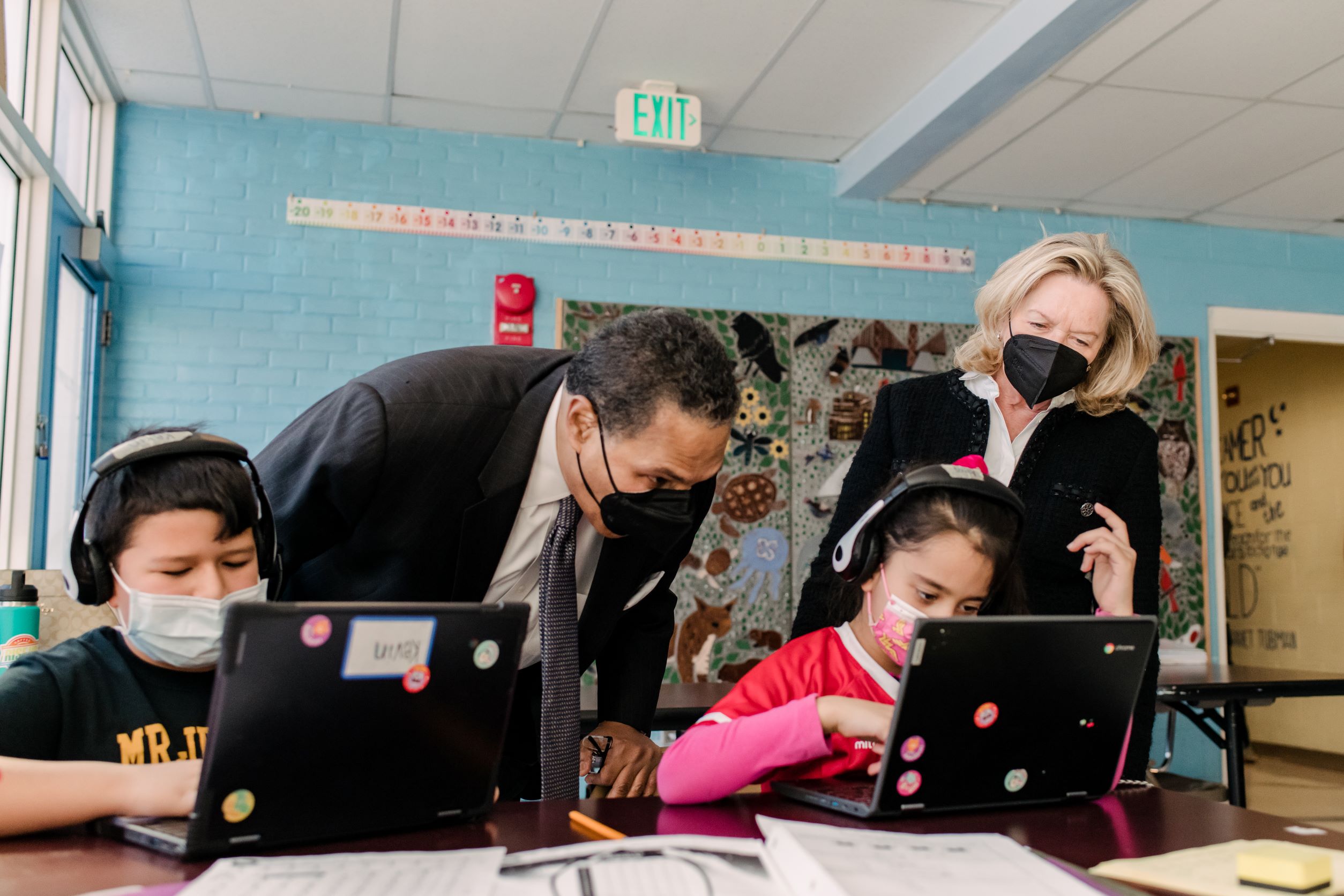
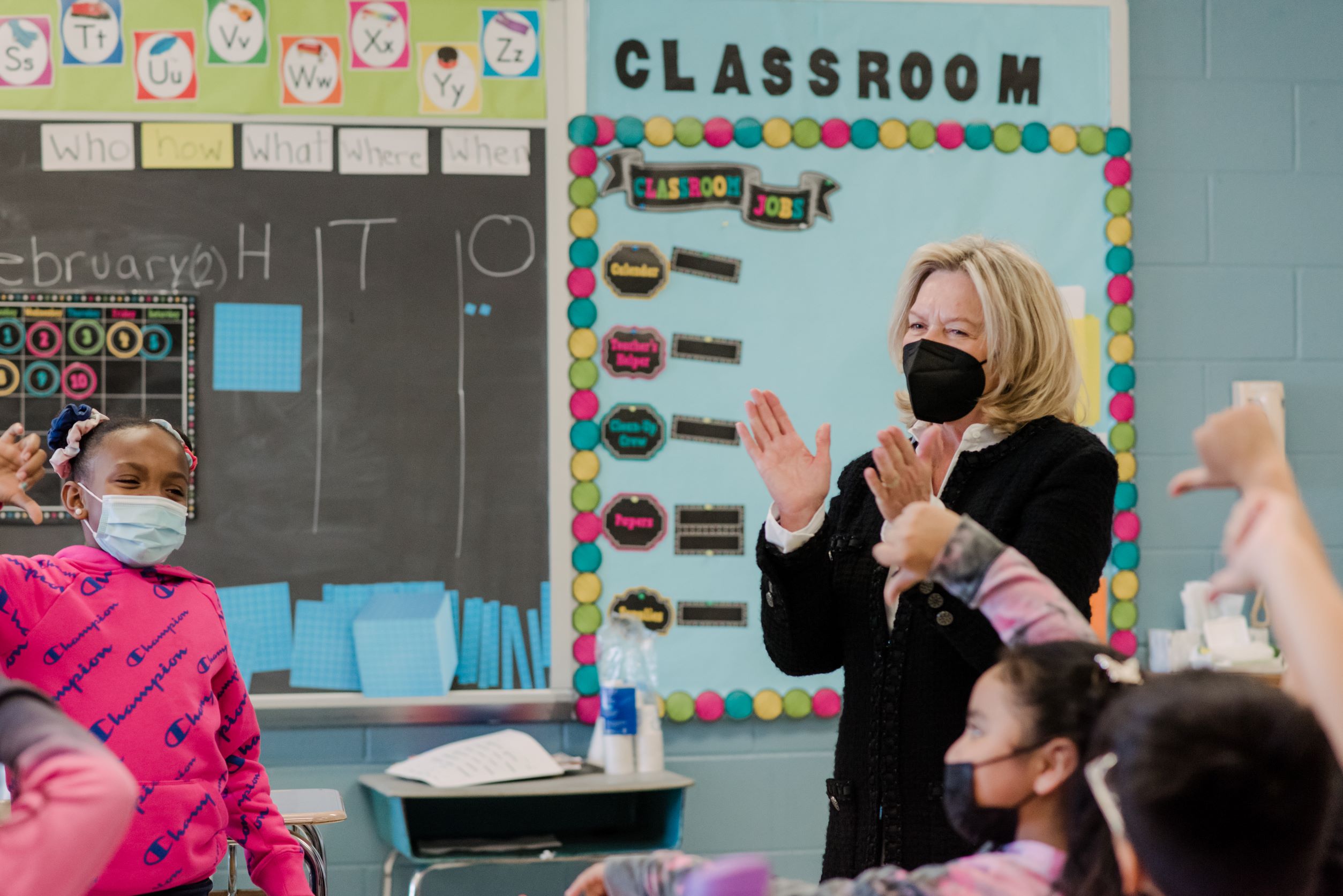
President Freeman Hrabowski and Betsy Sherman with students at Lakeland Elementary/Middle School.
Betsy and George Sherman’s philanthropy in STEM education has been inspired by Mrs. Sherman’s career in early childhood education and the late Mr. Sherman’s experience as an engineer and business leader. Their family foundation has now invested more than $38 million in UMBC’s education initiatives.
The Shermans have shared with UMBC a deep commitment to children’s equal access to high-quality education and a supportive community. “It is our job as the adults in the community to offer them an opportunity to grow in a way that will support them,” says Mrs. Sherman. “When a university is connected to a city, children thrive, families thrive.”
Betsy Sherman joins in a rhyming practice activity with students at Lakeland.
Meeting STEM needs
The Sherman STEM Teacher Scholars program, founded with the support of the Shermans in 2006, prepares UMBC undergraduate and graduate students from all majors to become highly qualified PreK-12 teachers with a focus on STEM education.
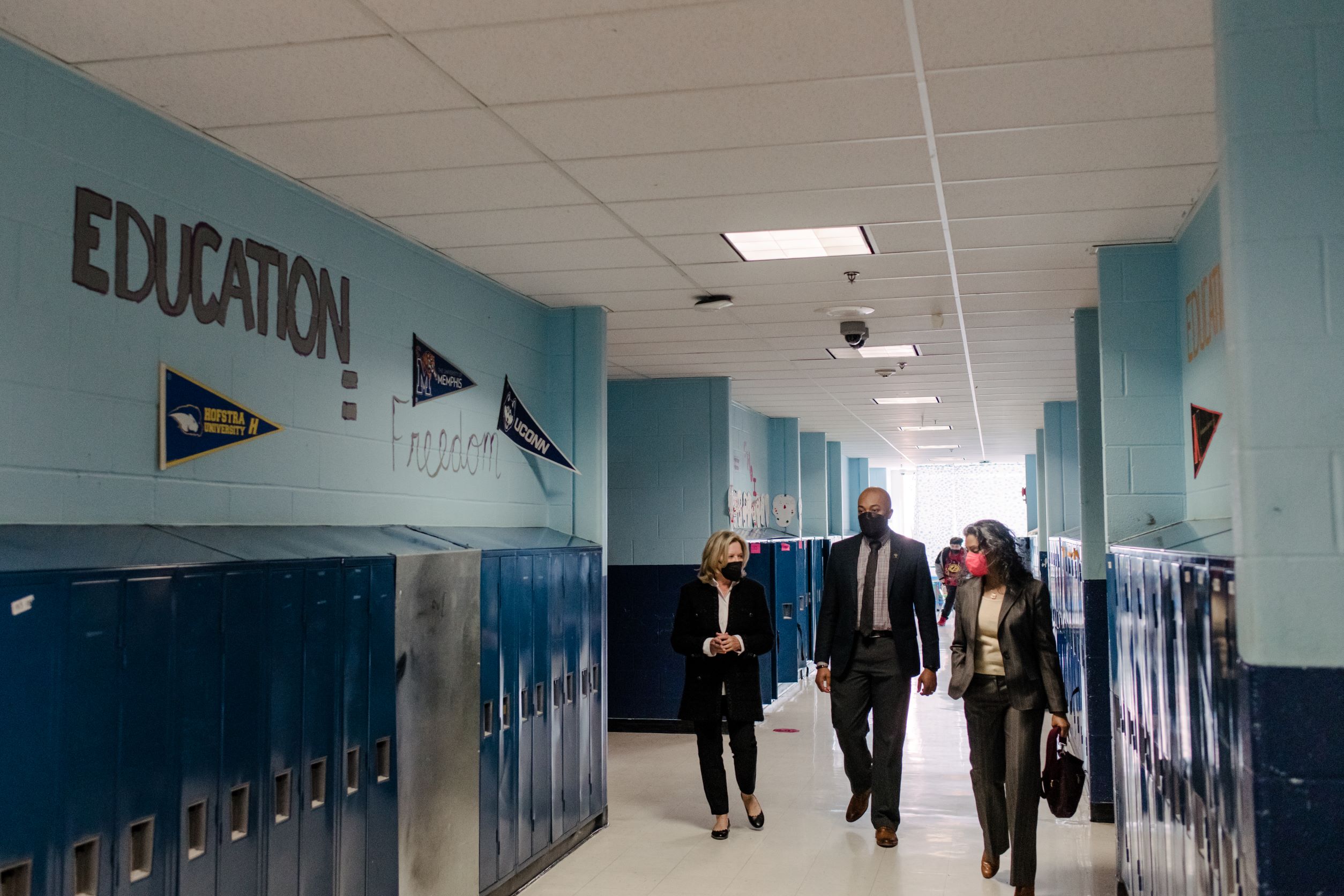
Lakeland Elementary/Middle School, in south Baltimore, was the first school to partner with UMBC through this program. Over the past decade, it has become a model of a full-service community school in Baltimore City. Among other exciting results, Lakeland now has a Community and STEAM Center, and the school has seen notable increases in students’ math test scores.
Gustavo Sanabria ’22, American studies, and current Sherman Scholar, is completing a certificate in elementary education while serving as a long-term 4th-grade substitute teacher.
The Sherman Scholars program now partners with ten schools to promote academic achievement through professional development for teachers and intensive tutoring for students. For example, more than 90 UMBC students, including Sherman Scholars and others, provide evidence-based math tutoring for over 350 elementary and middle school students in several schools across Baltimore. Early data show this approach is working.
Moving the needle
Rehana Shafi, director of the Sherman Scholars program, remembers the program’s first steps with fondness. “It started off with an investment that we wanted to use to figure out, with the right sorts of support in place—teacher professional development, after school activities for kids, and community engagement—how could we really move the needle for Lakeland’s students and their families,” explains Shafi.
(L-R) Betsy Sherman, with Corey Carter, and Rehana Shafi at Lakeland.
In 2021, the program graduated 22 scholars, 19 of whom are teaching in Baltimore City. Over the past 15 years (since 2007), the program has yielded 170 educators who are now teaching across the Baltimore region, the state of Maryland, and beyond, often in the most vulnerable school communities. An additional 20 conditionally certified teachers have been supported since 2020–educators meeting critical classroom needs while working to complete M.A.T. degrees.
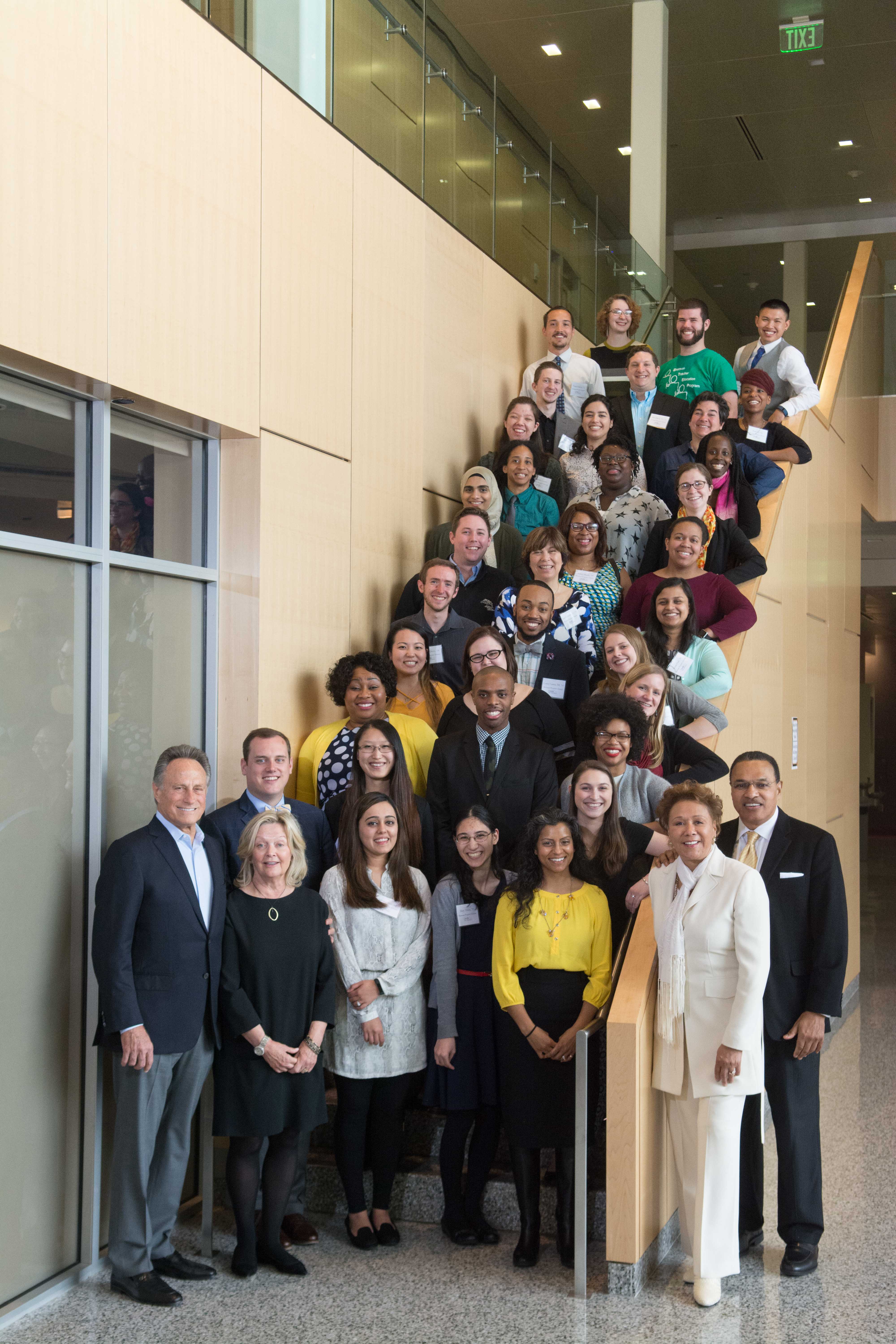
George and Betsy Sherman (front row, left) with President Freeman Hrabowski and Jacqueline Hrabowski (front row, right) next to Rehana Shafi (front row, in yellow) at the Sherman Scholars 10-year anniversary held on April 1, 2017.
More than a decade into the work, Shafi is proud of the strong collaborations that have developed. “Partnering with schools and with communities to walk together through the process of growth and dreaming and achieving…it’s what the work really is about,” she says.
Reflecting on this successful partnership model, she notes, “The work that we’re doing is ready to grow and expand, preparing even more teachers for classrooms across Maryland.”
Focus on early childhood
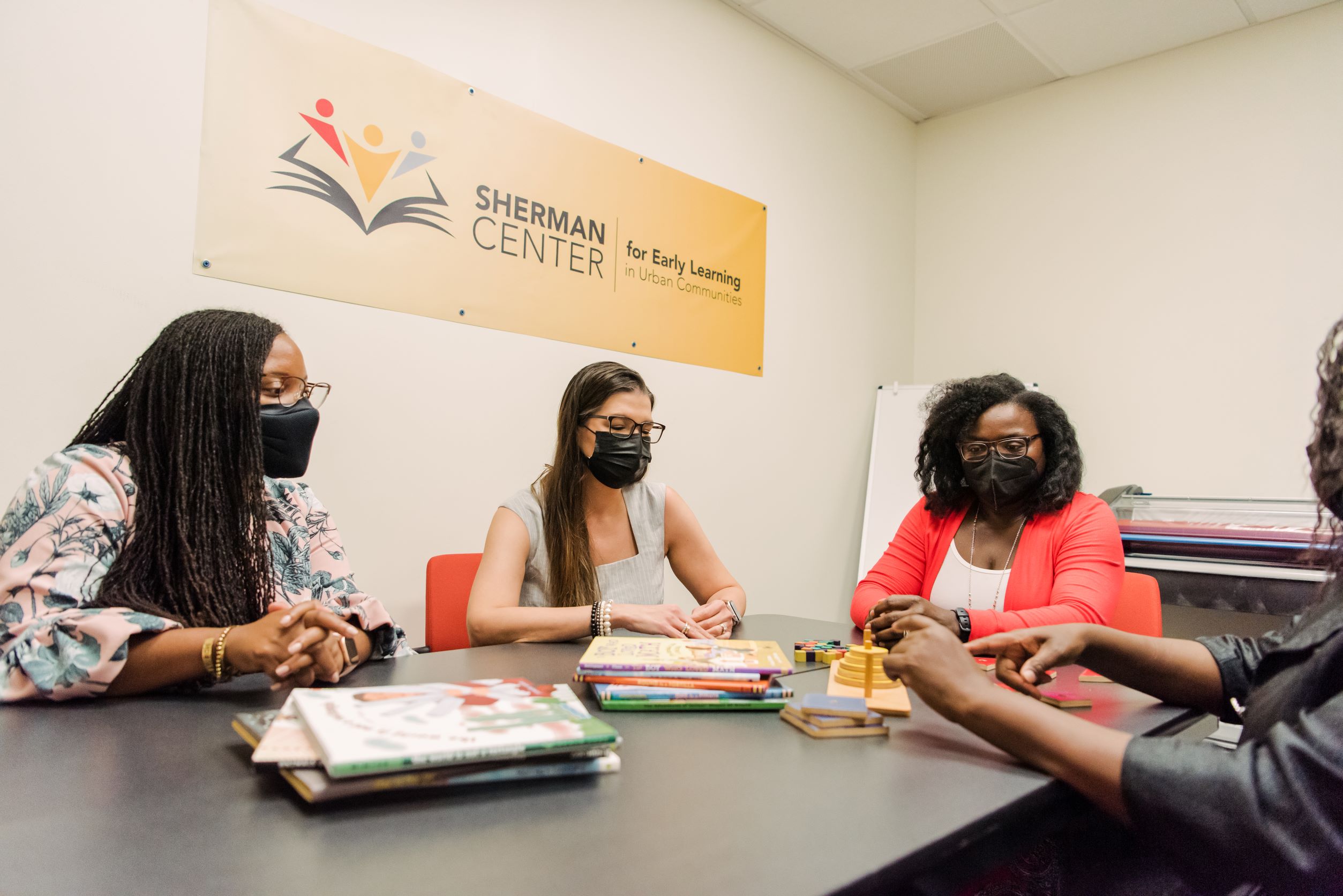
This new gift will also enable the expansion of UMBC’s early childhood programs. “I am excited to continue to grow our programming and further extend the impact and support for early childhood education,” shares Jennifer Mata-McMahon, director of the Sherman Center for Early Learning in Urban Communities and associate professor of early childhood education.
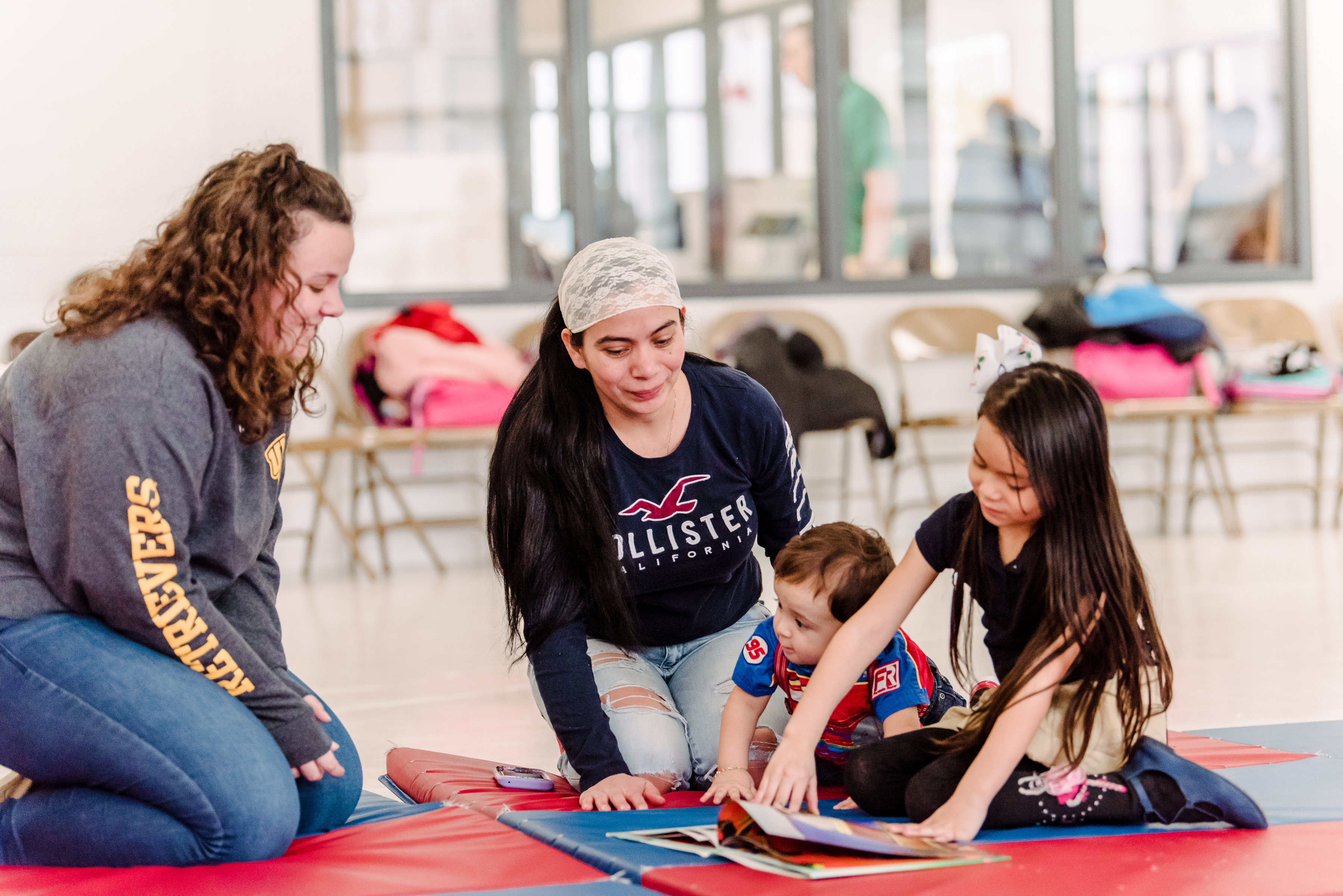
Lakeland community member at a Families, Libraries, and Early Literacy Project event.
In the last four years, the center has implemented four highly successful programs developed with and for teachers and families across five Baltimore City Schools: the Literacy Fellows Program in collaboration with UMBC’s Shriver Center, the Diverse Books Project, the Teacher Summer Institute, and the Families, Libraries, and Early Literacy Project. Hundreds of families have benefited from these programs.
UMBC’s students volunteer over 400 hundred hours a year in partner schools. Participating teachers receive research-based skill development and funding for teaching materials.
Olivia Grimes ’19, individualized study, Sherman Scholar alum and former Sherman Center program assistant, at left, with a Lakeland family in 2020.
The center also invests in community-engaged early childhood research to evaluate learning interventions, academic growth, social-emotional wellbeing, behavioral outcomes, and education policy with faculty across the College of Arts, Humanities, and Social Sciences (CAHSS).
Through its annual Faculty Research Award program, the center provides funding for new research projects. Past recipients have studied topics like Judy Centers in Baltimore, reading interventions, and culture-based computational thinking in urban preschools. Prior awardees have shared with the public their high-impact community-engaged scholarship on different ways to teach kids to read and math skills to prepare children for kindergarten.
“The College remains inspired by the enduring commitment of the Sherman family to urban education. This gift affords CAHSS faculty with the resources needed to further education research and practice,” shares Kimberly Moffitt, interim dean of CAHSS and professor of language, literacy, and culture. She is thrilled that UMBC students will have even more opportunities to work with PreK-12 students throughout Baltimore who are “deserving of dedicated teachers who believe in their abilities and their aspirations for the future.”
“This gift lays out the charge and we stand ready to fulfill it,” says Moffitt.
(L -R) Shana Rochester, the center’s assistant director and research associate, with Mata-McMahon, and Patricia Young, professor of education, and 2020 recipient of the Faculty Research Award.
Scaling and expanding programs
In addition to supporting research and classrooms directly, the center also advances the field by providing leadership development to early childhood educators across the state through the Maryland Early Childhood Leadership Program, which started its third cohort in 2021.
“The new funding will not only ensure the scaling of these programs, but also support new initiatives like Breathe2Think and the Sherman Center Research Conference,” says Mata-McMahon. She is leading the implementation of both programs to further support teachers’ well-being and develop teachers’ skills as action researchers.
“This is about sustainability over time and long-lasting impact in urban communities,” she says.
Full circle
The ripple effect of the Sherman family’s investment is beginning to come full circle. UMBC’s Sherman Scholar alumni are now teaching in Baltimore City classrooms and beyond, preparing the next generation of change-makers. And one scholar has returned to UMBC to share his on-the-ground experience with UMBC students just beginning their journey as future teachers.
Sherman Scholar alum Corey Carter ’08, biological sciences, ’10 M.A.T., taught in both Baltimore City and Baltimore County Public Schools after graduating from UMBC. In 2016, Baltimore County Public Schools honored him as Teacher of the Year. Seeking to expand his impact as an educator in a new way, he returned to UMBC to serve as assistant director of the Sherman Scholars program.
Corey Carter at Lakeland.
“I didn’t see myself in the classroom immediately when I came to UMBC,” says Carter. Without the Sherman STEM Teacher Scholars program, and the opportunities and guidance it provided, he isn’t sure that he would have found his way to the classroom. Now he sees the power of collaboration between universities and schools, fueled by philanthropy, to advance an education system truly centered around students and families.
Corey Carter leads a group activity at UMBC.
As Carter supports the work of the new Betsy & George Sherman Center, he’s excited to see it expand even further. “The impact that we all can bring when we come together to the table—with community, university, and school staff—is a really powerful example,” he says. “I look forward to building our vision together and seeing this energy and momentum spread throughout Baltimore.”
Banner image: Betsy Sherman at Lakeland Elementary/Middle School. All photos by Marlayna Demond ’11 for UMBC.
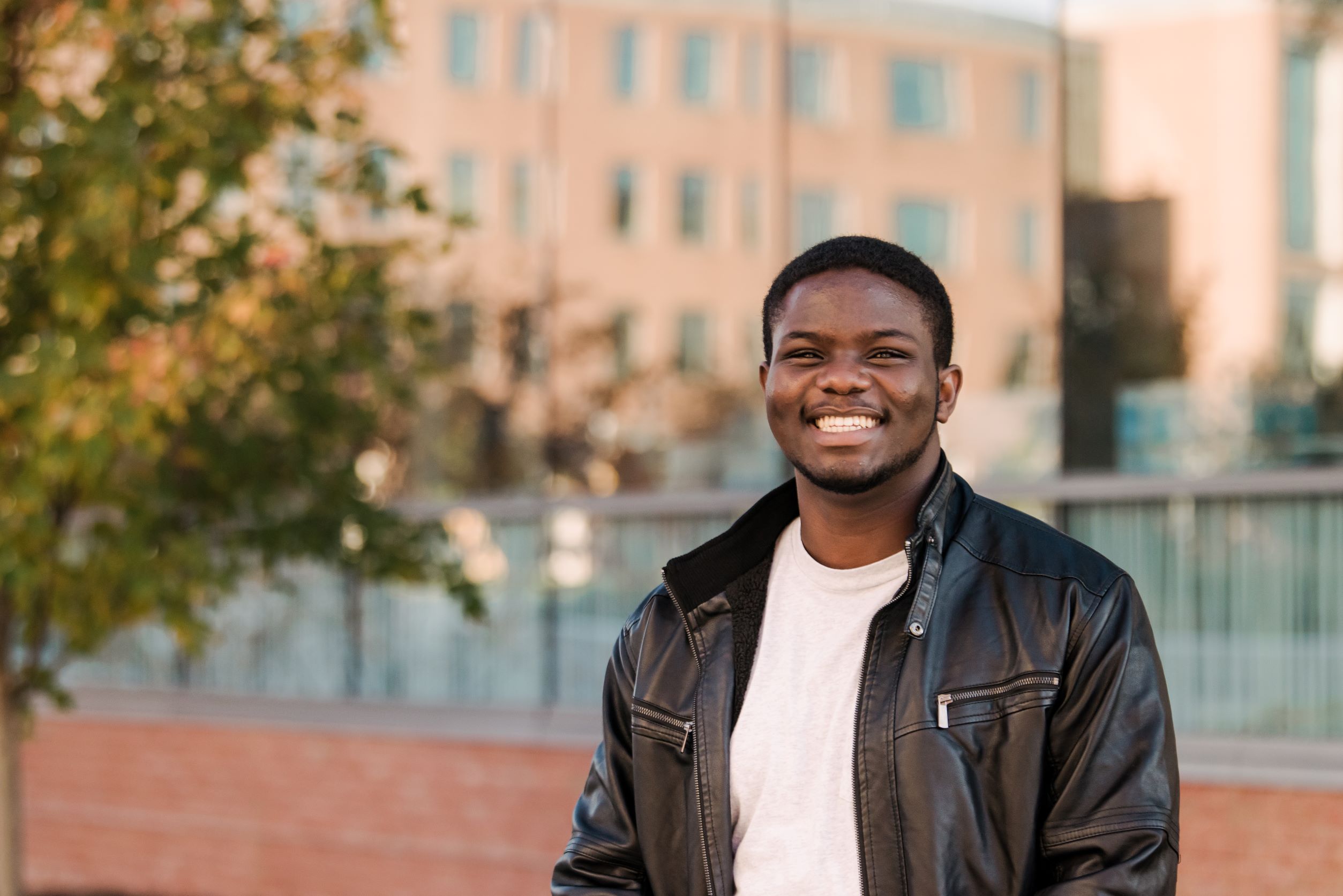
Praise Lasekan ‘25 checked off two major items from his to-do list this academic year: he traveled over 6,000 miles from Nigeria to the U.S. for the first time and he became a Retriever.
Lasekan’s cousin encouraged him to include UMBC on his list of top U.S. colleges to consider, and he was thrilled by what he saw. His decision was easy, he says. At UMBC he could study at the U.S. university of his choice, with the added bonus of living with some of his Nigerian family in Baltimore, home to an active Nigerian community.
Praise Lasekan
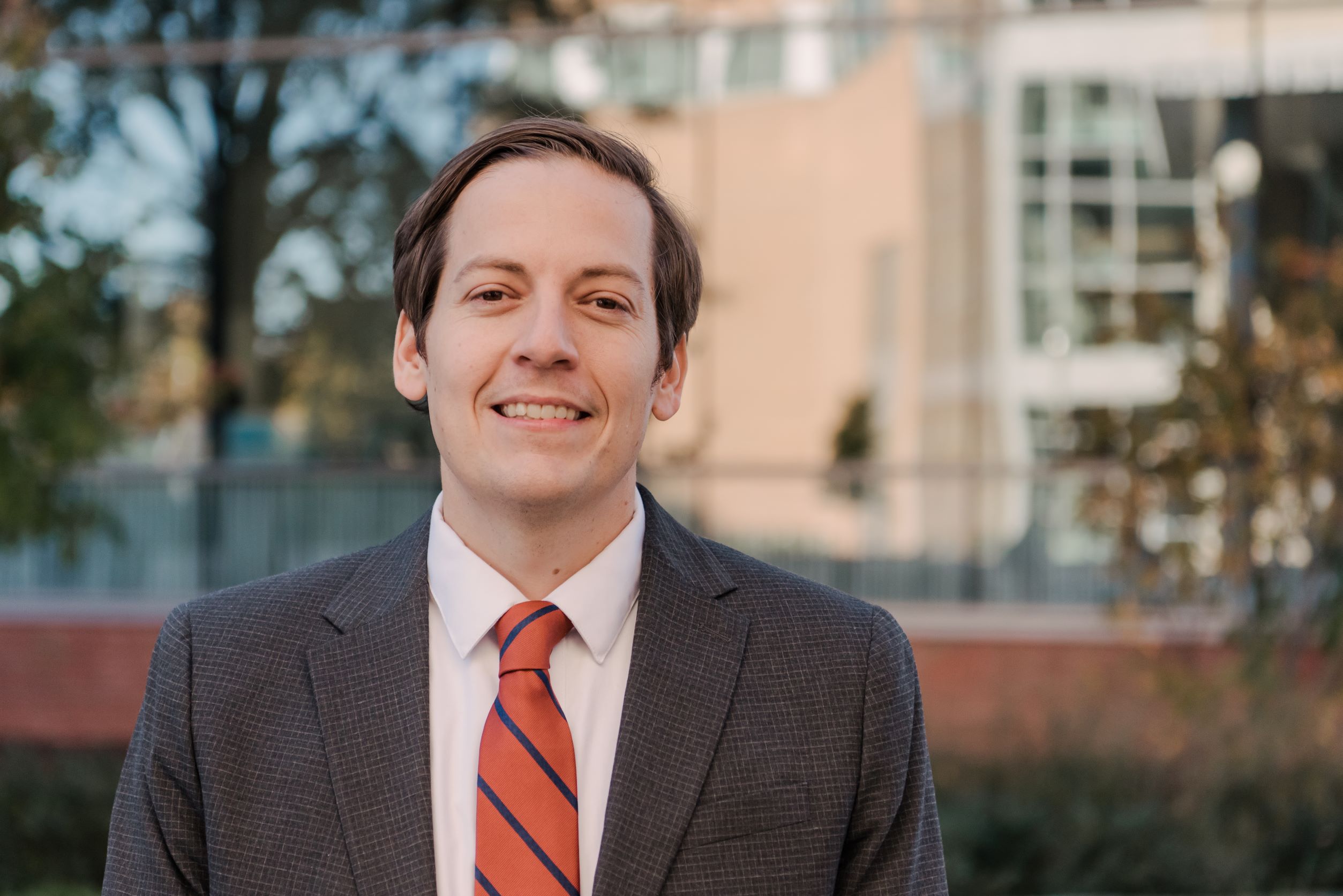
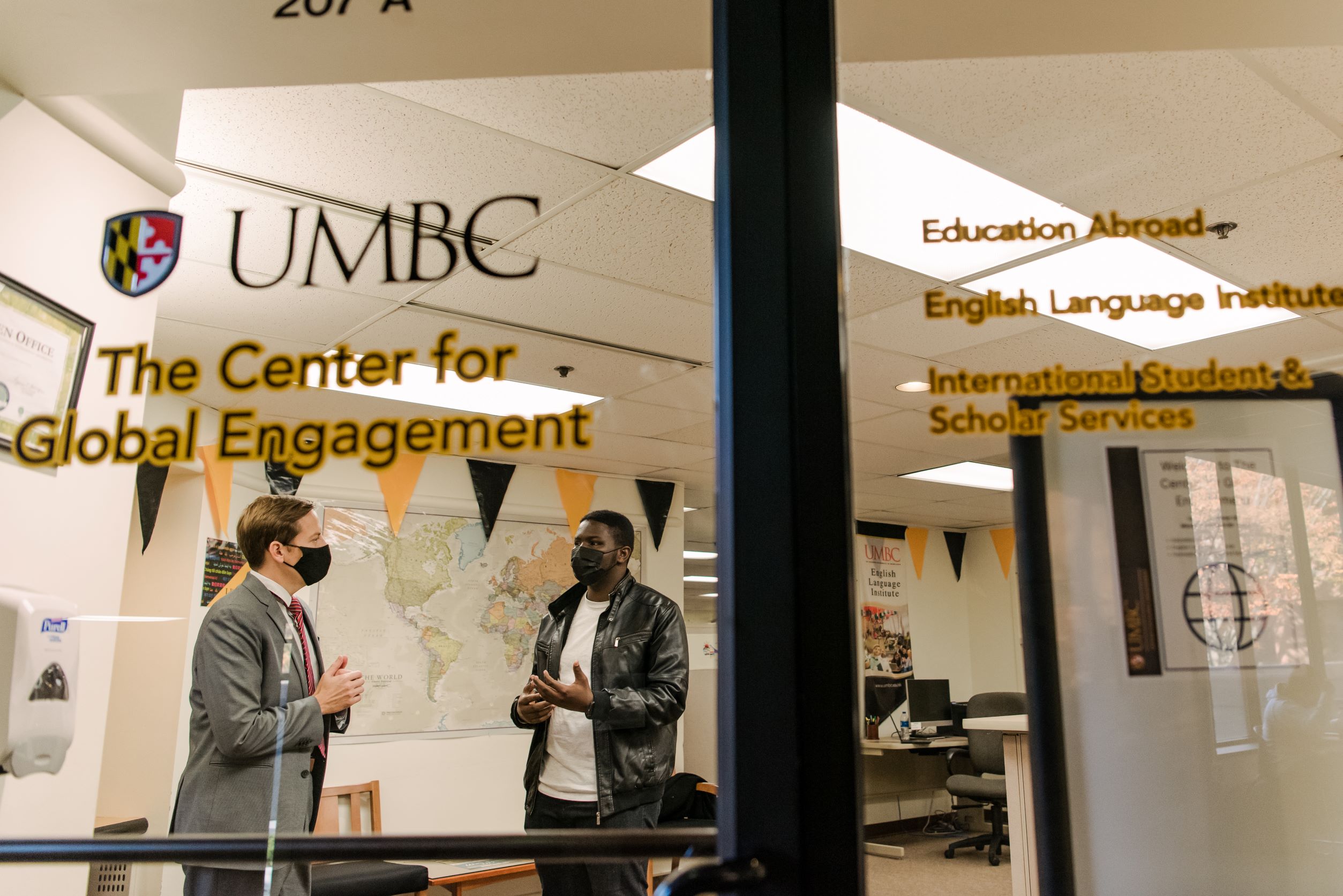
A few months prior to Lasekan’s arrival at UMBC, Adam Julian moved to Baltimore from North Carolina to join UMBC’s new Center for Global Engagement (CGE). He serves as director of international student and scholar services at the Center, which is the first point of contact for over 1,000 international students at UMBC. CGE provides support and advising on everything from the visa process and travel to enrolling in classes and accessing campus resources.
Adam Julian
Lasekan and Julian met through the Center for Global Engagement, and UMBC News brought them together for a conversation about their first year at UMBC.
A conversation with Adam and Praise
Adam: Praise, why did you choose UMBC?
Praise: What really caught my attention is the way UMBC loves undergraduates participating in research, which is something of importance to me. I also saw that UMBC actually accepts Black people. I read in an article that UMBC graduates the most Black students in the sciences that go on to get a Ph.D.
Praise: And why did you choose to come to UMBC?
Adam: I came to UMBC because of the opportunity that’s here for international education. Over the last couple of years UMBC has undergone a process of aligning its global education goals and broader university-wide goals. I was looking for an opportunity to be a part of something that’s really growing and developing. I wanted a chance to help build and grow CGE.
Adam: What are you hoping to do in your first year, in your second year?
Praise: In my first year I want to learn about the environment, learn how things run, and explore majors that interest me. Then, for my second year, when I see research that really interests me, I’ll speak to the professor. I like that, at UMBC, if I like something that the professor is teaching, I can ask them questions and do research on it. This is the first time I’ve had professors who welcome questions.
Julian (l) and Lasekan (r)
Adam: What are some of your goals around research?
Praise: I’d love to learn the process. I went to a secondary school that had a very investigative environment. I saw people perform different experiments, but I didn’t really understand it until I participated in one and then I fell in love with research as a way to address the world’s problems.
Praise: What have you enjoyed most so far in your time at UMBC?
Adam: Having the opportunity to work with students like you in their journey, and ultimately lead to a better world, is what gets me up in the morning. I think UMBC is a great place to have more opportunities to do that.
Praise: Are there any special people involved in all this who help you along your journey?
Adam: Yes, from senior leadership on down, the Center for Global Engagement has the support of the campus community. In particular, we have a lot of different student organizations that are really an essential part of creating a community for international students. What we have here at UMBC is a network of people who are here to help each other achieve their personal, professional, and academic goals. It’s special.
Adam: What are your impressions of the United States? Have you been before? What’s different than you thought it would be? What surprised you?
Praise: Actually, this is my first time in the United States. I’ve been in Nigeria my whole life. I’m a born and bred Nigerian. I think movies made me think that the U.S. would be a very different place. I got here and saw that the sky is still the same as in Nigeria, but the way things run is quite different. I’m still a young man, so it’s very easy to adapt. That’s the main reason why I’m here: to learn.
The CGE serves as a hub for students, faculty, and staff who are interested in engaging with the world. Through partnership with the Division of Professional Studies, UMBC’s English Language Institute became a part of the CGE, making it a one-stop shop for international students. Additionally, the CGE’s U.S. Fulbright Program and Education Abroad programs, which resumed this January after a pause during COVID-19, offer UMBC students, faculty, and staff special and rigorous opportunities for learning, research, and engagement experiences on nearly every continent.
Even with the challenges that COVID-19 presents, the CGE continues to provide support to help UMBC students access global learning opportunities.
The Education Abroad office will hold its next Study Abroad 101 online session on February 21, 2022. The CGE is located at UMBC’s University Center, Room 207.
Header image: and Praise Lasekan (L) and Adam Julian inside the UMBC Commons. All photos by Marlayna Demond ’11 for UMBC.