We use cookies for analytics and, unless you opt out, advertising.
You can opt out of advertising at any time.UMBC uses essential cookies to run this site. With your permission we would also use analytics cookies (to understand how the site is used) and advertising cookies (to measure and target our ads on other platforms). Nothing else loads unless you accept. You can change your choice any time from Cookie Settings in the footer.Privacy Policy
EssentialRequired for the site to work (login, security, your cookie choice). Always on.
Kristina Gaddy ’09, saves and gathers manuscripts, sheet music, pictures, maps, drawings, and anecdotes, sharing them on her blog to make public what she finds hidden in archives, private collections, and museums. For her fourth book, Go Back and Fetch It: Recovering Early Black Music in the Americas for Fiddle and Banjo (University of North Carolina Press, 2025), Gaddy teamed up with Rhiannon Giddens, a Grammy Award-winning musician who is equally passionate about digitizing and broadening access to the historical material culture of the banjo.
Gaddy came to UMBC as a Sondheim Public Affairs Scholar. Her passion for history and languages—Swedish, German, and Spanish—led her to graduate with a dual degree in history and modern languages and linguistics. Looking back on her time at UMBC, Gaddy is grateful for the opportunities the program provided, especially the chance to study abroad in Germany. There, she combined her proficiency in German with her historical training to research the foundations of her first book.
“The Sondheim Public Affairs Scholars Program was wonderful because of the funding I received to support my research and the cohort of students,” says Gaddy. “We were all really interested and excited about social issues, public policy, and how these ideas could be used to improve the world.”
Her collaboration with Giddens isn’t the first time Gaddy has written a book about banjos. “My start in music research and writing started 15 years ago when I was an AmeriCorps working with multi-instrumentalist Gerry Milnes at Augusta [Heritage Center in Elkins, West Virginia], and the friends I made while living in Elkins helped put me on the path to writing Well of Souls and Go Back and Fetch It.”
It’s not just documents that Gaddy used in her first banjo book—which are accessible on her blog—but also sound clips, performances, and interviews. While many historical records can be found online, many more have yet to be digitized. Gaddy, who also digitized and archived the West Virginia Upshur County Historical Society‘s local history collection, has made digitization an integral part of her process.
Kristina Gaddy performing at the Augusta Heritage Center in Elkins, West Virginia. (Image courtesy of Gaddy)
“Having come from the public history side of UMBC’s history department, I strongly believe in people having access to information as it pertains to their own history. It was one of the reasons I wanted to write Well of Souls,” says Gaddy, about her second book. “I had gathered all this information, and I could have shared it with just a few people, but I wanted anybody who wants access to banjo history not to have to go to some expensive conference to hear about it.”
A revolutionary collaboration
Giddens, a MacArthur recipient and Pulitzer Prize winner, is grateful for Gaddy’s dedication to digitizing and broadening access to historical material culture. While working on pieces of music highlighting 18th-century North American, Scottish, and Irish traditions for Ken Burns’s 2025 PBS documentary The American Revolution, Giddens was looking for samples of Black music from the Revolutionary War. She wasn’t having much luck until she explored Gaddy’s website, where she not only found what she was looking for but also the inspiration for their co-authored book, Go Back and Fetch It.
“I just kept going back to Kristina’s website, where she had put up these JPEGs. I would download them, lose the JPEG, and I’d go back and, like, download it again. And then I was just like, ‘Kristina, why don’t we put all of these in a book?’” explained Giddens at the 2025 Michigan University Arts Initiative interview on Go Back and Fetch It with Gaddy.
The book is their third collaboration. In 2018, Giddens invited Gaddy and her husband, Pete Ross—banjo maker, researcher, and musician—to present at a banjo symposium during the inaugural North Carolina Folk Festival, which Giddens curated. Gaddy presented her research on the African American roots of the banjo, an experience she credits as the inspiration for Wells of Souls, for which Giddens wrote the foreword. They also collaborated in 2022 on one episode of the 10-part series The Banjo: Music, History, and Heritage for The Great Courses.
“The idea behind the book was that there were all these little pieces of music in archives, in published books, in manuscripts that were sprinkled throughout the historic record of Black music in the Americas,” explains Gaddy in the same interview. “They weren’t compiled in one place. Rhiannon, as an artist, was frustrated that she couldn’t access them.”
For their book collaboration, they selected 19 pieces of music from 1687 through the 1860s. Gaddy wrote a historical research essay for each song explaining the types of banjos used, how and when they were played, and their socio-cultural significance across communities in the Americas and the Caribbean. Giddens transcribed the songs into modern treble clef and banjo tablature, which shows finger placement, rather than the Western classical notation tradition, making early Black Atlantic banjo music accessible to banjo players today, in the future, globally, and across all genres.
Following the banjo around the world
Gaddy’s last five years have been busy. But dig a little deeper, ask more questions, and do a lot of listening—just as she does for all of her interviews—it turns out that Gaddy really started her musical performance research in high school while playing traditional Swedish music with her mom and traditional American music with her uncle and aunt. After college, she fell in love with the banjo while living with other artists in West Virginia, developing a connection with a vast, diverse community passionate about banjo culture and history—including in Baltimore City, where Gaddy and her husband performed some of the songs from Go Back and Fetch It at the Enoch Pratt Free Library in September, right before she moved to Nottingham, England.
Gaddy and Ross perform at the Baltimore City Enoch Pratt Free Library.
Gaddy has also expanded her digital research presence to Substack, where she posted the news of her fully funded doctoral program at the University of Nottingham, where she will research Black fiddling in the 19th-century British Caribbean.
And even though she is a whole ocean away, Gaddy still feels the support of her UMBC history department.
“One of the most exciting things for me is to see other students and scholars diving deeper into these subjects,” says Gaddy. “My former history professor, Dr. Michelle Scott, recently put me in touch with Amina Thiam, a UMBC graduate student who is writing her thesis on Black banjoists and string instrumentalists in Maryland during the colonial period. I can’t wait to see what she uncovers.”
Keegan Cook Finberg, an assistant professor of English, started graduate school at UC Santa Cruz during the financial crisis of 2008, in a moment of extreme recession. “Privatization and austerity politics were everywhere. It was becoming increasingly clear that this wealth was stratifying upward, and notions of what constituted the public good were diminishing,” says Finberg. Finberg’s response to the times was to study avant-garde experimental poetry.
She notes that some might not see the connection between austerity politics and poetry. But she was excited about how poetry was engaging the public sphere. “Avant-garde poetry was obsessed with this notion of what made the public. And the category itself was becoming more interdisciplinary and more capacious,” said Finberg. “I started noticing and studying different forms of poems that didn’t look like what you might consider poetry. Poets were taking various aspects of state-controlled capitalist regimes and bureaucracy and using those forms as fodder for their poems.”
She remembers, around this time, books of poetry that were winning the major prizes were “avant-garde” in the sense that they chose words from material that wasn’t considered poetic. One poet chose words from the Department of Defense Dictionary of Military Terms to make poems about love. Others used these untraditional literary materials to document their experience of going through TSA at the airport, or repeating stories about racism on the street where people live. Finberg became interested in how all of these forms that we might think of as public forms were suddenly poetic forms.
In her debut book, Poetry in General (Columbia University Press, 2025), Finberg explores the privatization of the welfare state and the way that poetry changed in relation to that notion of the public. “I located the beginning of this history around 1960, which many people consider the ballooning of the welfare state, the opposite of privatization,” says Finberg. “I started thinking about what poetic form looked like in that moment and how we might trace it to today.”
Q: What drew you to poetry?
A: I have loved poetry since I was an early reader. I was first drawn to it because it is a way of experiencing the world and understanding it. As I got deeper into my studies, I became really interested in the way that poetic form changes with history.
I’ve always been curious about how the category of poetry makes us think differently. What does it mean for us to read poetry versus the way we read other forms? Can anything be read as poetry? How do we think differently if we try to read things as poetry that aren’t poetry?
These questions excite me. It’s a way to slow down and model reading practices, a way of interacting with language that’s very intentional and precise. I think if you’re interested in play, the unknowable, or unmasterable, it can really change the way you see your everyday life. That’s how I got interested in poetry and what still excites me about poetry.
Q: Is there a piece of poetry that challenged you to accept being uncomfortable, not knowing exactly what it meant?
A: I remember when I was assigned Gertrude Stein‘s poetry as an undergraduate, it did not make any sense to me. Why would anyone assign this to me? I was irate about it at first, but once I started working with the text and playing with it, Stein’s poetry became richer and more interesting to me.
I began practicing different modes of orienting myself towards the text. Eventually, it helped govern the way that I think about the domestic sphere, feminism, and regular objects around the house. In her book Tender Buttons (1914), Stein makes objects and foods in her house come alive. Part of my attention to language and my love of language and detail comes from the practice of trying to do this type of work.
Q: Is there a particular poetic technique that you like best?
A: I love constraint-based processes where poets make a strict rule to limit the words they choose. Often, I find our brain is attuned to think in a certain way. These constraints help us outside of what we usually think of as creativity or imagination into this other world that we didn’t even know was possible.
Keegan Cook Finberg. (Brad Ziegler/UMBC)
The book Zong! by M. NourbeSe Philip, a Canadian Caribbean poet, is a great example of a constraint-based process. The language for the book-length poem comes from the only historical record of an atrocious case that became important in the British abolitionist movement. Using only the text in the court case, Philip’s poem recounts the massacre of more than 130 enslaved Africans on the slave ship, Zong, headed to Jamaica from West Africa, who were thrown overboard to drown in 1781. The enslaved were dying of starvation and disease. Insurance would not cover this kind of loss. The captain decided that death by drowning could be claimed as a loss of property insurance claim. The insurance company approved the claim, but it was later overturned. No one was charged with murder.
Philip was trying to tell the story of the people on the ship and kept coming up against all of these gaps. The court case didn’t even contain the names of the people who were murdered. She decided to take the words of the court decision as a word bank for her book, to contort the case file to fill in these silences. The result is a testament to, and critique of, the horrors of the bureaucracy of slavery and its afterlife.
Most of the poems that I look at late in my book also use the language of archival documents about a major issue related to racial capitalism and the bureaucracy of the public sphere.
Q: What are other examples of constricted processes that you cover in the book?
A: I start the book with Yoko Ono. In the 1960s, she was doing wonderful experiments that were at the edge of what was performance and what was poetry. Ono was interested in speaking back to the category of racial capitalism through humor and expressions of everyday life as art. The poems in her book Grapefruit take this premise that instructions for everyday life can be fun, easy, or even impossible.
“
I’ve always been curious about how the category of poetry makes us think differently. What does it mean for us to read poetry versus the way we read other forms? Can anything be read as poetry? How do we think differently if we try to read things as poetry that aren’t poetry?
Keegan Cook Finberg
In my book, I also talk about three feminist artists from the 1970s, Eleanor Antin, Adrian Piper, and Bernadette Mayer. Their constraints are durational experiments where they go on some sort of diet, all of them for different reasons, for about the course of a month—the duration of a menstrual cycle—and document their journey. They’re writing about welfare and food assistance and their own reproductive rights on the precipice of Roe v. Wade. They’re interested in their own reproductive possibilities, and what it means to experiment with that as duration.
Q: This is your eighth year at UMBC. How do UMBC students respond to poetry in your classes?
A: For an upper-division class on feminist poetry, I recently taught Theresa Hak Kyung Cha’s Dictee, a famously complex avant-garde poem about Korean independence and about the experience of immigration and colonial violence. Cha writes in multiple languages to capture the disorientation of the acquisition of a new language, of a new culture, and the difficulty and violence of assimilation. It’s complex, and it can be off-putting to students.
In situations like these, I want students to be okay with not understanding everything that they’re reading while exploring the aspects that they do understand—to explore why this author might want it to be difficult in the beginning, why there might be something important in that feeling of discomfort that they’re experiencing with the text. Can they notice moments of beauty in the text, even if they don’t yet understand what they mean? A lot of our conversations start with that sort of work.
And once students realize that that is the goal—that they don’t need to be able to decode, they don’t have to be the person who knows it all in the room, there isn’t one right answer—it really unlocks a very different sort of space. I often watch that sort of journey with students. They realize that there’s something inherently important about this difficulty, important even to their understanding of themselves, their heritage, the way that language works in their households, even in their larger worlds.
And for my students who may take poetry to fulfill a lower division requirement, what I want more than anything is for them to see the ways that literature and poetry are alive in the world. Poetry is interesting, it’s happening, and they can read it. They don’t have to be afraid of it. Introductory level students are asked to attend literary events to see writers come and read and talk about their work. This is happening now. This is part of your world. If you’re a nurse, a scientist, or in whatever career path you follow, poetry and literature are alive and are going to continue to be part of the world that you live in. If you pay attention, this revelation may help you understand your experiences differently, connect to others in new ways, or even create new knowledge.
Asking Erin Hogan to choose her favorite film is like asking her whether she prefers to study Iberian or Latin American films—both of which she researches and fell in love with as an undergrad. The real answer is that Hogan’s favorite film is whatever film she is studying at the time. For her new book, Patriarchy’s Remains: An Autopsy of Iberian Cinematic Dark Humour (2024), she capped the list at 14 films between 1958 and 2018, whose characters must deal with the death of the male head of household. Hogan uses the visions of 14 diverse directors to study cinematic dark humor through a feminist, biopolitical, and socio-economic inequality lens.
“My work is pretty transversal, not exclusive to writing books about one director, one creator, one film, or one novel. I enjoy analyzing multiple sources and finding the patterns across texts. In this case, I focus on films with dark humor,” said Hogan, a professor of Spanish. Dark humor blends humor with grim topics like death, violence, crime, and social dysfunction through wit, irony, or satire.
“I’ve always been interested in dark humor. When I explain to my students why I study a wide range of texts, films, and languages—Spanish, Italian, Catalan, Portuguese, and most recently, Galego, the language of Galicia in Northwestern Spain—it always comes back to the joy of learning. I encourage students to ask themselves what they want to explore, learn, or know more about, and then to pursue it.”
Spain’s cinema 50 years later
The question Hogan pursues in Patriarchy’s Remains is how and why the legacy of Francisco Franco, Spain’s fascist, repressive, and violent dictator who ruled Spain from 1939 until his death in 1975, continues to impact Spain’s work toward democracy—even 50 years after his death on November 20, 1975.
“
u0022I’ve always been interested in dark humor. When I explain to my students why I study a wide range of texts, films, and languages—Spanish, Italian, Catalan, Portuguese, and most recently, Galego, the language of Galicia in Northwestern Spain—it always comes back to the joy of learning. I encourage students to ask themselves what they want to explore, learn, or know more about, and then to pursue it.u0022
Erin Hogan
professor of Spanish
“Patriarchy’s Remains has two meanings. One refers to the on-screen corpse of the patriarch and the other to the persistence of patriarchy in Spain today,” writes Hogan in her book. She draws parallels between the families in the films—who must figure out how to live after the patriarch they depended on dies or is killed—and Spain’s citizens, who are still working to understand what a functioning democracy looks like.
“In critiquing Spanish politics, I aim to highlight how Spanish democracy could better serve its people by heeding the protests of its own citizens, on and off screen,” writes Hogan. “Patriarchy’s Remains reveals persisting inequities in post-Franco Spain to shine a light on the disenfranchised children of democracy who grieve for the unfulfilled promises of greater civil liberties and improved quality of life.”
Interested in learning more about Iberian or Latin American film? Hogan is the co-founder and co-curator of CineMaestro an open-access collaborative digital project designed to promote audiovisual literacy and intercultural competencies through the study and teaching of the cinemas by Spanish, Latin American, and Latinx directors.
A couple of years ago, Jessica Floyd was enjoying delicious olive flatbreads in Opio, France, a village on the French Riviera, thanks to the hospitality of Judith Legman, who owned the olive grove and a manuscript Floyd had been trying to find for her doctoral work for three years. This bucolic heaven was not where Floyd, who studies erotic folklore, thought she would find the holy grail of erotic chanteys by Stan Hugill, a renowned British sailor and chantey singer. These sailors’ work songs, first collected in the 1900s, were passed down verbally by sailors, with some never recorded. These bawdy versions were never meant to be heard or read by women, much less shared between them.
“When you’re talking about erotic content, it automatically becomes something that is salacious and provocative and therefore seen as taboo,” said Floyd, Ph.D. ’17, language, literacy, and culture, an adjunct instructor of English. “Publications that are not conservative in their treatment of sex, gender, and sexuality are often deemed taboo. Scholars who are actively working in this field have to fight not only for their legitimacy, but also because we’re considered dirty workers. We also fight for the legitimacy of the materials that we’re researching. These are real human experiences. They just happen to be from the darker corners of the human experience.”
Like other scholars in the field seeking access to a variety of documents, Floyd reached out to the librarians at the Kinsey Institute, which holds the largest historical archive on sexuality. “They weren’t sure if the manuscript could be found in the extensive archive of Gershon Legman, which Judith, his wife, had donated,” said Floyd, of her research for her debut book Cabin Boys, Milkmaids, and Rough Seas: Identity in the Unexpurgated Repertoire of Stan Hugill (University Press of Mississippi, 2024).
She emailed Legman, following a tip from other chantey folklorists and researchers that Legman, a famous connoisseur and collector of erotic jokes, folklore, and songs, had the manuscript. “Lo and behold, she emailed me back. I still get chills talking about it,” said Floyd. “Judith said, ‘Not only do I have it, I actually just sent it to the Kinsey Institute. If you’d like, I’ll send you the copy.’” Dispersed throughout Legman’s chapter on erotic folk songs were Hugill’s erotic chanteys that had never been circulated.
The envelope sent by Judith Legman to Jessica Floyd with Stan Hugill’s unpublished manuscript. (Image courtesy of Jessica Floyd)
Chasing erotic rare texts
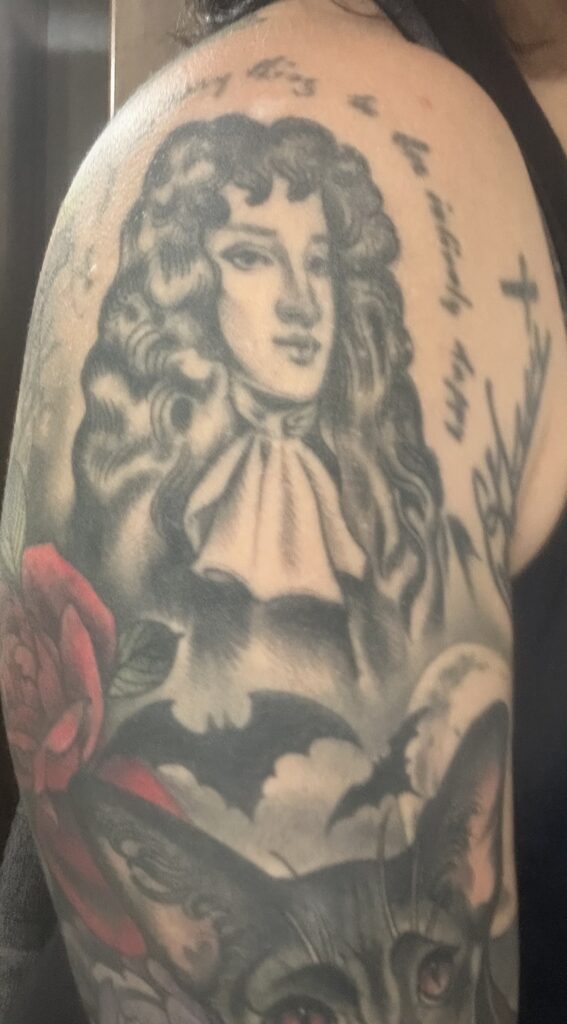
Floyd’s tattoo of John Wilmot, the Second Earl of Rochester, a late 17th-century English nobleman. (Image courtesy of Jessica Floyd)
Floyd is used to the chase and thrill of finding rare texts. She studies the gender and sexuality of sailors during the height of British and American sailing, from the mid-16th to the mid-19th centuries—when sailing ships dominated global trade and naval warfare—as well as 17th and 18th-century literature, erotic folklore, gender and women’s studies, and queer theory. This passion began in high school and continued through her undergraduate and graduate studies researching the life of John Wilmot, the Second Earl of Rochester, a late 17th-century English nobleman better known for questioning authority while also enjoying the excesses of court life and writing poetry that explored sex, desire, rebellion, and challenged social and gender norms.
“It made sense for me to research sexuality in chanteys because I want to understand why men sing dirty songs. What can chanteys tell us about how sailors negotiate sex and gender, especially in the constrained environment of the sailing ship?” said Floyd.
An epistolary discovery
Like Wilmot, Hugill also wrote and published his work. In the 1950s, Hugill began writing down the songs he remembered. In 1961, he published Shanties From The Seven Seas, a collection of over 400 chanteys now considered by chantey researchers and folklorists as the most comprehensive work on chanteys. Sailor Town was published in 1967, Shanties and Sailors’ Songs in 1969, followed by Songs of the Sea: The Tales and Tunes of Sailors and Sailing Shipsin 1977. Between 1962 and 1994, Hugill released 10 recordings—LPs, CDs, and cassette tapes—of chanteys and chantey history. Three were released posthumously. His Sea Songs CD, released in 1980, is now part of the Smithsonian Folkways Recordings catalogue.
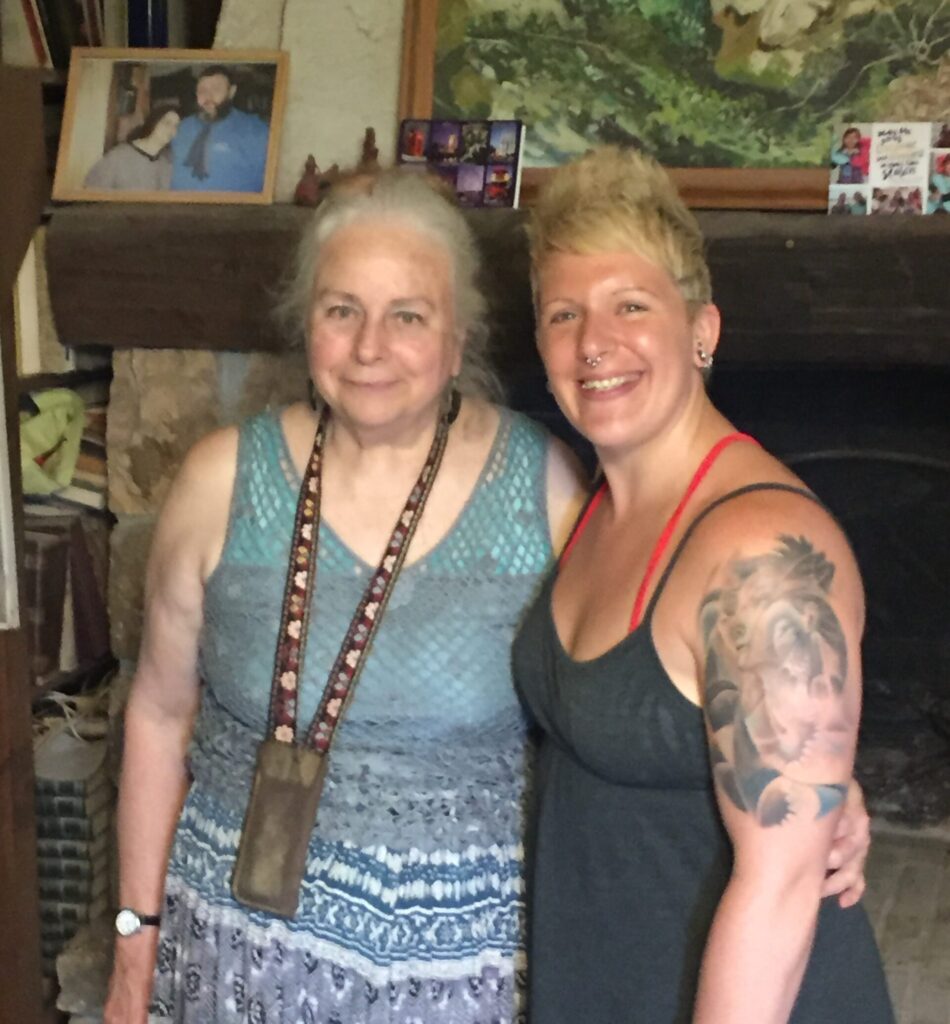
(l-r): Judith Legman and Jessica Floyd in Opio, France. (Image courtesy of Floyd)
However, unlike Wilmot, Hugill never penned the erotic versions and only sang them after a performance to an all-male audience. When Gershon Legman learned about Hugill’s repertoire, he wrote to Hugill, urging him to commit the erotic chanteys to paper for his vast collection. Hugill capitulated after years of correspondence with the condition that Legman not publish the manuscript before he could. Both men died in the 1990s without ever publishing it. With Hugill and Legman as the only witnesses of the manuscript’s existence, what was left for the chantey folklore community was rumors and the lore of its existence.
Thanks to funding from a 2016 UMBC Dresher Center for the Humanities summer fellowship, Floyd visited Judith Legman to study these letters alongside the manuscript. “Judith also had the letters shared between Hugill and Legman, which confirmed that this indeed was the sought-after manuscript,” said Floyd. She notes that by the time she left France, she had everything she needed to do a close analysis of the songs.
“Erotic worlds have fascinated me for a long time. It’s not your run-of-the-mill construction of gender. It’s actually focusing on the part of the human experience that we’re really reticent to talk about, especially in academic work,” said Floyd, who sports a palm-sized tattoo of Wilmot on her upper right arm. “This is the heart of my research—how do we write erotic worlds?”
Floyd is once again on the hunt for rare texts and has completed her second book, The Sons of Neptune. In this study, she is looking at cultural artifacts, from the 18th to the 20th century, that provide insight into why sailors are often thought of as sexy. This project is set to be published through the University of Mississippi Press in May 2026.
Theatre magic isn’t magic at all—it’s the result of months of students conceiving, designing, and constructing the theatre set under the guidance of their mentors. Throughout various stages of the process, UMBC students get to see the world they created come to life—from prologue to final curtain call. All the detailed measuring and crafting to scale pays off, because when the curtain goes up and the lights go down, the audience surrenders to a willing suspension of disbelief.
Prologue
“Attention on stage,” echoed loudly across UMBC’s Proscenium Theatre as Malaak McDonald, a theatre design and production and geography and environmental systems junior, warned the production crew to stop and await safety instructions.
It was a humid summer day, technically the off-season for UMBC’s theatre shows, but not for the production crew. From mid-May to mid-August, the undergraduate production staff set up construction stations across the Proscenium and the Black Box Theatres.
“Mine’s at 16, second electric, flying in, down stage,” said McDonald. The crew of five, in unison, looked up to ensure they were not underneath the second electric batten descending by a manual counterweight pulley system. The batten is a hollow metal bar, about the length of the stage, with electrical cables threaded inside, and rigged with hooks to hang stage lights and scenery. Fully loaded, it can weigh hundreds of pounds and can be flown in (lowered down) or flown out (raised) for seamless scene changes. Once the bar is at eye level and the line is locked, the crew returns to work.
All were trained by Gregg Schraven ’97, production manager for UMBC’s design shop, and Evan McDougall, assistant technical director, to use onsite industrial woodworking tools, welding machines, and behind-the-scenes stage technology. While McDonald tended to the lights, others were hand-painting a set floor. Another group inspected eight long wooden trellises drying on sawhorses, checking for scratches from their move from the paint booth to the stage through one of two 16-foot-high doors connecting the shop to both theatres.
Malaak McDonald looks up at the electric batten. Photo by Brad Ziegler.
To produce two fall plays and two spring plays annually, the faculty, staff, and students in UMBC’s theatre productions must adhere to a strict cycle that begins in November when the next season’s plays are chosen. Directors develop their script and then share their vision with the set, lighting, sound, and costume design directors. They then pick their student counterparts, all while producing the current season and teaching classes.
Theatre magic is not magic at all. It is the product of extreme organization, hefty technical skills, and commitment to learn, show up, and do the work. Theatre is a community service, explains Gerrad Alex Taylor, assistant professor of theatre and director of the 2025 – 2026 season opener, Shakespeare in Harlem, in celebration of a hundred years of the Harlem Renaissance and part of UMBC’s Arts+ initiative.
“This phenomenon of watching a play is cathartic and an important community service. It’s healing. It’s a service of the heart,” said Taylor, a classically trained Shakespearean actor. “We have to ask, ‘What do the hearts of people need right now?’ and what stories can we be telling to connect with their hearts?”
Abigail Adams, media and communication studies junior; McDonald; Ann Davies, visual arts and theatre design and production senior; Tyler Brust; Adam Harper, mechanical engineering and theatre design and production junior; and Gregg Schraven at the scene shop. Photo by Brad Ziegler.
Act One: Tools of the Trade
That kind of passion needs precision. Three years after graduation, Tyler Brust, theatre, a scenic designer and technical director, is a staple at the UMBC set design shop, where he is often on contract for the build cycle through tech week while also working in local theatre. “Coming back as an alum, it felt like I did not miss a beat as a result,” said Brust. “I immediately felt like I had the tools I needed to effectively lead small groups of student staff where necessary, all while balancing my own personal task list.”
He remembers his first production team project in 2019, building the floor layout for The Turn of the Screw set in late 1800’s England. The students created an illusion, a forced-perspective floor. Wooden floorboards were designed to be widest near the audience and gradually narrow toward the back of the stage, making the stage appear deeper and longer, creating a railroad-track effect. “This was all done by hand, with a straight edge and a router,” said Brust.
The forced perspective floor designed for the 2019 The Turn of the Screw. Photo by Marlayna Demond ’11.
“Now, for Shakespeare in Harlem, Evan helped us through a multi-step process to modify the hardboard floor from last fall’s play. I now have the skills to completely fake these lines via paint and handle the complex layout of overlapping ovals and forced-perspective bricks,” said Brust.
McDougall calls this “theatre production with training wheels.” Before the drilling and the cutting commence, he has students start with what he calls the boring part—reading the manufacturers’ manuals. He then reminds students of his number one rule: Don’t trust anything—even if it’s in the manual. “The students say I have trust issues.
You can’t make any assumptions about what is true in theatre production,” said McDougall. As UMBC’s master electrician with decades of experience in woodworking, welding, and blacksmithing, he is indispensable for students to understand the mechanical, manual, and technical aspects of set design, growing in expertise over their time at UMBC.
“I joke with my students that they come in with this preconceived notion of ‘this is parallel, this is plumb or level’—and once we begin installing sets and moving pieces around in the space, those realities don’t exist anymore,” said McDougall. After all, the production director aims to execute the set designer’s vision, while the set designer works to visualize and create the environment the director imagines.
Left to Right: Evan McDougall and Tyler Brust work on a set piece. Brust discusses the floor design with student staff. Photos by Brad Ziegler.
Brust absorbed every lesson alongside McDougall and Schraven, which helped him become a Swiss Army Knife of technical abilities as a carpenter, scenic artist, puppet artist, associate scenic designer, and design and technical coordinator. “The agency and mentorship that Gregg and Evan give students is what makes all the difference,” said Brust. “It allows us to flex our muscles into actual project management, which is otherwise difficult to emulate during a class session.”
Schraven and McDougall’s mentorship helped Brust branch out of UMBC to local theatre production companies like the Strand Theatre, Submersive, and True Penny Productions as a scenic artist, carpenter, general fabricator, and technical director. It is also why he is highly sought after in the UMBC theatre cycle.
“Tyler is a person I trust. I want to know what he’s thinking and can have dialogue about a problem,” said McDougall. “Here’s what my gut’s telling me. What do you see? We can start riffing off of each other. He’s now a coworker.”
Act Two: Metal, Steel, and Wood
In partnership with the Langston Hughes estate, Taylor adapted Hughes’ collection of monologue poems exploring the rhythms of jazz, the blues, Black love, and the daily struggles and joys of life in Harlem into a full-length play, blending poetry, music, and dance for an immersive journey into the world he so vividly celebrated. The only thing left to do was to construct an equally inspiring home into being. To bring the physical world of the Harlem Renaissance to UMBC, Taylor worked with Nate Sinnott, the scenic designer and faculty properties and paints supervisor.
Sinnott found inspiration in the original New York City Penn Station of the 1920s with 150-foot ceilings, granite columns, steel-vaulted ceilings, and an arching glass roof. Enter Schraven, McDougall, Brust, and the summer student production staff: McDonald, Adam Harper, a theatre and engineering and information systems senior, Ann Davies, a visual arts senior, and Abigail Adams, a media and communication senior.
Left to Right: Photo courtesy of New-York Historical Society, “Manhattan: interior main concourse of Penn Station, 1911,” which served as the inspiration for UMBC’s Shakespeare in Harlem scenic design. Part of the set’s faux steel trellis after layers of paint have been applied. Photo by Brad Ziegler.
Together, they built the director’s vision creatively and safely—with a unique twist. Taylor, who is a member of the resident company at Chesapeake Shakespeare Company (CSC) and founder of the company’s Black Classical Acting Ensemble, thought through a project that could “uplift the Black students who are about to graduate and have the acting chops to handle the material, and bring some of the Black Baltimore community to UMBC,” said Taylor. “Then take this Black ensemble and bring it back to Baltimore City’s community.” In brainstorming what all that could look like, UMBC theatre developed a collaboration with CSC.
This means that the technical crew designed the set to work for both UMBC’s Proscenium Theatre and Baltimore City’s CSC’s stage. The production team built a forced-perspective floor and 16 faux steel trellis arches constructed from multiple layers of wood and foam. Each trellis was finely carved with intricate triangular patterns using a computer-controlled machine, then glued together in pairs to form eight lightweight units. The arches had built-in break points, allowing them to be disassembled, packed into a 16-foot truck, and reassembled identically at each theatre—even with performances months apart.
“My job is to teach the students to the point where they can do it all,” said Schraven, associate teaching professor and technical director. For Schraven, UMBC is more than where he began studying theatre in 1989 and more than the place where he has worked, off and on, since the 1990s. It is where he gets to pass down the more than 30 years of theatre tech knowledge to students working in a scene shop he helped design.
Top Right: Davies works on steel to add to a set structure at the Black Box Theatre. Top Left: Brust and Harper inspect the height of the trellis. Bottom: The official technical drawings for the arches. Photos by Brad Ziegler.
“When I was a student, I was easily in the shop six to 10 hours a day. I probably did more welding in a year than they will do in their entire careers. That’s why I keep the shop open to students in the summer. That’s why I have a student labor budget and why 100 percent of all show proceeds are for undergraduate scholarships. I want to use every single penny of it on students,” said Schraven. “The more you’re in the shop, the more you learn. When students learn how to weld, I tell them to give it 80 times. Then they’ll be really comfortable with it.”
Act Three: Dress Rehearsal
It’s two weeks before showtime. At 6:30 p.m. sharp, the unspoken hero of the play, Tatiyana ‘Tati’ Terrelonge, an acting and media and communication studies junior, is poised at center stage on the floor designed to look like brown bricks. Terrelonge, who intrepidly served as the entire cast’s understudy, is holding a binder with the lead’s lines at the ready. Looming behind her is the finalized, floor-to-ceiling vaulted arch. Four costumed students sit in wooden chairs recently stained brown by the production crew, while another peeks out of a window, one of several frosted glass ceiling panes below the arch.
In the audience are four crew members managing lights, sound, props, and character lines. Today, the lines are for a scene where a character, Bruce, is writing a letter to his mother in the South, and another character, Leonard, is reading a letter to his sweetheart, begging her not to return to the South.
They represent the millions of Black men and women of the Great Migration, who fled the legacy of slavery and the terror of racism of the South between 1910 – 1970 for the North. Hundreds of thousands arrived at NYC’s Penn Station with the artistic talents and skilled labor that birthed the Harlem Renaissance. Their success inspired others to follow, who were ready to reap all the freedom that the Harlem Renaissance promised, only to be met first with the daily grind of work that made Harlem glimmer with the dreams of its people.
Dario Prioleau, acting senior, as Leonard. Photo by Kiirstn Pagan ’11.
Top: LaTrelle Jamez, acting senior, as Bruce; Taylor; Terrelonge; and Prioleau. Bottom: Taylor directs the ensemble. In the background, left to right: Sumedha Bhat, student assistant stage manager; Lucas Sanchez, student assistant stage manager; Isaiah Mason Harvey, guest assistant director for Shakespeare in Harlem and a member of the Black Classical Acting Ensemble at CSC; and Grace Shepperd, UMBC’s production stage manager. Photos by Brad Ziegler.
“Langston Hughes was canonizing Black life in America in the same way that William Shakespeare did, of life during England’s Elizabethan era,” said Taylor, who added a personal touch by including some of his grandmother’s stories and kept the show going by stepping in as the character of Simple. “A lot of my research here at the university and as an artist is looking at African American stories and stories of the diaspora that have been forgotten about, misrepresented, and stolen,” said Taylor, “and bringing a new lens and a new perspective of our contemporary consciousness to them.”
Curtain Call
Lauren Davis, as Griot—the play’s storyteller—gives respects to the ancestors that made the play possible. Photo by Kiirstn Pagan ’11.
“You are here!” said Lauren Davis, in the commanding voice of her character, Griot—the play’s storyteller, historian, and cultural guide—to the first audience of the fall season. Davis, a guest artist and member of the CSC’s Black Classical Acting Ensemble, is radiant in golden light. Behind her, the arched glass ceiling transforms with a projection of stained glass in rich royal hues, thanks to McDonald, the show’s head electrician, and the lighting team, who hung the lighting designer’s light plot—a map, essentially—a month early to give lighting design students time to learn the process.
“I want to get the acknowledgment well of the ancestors into the space,” booms Griot, lowering a large basket—the well—onto the floor. “I call so that you remember the grandmothers on whose shoulders we stand. I’m no longer accepting the things I cannot change. I am changing the things I cannot accept.”
With that, the set morphs into bedrooms, apartments, and streets, made real by the artistry of UMBC’s theatre students and their mentors. Traveling trunks become an altar, and light posts double as clotheslines. The actors tap in, weaving with the words and sounds—reading, stomping, marching, crying, laughing, inhaling—that syncopate the lives of lovers, friends, entrepreneurs, religious leaders, landlords, family, and a fledgling poet—an homage to Hughes—whose future letters are masterfully projected across the Harlem sky.
Top: The ensemble creates a church with luggage trunks as the altar and chairs as pews. Bottom: The ensemble creates a church with luggage trunks as the altar and chairs as pews. Photos by Kiirstn Pagan ’11.
When we think of toys, we imagine a finished product, a remote-controlled car, a mini piano, or a glitter-filled beach ball. The internal pieces that make up the toy are only seen if the toy breaks. However, for some children with disabilities, the feel, sound, and shape of a toy’s exterior can be as important as the internal components. Features such as a multi-button remote, pressing piano keys, or grasping a ball can reduce accessibility to developmentally essential play.
Molly Y. Mollica, assistant professor of mechanical engineering (ENME), challenges sophomores in her ENME 204 class, Engineering Design with Computer Aided Design (CAD), to create an accessible toy for an individual with a specific disability or a toy for collaborative play between children with and without disabilities. CAD helps students create, modify, and analyze technical drawings and 2D or 3D models.
Team Goat Cheese, a five-student collaboration that included Adam Harper, a mechanical engineering and theatre design sophomore, was voted the ENME 204’s Most Creative Design and the Most Viable Product by UMBC faculty, ENME 204 teaching staff, and needs experts. Their competitors also voted them the Most Creative Design for designing two accessible toys for children on the autism spectrum: a soft, stuffed sea turtle and a bald eagle with weighted body parts, textured fabrics, and interchangeable parts.
Team Goat Cheese’s stuffed eagle and turtle with interchangeable parts. (Images courtesy of Harper)
Integral to their success was the involvement of community members on the autism spectrum. “Many of us have someone close to us on the autism spectrum,” said Harper. “We asked them what kind of toy they would have wanted when they were seven or eight.” Harper’s close friend shared that they never had a stuffed animal because the stuffed animals on the market never met their sensory needs.
“Students have the opportunity to design in collaboration with needs experts—including physical therapists, special education teachers, and potential product users,” said Mollica. “In some cases, the resulting designs are developed enough to be shared with these experts to help address real challenges in accessible play.”
Designing with needs experts
The team’s online market research found that stuffed animals with sensory designs, such as weighted bodies, textured fabric, and scents, can help reduce anxiety, increase focus, and ease transitions for children on the autism spectrum, fostering greater engagement with peers and family. Another key takeaway of their research was that many sensory toys included only one sensory feature, limiting their effectiveness for children who benefit from multiple tactile inputs.
Team Goat Cheese used this as their inspiration. “We felt we could do better,” said Harper. “We decided to create two cartoon-like stuffed animals with multiple sensory inputs.” First, they used CAD to design interchangeable body parts. After several trial-and-error sessions, they created a lock-and-release mechanism for interchangeable parts. The eagle’s head, wings, and legs all come off the body. The sea turtle’s front and back flippers and head are also interchangeable. If a child doesn’t like the texture of the bald eagle’s head, they can swap it for the turtle’s head, creating a completely different sensory experience.
Sewing tactile play
Choosing the materials was also a process. The team chose soft brown corduroy for the eagle’s wings due to its unique texture and geometry, and extra soft sweatshirt fleece for the eagle’s head and tail feathers. The beak and talons are a yellow iridescent mesh fabric with metallic gold squares fused onto it, noted Harper.
(l-r): The eagle’s right wing insert, stuffed eagle without weighted wing pockets, and the fabric for the beak and talons. (Images courtesy of Harper)
The turtle’s body was made of minky fabric—a soft, velvety green plush, polyester fabric—with raised almond-shaped dots that felt like soft scales. The shell was made from a soft brown fleece.
Fabric for the turtle’s body and shell. (Images courtesy of Harper)
Harper—the team’s secret weapon as the only member who knew how to sew—owned a sewing machine and had years of experience sewing, welding, sawing, and constructing theatre sets, so he was in charge of sewing the final product.
“For the weighted components, I double-stitched corduroy pockets and filled them with glass microbeads, then placed them inside the wings, head, and body. I filled the rest of the body with polyester fiberfill—a synthetic fiber used for stuffed animals,” said Harper. “It was many hours and days of sewing and making pouches and remaking pouches and seam ripping and fixing.”
“Our goal is to prepare the next generation of engineers who understand the engineering design process,” said Mollica, “are proficient in engineering design tools, value input from needs experts, and are equipped to create high-quality products that are accessible to as many people as possible.”
While photos of the eagle and turtle stuffed animals still exist, the physical toy is no longer in the team’s possession—it has been passed on, and they hope it’s now in the hands of a child who is happily creating turtle-eagles with their friends.
Abbie Fakoya is at the front of the room, smiling and encouraging over 40 UMBC faculty, staff, and students to follow her dance steps. Many of the attentive dancers were either new to the intricate K-pop choreography, learning this sequence, or, like millions of fans around the world, ready to show off their synchronized dance moves to “Golden,” the 2026 Grammy-nominated Song of the Year, from Netflix’s KPop Demon Hunters film.
The global success of the film drew fans to the KPop Demon Hunters: A Conversation on Media, Culture, & Globalization event organized by the Asian Studies Program in collaboration with several CAHSS departments at the Skylight Lounge this fall. Fakoya, a biochemistry senior and the event coordinator for UMBC’s K-pop Dance Club, was not surprised to see the long line of people waiting to participate in an evening of Korean culture, dance, and food that celebrated Korea’s vast snack culture thanks to the D.C. Korean Foundation and a delicious Korean-fusion catered dinner by Baltimore’s own Dooby’s restaurant
Participants line up for a Korean-fusion dinner and Korean snacks and drinks.
“Seeing the movie accurately portray the food and cultural practices I grew up with in a positive way—like the noodles, the Korean spa the characters enjoyed, and Korean shamanistic practices—reminds me of my own childhood experiences, and doing those same things now when visiting family in Korea. It is really inspiring,” said Angelina Jenkins, assistant director of UMBC’s Mosaic Center for Cultural Diversity, a member of the expert panel.
Growing up with K-pop
Fakoya became interested in K-pop in elementary school, at a time when she felt that liking K-pop—especially if you weren’t Korean—was not as well received. Friend and club historian Esha Shah, an information systems junior, agrees. “This year has been very exciting. We’ve had a lot of interest in the club because of the movie,” said Sha. “I remember when I was in elementary and middle school, kids would give me side-eyes for liking K-pop and singing in Korean and ask me why I wanted to be Korean.”
The two met in 2022 at the RAC for a packed K-pop dance workshop, featuring the then-top K-pop song “Dope,” by BTS. It was the first in-person dance workshop after COVID-19 restrictions were lifted. “UMBC’s K-pop dance club moved its dance workshops online during the COVID-19 lockdown because K-pop artists were still posting songs and dance videos,” said Sha. “When students came back in person, there were so many people who wanted to participate that the club had to keep rotating participants in and out of the workshop.”
For Jenkins, a life-long K-pop fan, being among Retrievers who champion, appreciate, and embrace Korean culture was also a welcome change from her experience growing up in Pennsylvania, where she was one of the very few students of color in her high school. “I’m super excited to be here as I am what I consider to be a one-and-a-half first-generation American, Korean American, who not only does their work through the Mosaic Center,” said Jenkins.
“I am also a third-year Ph.D. student at the University of Maryland, College Park, looking at culture studies, Asian American identity development, and how films like KPop Demon Hunters allow young Asian American students to really understand what this means to bridge the gap between American culture, Korean culture, and this idea of globalization.”
(l-r): Mea Lee and Angelina Jenkins discuss Korean culture as represented in the film KPOP Demon Hunters.
Alongside Angelina Jenkins, Mea Lee, a doctoral student in the Language, Literacy, and Culture Program at UMBC and a librarian at Anne Arundel Community College, highlighted the film’s cultural integrity. Lee emphasized how breaking Asian stereotypes and incorporating authentic cultural references can empower not only Korean communities but all minority groups in America.
She explained how Korean folk narratives and art were skillfully woven into the storyline, enriching the film’s depth and relevance. One example is the blue-striped mystical tiger, Derpy, and the magpie, Sussy, with three eyes on each side of its head, who are paired together to act as messengers and protectors. These elements not only honored tradition but also created a bridge between folklore and modern fantasy, allowing the narrative to resonate with diverse audiences.
Lee discusses the meaning of a Korean mystical tiger and magpie in Korean folklore.
K-pop’s influence beyond the screen
The panel, moderated by Fan Yang, professor of media and communication studies, director of the Asian Studies Program, and the faculty leader of UMBC’s Global Asias Initiative, discussed the spiritual, gender, linguistic, and artistic Korean cultural references throughout the movie, along with the Westernization of K-pop.
“The experience of being a human and a demon—struggling with duality— is very relatable. I’m an American,” said Lee, “but I also want to live within my Korean culture. It’s a balance between how much I really want to be an outcast in either culture, versus how much I’m going to accept. It’s a constant struggle.” Lee continues, “It’s a similar duality that Rumi, the main character, faces as a half-demon and half-human. Life isn’t always so clear. We spend most of our lives in the grey area. It’s a balance. At least I don’t have to fight four dancing demons.”
Fakoya and Sha have also witnessed the Westernization of K-pop, with a shift from Korean lyrics to mostly English lyrics—like in KPop Demon Hunters. First, they didn’t expect to like the movie because it was marketed for children, and most of it was in English. “I don’t speak Korean, but I like to memorize the Korean lyrics and the dances,” said Sha.
Abbie Fakoya leads the audience in a K-pop dance sequence at the KPop Demon Hunters: A Conversation on Media, Culture, & Globalization event.
They were won over by the movie’s attention to detail of the K-pop culture they’ve been a part of since childhood. Now, they’ve found themselves as ambassadors encouraging students who “don’t want to like it because everyone likes it now,” to explore the genre beyond what’s popular. “There are different sounds and niche groups just like in any type of music,” said Sha.
In preparation to lead the “Golden” dance workshop, Fakoya memorized the Korean and English lyrics and choreography. “K-pop is so cool. It’s just a habit. I love it,” she said, after masterfully and patiently showing everyone how to be a K-pop demon superstar.
In early 2025, thousands of U.S. federal workers were unexpectedly laid off, many living in the Washington, D.C., Maryland, Virginia (DMV) area. Patrick Shirdon ’92, economics, a civil servant of 33 years, was among those left to grapple with the uncertainty and frustration of restarting a career. While searching for resources, he found UMBC’s Paws & Pivot free webinar series, where career development experts share concrete skills on resume writing, interview preparation, navigating a tech-centered job market, and more.
“After losing my job, I didn’t know what to do. I was just so happy to find something to do—and this series became so much more than that for me,” wrote Shirdon in an email to Rex Jarrett, the director of professional programs in UMBC’s Division of Professional Studies (DPS).
“Growing up in Montgomery County, being part of the DMV, I knew a lot of people whose parents were federal workers,” says Jarrett. “Many of my friends followed in those footsteps and were impacted by the layoffs.” The 2024 annual Maryland employment statistics report totaled the Maryland workforce at 2,764,497 people. Of these, some 530,257 workers, or 19.2 percent, were employed by federal, State, and local governments in the public sector.” Those impacted were asking for help to access new professional networks via Facebook and LinkedIn after decades of serving their country,” Jarrett noticed.
With skills in webinar development, Jarrett knew this format could quickly serve a wide audience. He reached out to Jill Barr, then associate vice provost and assistant dean of the Graduate School, and Julie Gilless, assistant vice provost for marketing in DPS, with an idea for a job skills development webinar series. What began as an idea grew into a conversation, and with the full support of Barr and Gilless, became a call to action.
Gathering the Paws & Pivot pack
Jarrett came to UMBC in fall 2024 after more than half a decade leading the Harvard Business Analytics Program. He was excited to return home to Maryland and put his expertise in career growth and community engagement to work for the greater good. Jarrett is passionate about his work because it helps him answer a question that is always on his mind—How can I make the world a better place? He did not anticipate that the answer would come so soon after joining UMBC, nor that it would involve hundreds of federal workers.
Quickly, the team created the Impacted Federal Workers Think Tank Committee and agreed that the series would be free for everyone—regardless of a UMBC affiliation—and remain accessible on the division’s YouTube channel. Thanks to DPS’s Rashad Cheeks, associate director of marketing, and Theresa Mabe, marketing data manager, the series received a memorable name and logo. The first episode of Paws & Pivot, “Building Your Digital Brand,” aired on Wednesday, April 16, 2025, and featured Rowena Winkler, assistant director for graduate student career development.
Jarrett, with the DPS team (l-r): Allison Jones, assistant vice provost, Gilless, Winkler, Elliot Talbert-Goldstein ’11, media and communication studies, director of digital marketing, Mabe, and Cheeks. (Brad Ziegler/UMBC)
A few months after tuning into a Paws & Pivot webinar, Shirdon reached out to Jarrett: “Today, I attended my orientation day with the human resources team at my new organization. It has been 33 years since I was a ‘new’ employee!” wrote Shirdon.
Award-winning programming
Since launching in April, Paws & Pivot has hosted 15 sessions, amassed 150 registered participants, and engaged with over 900 impacted federal workers and government contractors. Over 90 percent of attendees say they would recommend the series to other impacted federal workers. The University Professional and Continuing Education Association (UPCEA) has nominated Paws & Pivot for their “2026 UPCEA Regional Program Award‘ as a Mid-Atlantic educational program that focuses on addressing a regional need. Jarrett notes that the initiative has become a model of regional engagement, scalable virtual learning, and social impact, grounded in the values of continuing education, career resiliency, and access.
“Paws & Pivot was/is amazing. In addition to the wonderful, technical information taught at the Wednesday sessions, an unintended benefit for me was the ability to have an event on my calendar. It gave me something to look forward to, and truthfully, I learned a lot,” writes Shirdon. “I certainly had my share of ups and downs, more downs than ups. But UMBC’s effort was an absolute blessing for me. Now, I just have to go and do great stuff! Ball in my court.”
Pete Fitzpatrick ’96 completed his paramedic training in a speeding ambulance in West Baltimore over 30 years ago. It wasn’t the career he had envisioned, but after a friend gave him a textbook for an elective Emergency Medical Technician class, he switched his major to emergency and disaster health systems. “I kind of fell in love with it. As a kid, I never saw it as a profession for me,” says Fitzpatrick. “There are no firefighters or paramedics in my family.”
His ability to communicate clearly and calmly under pressure, foresee medical or technical issues, and notice the tiniest details led him to return to school for nursing. He first worked in an adult neuroscience unit at Johns Hopkins Hospital before returning to ambulance and helicopter transport, including pediatric transport.
Fitzpatrick has spent the last 12 years at the Children’s National Hospital in Washington, D.C. As a transport team shift coordinator, he meets the needs and addresses the challenges of flight crews, medics, receiving hospitals, and families before, during, and after helicopter or ambulance transport. “I remember my surprise the first time somebody referred to me as a pediatric nurse,” says Fitzpatrick. “I guess I am.”
Addressing the opioid crisis
Pete Fitzpatrick and a young Sam. (Image courtesy of Fitzpatrick)
In light of Fitzpatrick’s background and relevant training, in May 2025, he was appointed as one of 12 members on Maryland’s Opioid Restitution Fund Advisory Council. Established in 2022, the council makes recommendations for the allocation of financial settlements from prescription opioid-related lawsuits to help fund programs and initiatives that address the opioid crisis. Fitzpatrick, who is married to Kim Fitzpatrick and father of Sam, Mikey, and Danny, a first-year chemical and environmental engineering student, serves as the council member representing those who have lost a family member to an opioid overdose.
“It’s really a sad story. My oldest child, Sam, died of a fentanyl overdose in May of 2020. He was 22,” says Fitzpatrick. Fentanyl is a highly addictive synthetic opioid used in hospitals to treat severe and chronic pain from cancer and surgery. The Maryland Department of Health reported that between September 2024 and August 2025, there were 631 opioid-related deaths in Baltimore City and County combined, 575 of which were fentanyl-related deaths.
“I tell my colleagues, in emergency pediatric transport, we deal with children in sometimes very tragic circumstances,” says Fitzpatrick. “I say to them, ‘When you lose a child in transport, there’s only one thing you can do—you have to go and try to save the next one.'”
Broadening access to life-saving treatment
Governor Wes Moore with Fitzpatrick at the Maryland General Assembly, where Fitzpatrick testified to expand the Maryland Good Samaritan Law. (Image courtesy of Fitzpatrick)
Coming from an emergency medical services (EMS) system approach, Fitzpatrick hopes the opioid crisis will be solved through similar measures. “The 1973 EMS Systems Act came about because of the rise in deaths due to a lack of emergency care,” he says. “The act created grants and programs to fund EMS training, equipment, and infrastructure.” UMBC established its emergency health services (EHS) baccalaureate program in 1980 to develop highly skilled emergency healthcare leaders, managers, and providers. In 1984, UMBC launched the first EHS graduate program in the U.S., and it remains a national leader in EMS education. Both programs are now part of UMBC’s emergency and disaster health systems department.
Broadening access to life-saving treatment for opioid use disorder is always on Fitzpatrick’s mind. Having access to good healthcare, a supportive family, education, and intervention resources helps, but he notes that not all families have that. For example, there were times when Sam was in crisis, and the family needed access to the police department.
“Baltimore County has a great crisis response,” Fitzpatrick says, “but what if we had not felt comfortable accessing the police department when we needed that help?” He now serves on the Police Accountability Board for Baltimore County to help strengthen the relationship between police and the community and fundraises for the American Society for Addiction Medicine.
“Sam had a lot of things going for him, and it still didn’t work. That’s sad. There’s only one thing I can do at this point,” says Fitzpatrick, “and that’s to try to make a difference.”
For tech-savvy individuals like Eric Stokan, artificial intelligence, programming languages, and open-source software are powerful tools that can turn once-impossible ideas into reality. Researchers can use human language processing to analyze historical documents or legal texts. Through collaborative platforms, global organizations can collaborate quickly without incurring travel costs. In the social sciences, open-source tools provide students with unique opportunities to work with experts developing projects that address community needs. However, to take full advantage of these revolutionary technologies, these tools often require advanced computing skills or access to expensive software, which can limit their impact and exclude those without the necessary resources or training.
Stokan, director of the Center for Social Science Scholarship (CS3), is committed to removing these barriers for faculty and students in computational social science, which uses computers, data, and algorithms to study human behavior and social systems. His research lies at the intersection of urban policy, economic development, and computational social science, with a focus on how local governments make policy decisions and how those decisions impact equity, economic growth, and environmental sustainability.
The Elkins Professorship is named after Wilson H. Elkins, a former Rhodes Scholar and president of the University of Maryland, College Park from 1954 to 1978. This prestigious award is for faculty within USM who are working on innovative projects focused on the use of generative AI to advance academic transformation, foster improvements in access, affordability, quality of outcomes, and/or stewardship of people’s time, money, and other scarce resources.
Stokan’s examples of the R open-source programming language.
“The professorship will allow me, through the Center for Social Science Scholarship, to first assist faculty and students in understanding how to leverage advances in computing and AI to address new research questions and scale their research in ways that were unfathomable during Dr. Elkins tenure,” says Stokan, associate professor of political science, who earned one of three $10,000 awards. He will use the funding to complete Computational Public Administration—his first book written with R, a free programming language used for statistical computing and graphics—about computational social science methods focused on addressing public policy and administration topics, such as climate change and economic development.
The funding will also support the design and implementation of five hands-on training modules and workshops tailored for faculty, students, and community organizations. Participants will learn to use generative AI large language models (LLM) like ChatGPT and R. The goal is to help participants answer novel and important research questions, develop marketable technical skills, to work more effectively with data, and better communicate the results of their analyses with the broader community.
Left: Codi Hrynko, Ph.D. ’29, chemistry, and Sarah Lanasa, Ph.D. ’25, environmental engineering work together. Right: Nagaraj Neerchal, professor of statistics, at the first workshop series on AI, LLMs, and computational methods.
“I am deeply honored to receive the Elkins Professorship, in honor of the late Wilson H. Elkins, who was a transformational leader, administrator, and educator,” says Stokan. “This award is important to me because it not only provides support but also affirms my commitment to accommodating learners at all levels of experience in computational social sciences, promoting accessibility, equity, and methodological transparency.”
Alyssa Thomas is more of an “and” person than an “or” person. Growing up in a military family stationed in Florida, Thomas learned flexibility, a sense of curiosity, and a “Why not?” approach to life. So when Shin Yon Kim, assistant teaching professor of Asian studies, encouraged her to apply to the U.S. Fulbright Student Program during her junior year, Thomas was skeptical. “I decided to give it a try, but I didn’t think I’d get very far because I had never studied abroad,” said Thomas. “And then Dr. Kim said, ‘I need you to start believing in yourself and actually push yourself to apply for it.'” Those words of encouragement stuck with her. Thomas took her own advice and said, “Why not?”
Thomas ’25, Asian studies, ended her summer by moving to Taipei, Taiwan, where she is already working as a Fulbright English Teaching Assistant. She hopes her rudimentary Mandarin will help her learn Taiwanese Mandarin and the various dialects while she’s there. “There’s a big difference between learning in the classroom and in person. Accents, tempo, and slang are elements of Mandarin I’ve yet to adjust to,” says Thomas.
Retriever advice from Alyssa Thomas’25 U.S. Fulbright Student Program English Teaching Assistant, Taipei, Taiwan
“It’s important to learn how to manage your stress, especially if you have never traveled abroad or applied for a Fulbright. For me, it’s morning walks. Find what works for you—whether it’s journaling or therapy—to help manage the unexpected.”
Deciding to apply for a Fulbright is only the beginning. The process usually starts with a mentor pointing the way toward Brian Souders, M.A. ’19, TESOL, and Ph.D. ’09, language, literacy, and culture, the associate director for global learning at UMBC’s Center for Global Engagement. CGE hosts Fulbright information sessions in the spring for undergraduate, graduate, and recent alumni. Retrievers can apply to earn a master’s, conduct research, or be an English Teaching Assistant in East Asia-Pacific, Europe and Eurasia, Middle East and North Africa, South and Central Asia, Sub-Saharan Africa, and the Western Hemisphere.
With three UMBC 2025 – 2026 Fulbrights already settled in Taiwan, Norway, and Indonesia, and three preparing to cross the Atlantic Ocean to Belgium, Israel, and Germany, these alumni are eager to share tips to inspire and prepare the next generations of Fulbright Retrievers.
Transforming the lives of incarcerated women
Right now, it is the beginning of fall in Bergen, Norway, where Shanika Freeman’24 is settling in at the University of Bergen, working with faculty studying the reentry experiences of native Norwegian and non-native Norwegian women into the community after incarceration. Freeman’s individualized studies major at UMBC focused on recidivism and policy in urban communities, making Norway a perfect research location. The country’s progressive and humane approach to rehabilitation, from the point of entry into the carceral system to successful reentry, has made Norway have the world’s lowest recidivism rates. Though Baltimore and Norway are worlds apart geographically and culturally, Freeman hopes to use what she learns abroad to help transform the lives of incarcerated women in the U.S. by exploring practices that shift the focus from punishment to rehabilitation and community building.
Retriever advice from Shanika Freeman ’24 U.S. Fulbright Student Program Research in Bergen, Norway
“Build a team. I found out about Fulbright through Dr. Brian Souders. I didn’t know anything about it before and felt like Fulbright was out of reach for me. The furthest I had traveled was to California, and that was only for a weekend. I never thought a person like me—low-income, two-time college dropout from Baltimore City—would get the opportunity to go abroad.”
Her team included the INDS faculty and her academic mentors: Tammy Henderson, associate teaching professor of Africana studies; Loren Henderson, director of the school of public policy; László Kőrössy, assistant director for academic advising, outreach, and assessment; and Eric Stokan, director of the Center for Social Science Scholarship. “I applied because the faculty encouraged me and supported my research. I knew that my research was important, and Fulbright allowed me to take it further. Applying was a bit overwhelming at times, but Dr. Souders was extremely thorough, patient, kind, and knowledgeable. My team of faculty and staff was instrumental in my development as a scholar and fostered my academic goals.”
Researching your roots
Since Eilah Goldberg ’25, history, with a Judaic studies minor, first learned about the Fulbright Program during her sophomore year, her academic goals became very clear—build a strong academic and social foundation to earn this prestigious award. Goldberg knew she wanted to study Jewish history, religion, and culture abroad. The first step was studying abroad in England at the University College London (UCL) Hebrew and Jewish studies department, with the intent of returning to earn a master’s. “When I told Dr. Souders my plan to return to London after graduation, he asked me what I really wanted to do,” says Goldberg. “I shared my deep interest in Jewish studies, and he helped me realize that I could go directly to Israel to study—that it was a real option.”
Retriever advice from Eilah Goldberg ’25 U.S. Fulbright Student Program Master’s at Hebrew University of Jerusalem
“Stay true to yourself, your interests, passions, and intellectual curiosities. Don’t let fear stop you from traveling to places or studying topics that are personally and culturally meaningful to you. Take the opportunity to conduct firsthand research into your roots, identity, and beliefs. Lean on the support of student clubs and cultural communities, just as I did with UMBC’s Chabad and Hillel Jewish student organizations and UCL’s Jewish Student Union. It’s important to have people to encourage you and believe in you.”
Goldberg will earn a master’s in Israel Studies at the Hebrew University of Jerusalem, surrounded by her extended family in Israel, an hour away from Jerusalem. She will study the impact of American Aliyah—ascent in Hebrew—the immigration of American Jews to Israel, and how it shaped Israeli society historically, culturally, and politically.
Pre-med neurologocial research abroad
The summer before his first year at UMBC, Andrew Opincar ’25, biological sciences, mapped out a four-year plan to ensure he would complete his major requirements, gain clinical experience, and take the MCAT all before graduating. As a participant in STEM Build—a National Institutes of Health initiative focused on enhancing diversity in the biomedical and behavioral sciences workforce, Opincar was excited to explore diverse perspectives in healthcare and research. While planning for his final two years at UMBC, he took the opportunity to study abroad in Amsterdam, Netherlands, to learn about the Dutch public universal health system.
Retriever advice from Andrew Opincar ’25 U.S. Fulbright Student Program Research at the University of Heidelberg, Germany
“For pre-med students to critically analyze the health systems around us, we need to understand systems and people different from ourselves. It’s difficult to be well-rounded physicians, scientists, or researchers when you’ve only lived in one place and had one kind of experience,” says Opincar, who, even though his mentors encouraged him to apply, was unsure if he was “Fulbright material.” “I like the sports quote, ‘You lose 100 percent of the shots you don’t take,’ so you really must take a chance on what you care about and put yourself out there.”
Now, Opincar has mapped the time between graduation and medical school to learn a new healthcare system and expand his research experience from cell migration in fruit flies to spinal cord regeneration in mouse models at Heidelberg University, Germany, a global center for molecular biology and neuroscience. He’s excited to plan for many unknowns, like exploring a new research field, becoming bilingual, and stepping outside of his comfort zone to gain more confidence personally and professionally.
Connecting with your community across borders
Law and politics have been on Navara Syed‘s mind as long as she can remember. Her political science professors, Carolyn Forestiere, Brian Grodsky, and Jeffrey Davis, fueled her passion for comparative politics, civil and human rights, and community advocacy, leading her to choose a major in political science. During her visits to Pakistan to visit family and to Thailand to study abroad, Syed began to understand the complexity and broadness of what community can mean, and is ready to embrace the community she will be part of during her Fulbright in Indonesia as an English Teaching Assistant.
Retriever advice from Navara Syed ’25 U.S. Fulbright Student Program English Teaching Assistant Padang, West Sumatra, Indonesia
“Dip your toes into different ponds. You never know what you will find. I’m Muslim and have never lived in a Muslim country. In the U.S., I always have to think about where to get Halal food. In Thailand, a kind person approached me and offered to show me where I could find Halal food. Our tour guide even made sure to include Halal restaurant options.
Indonesia is a Muslim country, so spending Ramadan and other major Muslim holidays without needing to explain them or figure out how to participate in them is a dream come true. No experience is a waste—it’s just as important to realize what you don’t like as it is to discover what you do.”
Since graduating in May, these connections, along with her time in Mock Trial, the Muslim Student Association, and the student events board, continue to plant seeds of possibilities for her future in the field of law, whether as a judge, legislator, professor, or advocate.
Intersectional approach to flood mitigation
Daniel Douglas’21, global studies, M.P.P. ’24, public policy, a current Ph.D. student, has been clear about his career path since his undergraduate years, when he began researching environmental policy focused on disaster mitigation and natural hazards. As a Fulbright recipient, he is now taking his expertise to the international level in Antwerp, Belgium.
Retriever advice from Daniel Douglas, Ph.D. student U.S. Fulbright Student Program Research at University of Antwerp, Belgium
“In every single field of study at UMBC, you can identify a way to apply your work for the common good. Find and seek your purpose above all else. This is especially important today when research and academia are being challenged. Now, we all have to uplift goodness, justice, and each other. And most of all, we can’t give up hope. I try my best to uplift those around me, knowing and trusting that they are pushing me forward to new heights.”
At the University of Antwerp, Douglas will conduct research on Belgium’s Sigma Plan—the primary flood mitigation plan along the Scheldt River Valley in Flanders, Belgium. Originally launched in 1977 as a single-purpose safety plan, it has since evolved to manage flood protection with nature conservation, recreation, and the needs of shipping and agriculture. This intersectional approach to flood mitigation is Douglas’s passion. He plans to build on his skill set in Belgium, then bring this newfound knowledge back to UMBC to complete his doctorate, and help communities worldwide—including Ellicott City—reduce the disastrous impacts of environmental hazards through disaster prevention, mitigation, and governance.
When Ivy Nguyen moved to the United States from Vietnam in 2014, her high school peers struggled to understand the British English she had grown up speaking. As she found herself “lost in British translation,” Nguyen decided to expand her skills across multiple English accents—Mid-Atlantic English, British English, and the accent with a mix of Vietnamese and English. From high school through college, these linguistic bridges provided Nguyen with opportunities for community building and leadership. Now, equipped with these strengths, she is headed to Taiwan to add Chinese to her language repertoire.
Nguyen wearing a hanbok, traditional Korean clothing, at Gyeongbokgung Palace in Seoul, Korea. (Image courtesy of Nguyen)
“Being able to listen without judgment is a critical skill,” says Nguyen, who double majored in Asian studies and global studies—adding Chinese, Korean, and a bit of Japanese—as well as some mileage in between with an education abroad experience at the Ewha Womans University in Seoul, Korea, during her junior year.
Since graduating in 2023, Nguyen has worked as a tutor at several public schools in Anne Arundel County, supporting students in first to ninth grade during the academic year, and served as a Generation Teach AmeriCorps Summer Teaching Fellow, a five-week K-8 STEAM academy, during the summer. “Two core values of Generation Teach are to foster belonging and to make sure everyone is included,” said Nguyen of her intensive training in identity, community building, content, and teaching. “We have students and teachers from all kinds of different backgrounds. I learned more about expressing myself without causing misunderstandings and how to convey my message while understanding the role that privilege plays in communication.”
Nguyen’s language chops and ability to teach, lead, and uplift multiple communities earned her two prestigious international opportunities: First, as an alternate for the Fulbright U.S. Student Program award to Taiwan to pursue a master’s in Chinese as a second language; and the second is admission to the National Normal University, a leading institution in education and education research in Taipei, Taiwan, with funding from Taiwan’s Ministry of Education.
After completing over 350 hours of AmeriCorps service, Nguyen decided to forgo the alternate Fulbright spot and apply her hard-earned wisdom to pursue a master’s degree in teaching Chinese as a foreign language in Taiwan.
“When I was a kid coming to the United States, I was excited to get on a plane and move to a different country, but once I got here, I realized how different it was from what I thought it would be or sound like,” said Nguyen, who is already applying for a part-time job in Taiwan’s Ministry of Education English Language Teaching Assistant Program. “You have to know how to be flexible and pick what is right for you. If there is a change in plans, that’s still okay. Everything will be okay in the end.”