All posts by: Catalina Sofia Dansberger Duque


UMBC’s first Fulbright Scholar-in-Residence shares unique research on neurodiversity in language teaching and learning

Neurodiversity inclusion and representation have been at the forefront of Michael Canale’s 20-year career in the disability services and education field. Canale, M.A. ’24, intercultural communication, is the assistant director of UMBC’s Office of Student Disability Services and teaches the first-year seminar Introduction to Disability Studies. “Sometimes parents of neurodivergent students worry that their child is incapable of learning another language,” says Canale. “I work with parents to ease their fears by showing them how their child can excel in college with the proper individualized accommodations.” These can include note-taking software, counseling services, tutoring, time management support, and more.
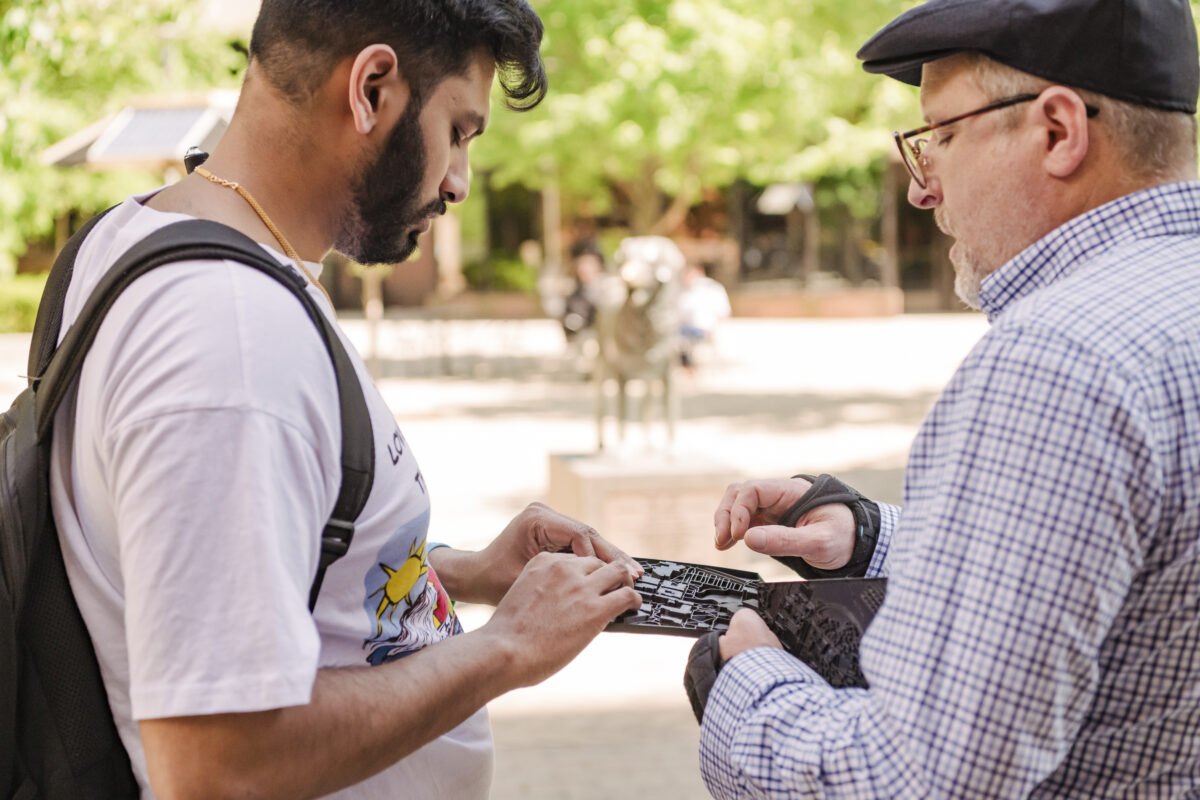
A blind college student uses a personal tactile map of a campus neurodiversity
Michael Canale (r) has been working with Ph.D. students in human-centered computing to create personal tactile maps of campus for blind students at UMBC, like Shawn Abraham ’24, political science. (Marlayna Demond ’11/UMBC)

When Canele, who also received his post-master’s certificate in college teaching and learning science, heard that UMBC’s first Fulbright Scholar-in-Residence, Jules Buendgens-Kosten, would be teaching Language Learning and Special Education – Advanced Special Topics in Education, he was quick to enroll. The course, part of UMBC’s teaching English to speakers of other languages (TESOL) master’s program, was designed for anybody planning to work with heterogeneous groups of learners, including those of different neurotypes, both in special education and mainstream education settings. 

Buendgens-Kosten, a research assistant at the Institute of English and American Studies at Goethe-Universität Frankfurt, Germany, began their partnership with UMBC as a research collaboration with Shannon Sauro, associate professor of education. Sauro recognized that Buendgens-Kosten’s expertise in English language teaching and teaching neurodivergent populations in Germany would add an international and non-U.S.-based perspective to UMBC’s TESOL program and education department. 

“If students have not experienced an inclusive classroom, they may be afraid of managing an inclusive classroom when they become teachers,” says Buendgens-Kosten, whose research helps prepare educators to teach students with dyslexia, ADHD, autism spectrum disorder, and other minority neurotypes. “One way to reduce this fear is giving teachers tools for best practices.”

Own-voice texts

To help students learn about neurodivergent experiences, Buendgens-Kosten had students choose an “own-voice” children’s book that included characters with dyslexia, ADHD, autism spectrum disorder, and other minority neurotypes. Own-voice texts are books written by underrepresented authors, in this case, neurodivergent authors writing about neurodivergent communities. The stories veer away from narratives based on neurotypical authors’ understanding of neurodivergent people and those who champion overcoming neurodiversity to embrace a more neurotypical lifestyle. 

Valeri Vanier, an international TESOL student from Dijon, France, chose Nelson Beats the Odds by Ronnie Nelson Sidney II. Vanier explained Nelson’s experience as a student who has ADHD and a learning disability. “The book is very colorful and a fun story. It’s about having positive self-esteem and reflects the author’s experience with learning disabilities,” Vanier said. “But, I’m critical of it because I feel that Nelson’s success is defined by achieving academic success in a neurotypical way.” 

Buendgens-Kosten agreed with Vanier, noting the info boxes about well-known neurodivergent people in the book might inadvertently send a message that it is okay to be neurodivergent as long as you grow up to be rich and famous.

Vanier began his teaching career shortly after COVID-19 forced him to close his historical guided tours company. He saw the need to support remedial learners and launched Le Goût d’Apprendre/ A Taste for Learning, which partners with parents, schools, and organizations to develop individualized learning programs. After in-person teaching came back in full swing, Vanier wanted to broaden his teaching skills and subject area to include a TESOL credential. He found a home in UMBC’s TESOL program. His advisor suggested this seminar because of his prior teaching experience.
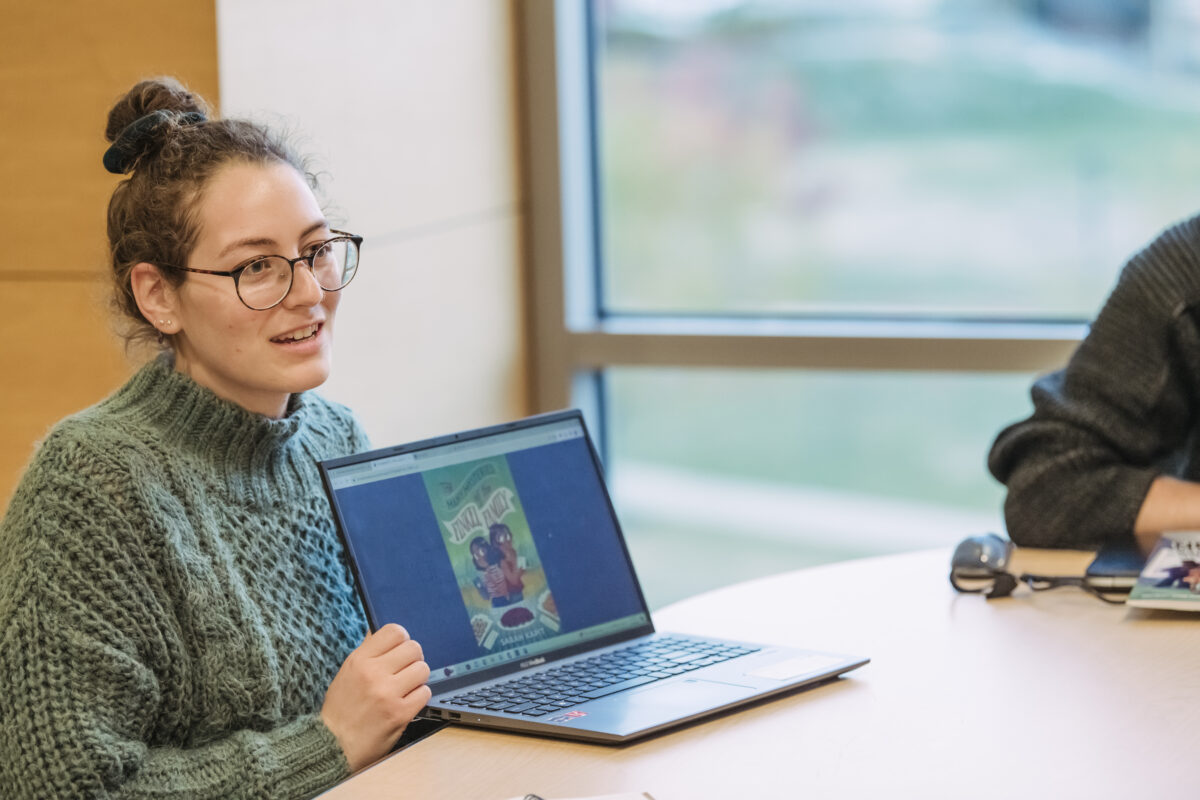
A college student sits at a table showing a book cover on their laptop
Maia Scarabelli. (Marlayna Demond ’11/UMBC)

Fellow TESOL masters student, Maia Scarabelli, a 2022 Shriver Peaceworker Fellow, is preparing to become an early education teacher of English language learners. Scarabelli also came to UMBC with teaching experience. Before UMBC, she taught English as a Peace Corps Volunteer in Honduras and Myanmar. For Buendgens-Kosten’s class, Scarabelli analyzed Daniela Schreiter’s graphic novel The World Beyond My Shadow about her life growing up with Asperger’s syndrome. “The visuals make the story more accessible for English language learners,” says Scarabelli. “The oscillation between her life as a child and as an adult looking in from another planet—in the context of English language teaching in the U.S., feeling like an outsider from another country—resonates with the experience of many English language learners.”

Addressing English language acquisition with neurodiversity in the classroom is one of the reasons Scarabelli wanted to work with Buendgens-Kosten. Scarabelli says, “It’s not common to find a special education specialist who is also an English language acquisition specialist. We tend to keep those specializations separate. This is a refreshing and unique experience.”

Inclusion practices create pathways for neurodivergent students to learn in a heterogenous classroom and for neurotypical students to work alongside neurodivergent peers. This is key for students preparing to be teachers. It reduces the stigma of neurodivergent students. 
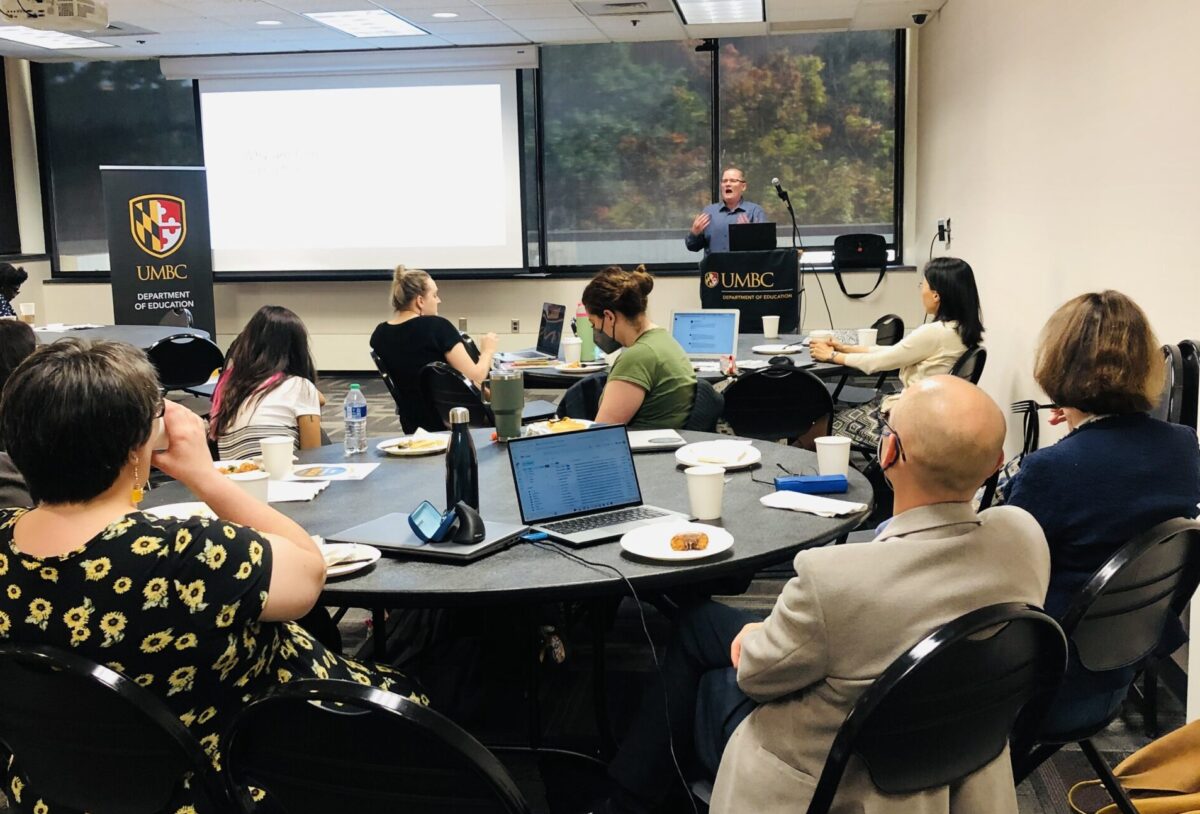
A professor speaks to a room full of people
Buendgens-Kosten speaking at UMBC’s Department of Education Research Seminar series organized by Francis Hult (in beige suit), graduate program director of UMBC’s TESOL program. (Image courtesy of Sauro)

“If you have people of different neurotypes in your language classroom, you should reflect their interests, their lived experience, communicative habits, communicative needs, and communicative interests,” Buendgens-Kosten explained to UMBC faculty at their Fulbright Scholar-in-Residence research lecture. “Sharing the experiences and needs of only the neurotypical majority cannot be the only measure of how and what we’re teaching. This also means that they deserve to see models of successful language users of their neurotype.”

Life-changing inclusion
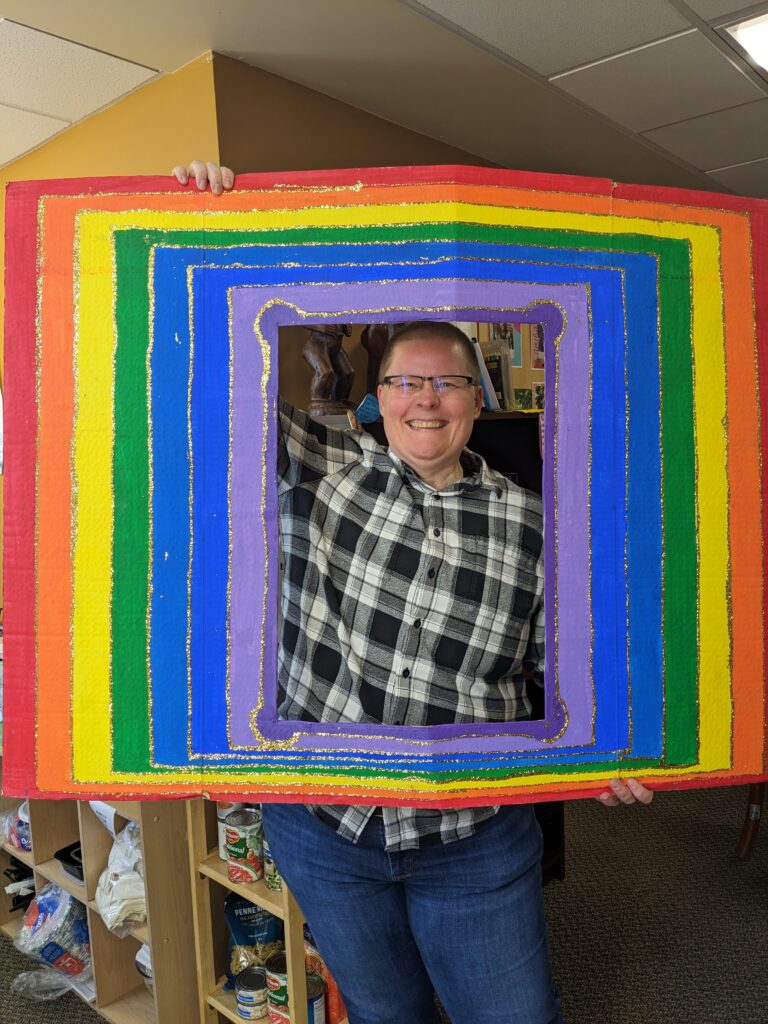
A person holds a large rainbow social media picture frame
Buendgens-Kosten at UMBC’s National Coming Out event.

While Buendgens-Koston was at UMBC, not only did they share their expertise, but they also learned about new technical tools to improve the learning process at the college level, such as UMBC’s Blackboard Ally, which improves content accessibility and usability. “The Ally accessibility feature really impressed me,” said Buendgens-Kosten, now back in Germany where they shared the tool with their IT team. “I liked that people could add a recording of their name to their official profiles—this is very helpful when you have a name like mine.” 

Buendgens-Kosten also enjoyed the inclusivity of campus events. “When you log into myUMBC, there are events across all disciplines, for students, for staff, etc.,” said  Buendgens-Kosten. “At my university, I know what is offered by my institute, or maybe even my faculty, but I see much less of what is going on in other parts of the university.” They also were surprised that UMBC celebrated National Coming Out Day and commemorated Trans Day of Remembrance, something they say is missing at Goethe University.

“My Fulbright experience at UMBC deeply impacted how I view the university as a community and place of learning,” says Buendgens-Kosten. “I experienced different ways of teaching and interacting with students. Such small-seeming things can make a surprisingly big impact.

Sauro says UMBC’s first Fulbright Scholar-in-Residence has inspired other faculty to apply to welcome another Scholar-in-Residence. “I think this is a wonderful opportunity for internationalizing at home and fostering the exchange of ideas with scholars from different parts of the world,” says Sauro.

UMBC’s future in neurodiversity research

A grandparent hugging their grandson
Canale with his grandmother, Lillian Michalina Canale.

For Canale, learning from Buendgens-Kosten was yet another confirmation of how life-changing inclusion can be. He wishes inclusive teaching had been offered when his Deaf grandmother was growing up. Lillian Michalina Canale depended on her grandson and the rest of her family to navigate life in a hearing world. “When I enrolled in a sign language interpreter undergraduate program, my grandmother was amazed that there was formal education for sign language,” says Canale. “It was then that I realized I had been interpreting since I was nine, but had no clue. I was just telling others what Grandma said, and I’m telling Grandma what they said.” It was the foundation for his career.

The end of Buendgens-Kosten’s visit was bittersweet for Canale. “There isn’t anyone like them at UMBC right now,” says Canale. He’s grateful to have grown the disabilities services program over the last 10 years that he’s been here. However, he knows the possibilities are exponential. “It may begin with having a conversation about accommodations but UMBC has the potential to lead in accessibility and inclusion research in every field of study because neurodivergent students, professionals, clients, and consumers encompass all parts of life.” 


The Institute of International Education, which manages the Fulbright Scholar-in-Residence program, has selected UMBC’s Center for Global Engagement (CGE) to facilitate the pre-departure orientation for all Scholars-in-Residence globally working at universities across the United States. This June, 43 scholars will participate in a three-day virtual orientation. CGE staff will lead sessions on various topics including campus and community engagement and networking led by Madison Pickard M.A. ’24, intercultural communication, a 2022 Shriver Peace Worker, and a graduate assistant and special programs coordinator. Classroom management led by Ryan Sheldon, director of the English Language Institute and Special Programs. Diversity and inclusion on a U.S. campus led by Viridiana Colosio-Martinez ’22, modern languages, linguistics, and intercultural communication, and M.A. ’24, intercultural communication. Intercultural communication led by Brian Souders, M.A.’19, TESOL and Ph.D. ’09, language, literacy and culture, the associate director of global learning. The U.S. higher education system led by David Di Maria, associate vice provost for international education.

Learn more about UMBC’s TESOL program and the Center for Global Engagement.
Ryan Bloom, English, receives 2024 Guggenheim Fellowship for translation

Ryan Bloom, senior lecturer in English, has received the 2024 Guggenheim Fellowship for translation to work on the first complete edition of the French-Algerian author Albert Camus’s notebooks, journals, and other works. This year, 188 grants were awarded from more than 3,000 applicants from over 52 academic disciplines across the U.S. and Canada. Fellows are provided funding to freely pursue their creative projects through their unique process without any special conditions. 

“In many ways, the situation Camus experienced in post-World War II Paris bears similarities to our own times here in the States. To give just one example, one of Camus’s great fears was a world where, in support of ideology, people were willing to excuse, if not actively cheer, the murder of other human beings,” says Bloom. “We need only turn on the news or scroll through our social media feeds to understand how some might feel that same fear today.”

Bloom has been translating Camus’s work for more than a decade. Most recently, he completed translations of Camus’s North and South American journals, Travels in the Americas: Notes and Impressions of a New World (Chicago University Press, 2023) as well as Camus’s Caligula and Three Other Plays (Penguin Random House, 2023). His translation of Albert Camus’ Notebooks 1951 – 1959, (Ivan R. Dee Publishing, 2008) was a finalist for the French-American Foundation and the Florence Gould Foundation’s Translation Prize for outstanding published English translations of prose originally written in French; his translation of Travels in the Americas is again a finalist for this year’s prize, to be awarded in June. Bloom notes that his drive to translate Camus’s work stems from the relevance the author’s work still has today, more than 65 years after Camus received the Nobel Prize in Literature in 1957.

“Humanity faces some profound existential challenges,” said Edward Hirsch, award-winning poet and president of the John Simon Guggenheim Memorial Foundation. “The Guggenheim Fellowship is a life-changing recognition. It’s a celebrated investment into the lives and careers of distinguished artists, scholars, scientists, writers, and other cultural visionaries who are meeting these challenges head-on and generating new possibilities and pathways across the broader culture as they do so.”

In 2017, Deborah Rudacille, professor of the practice in English, was the first UMBC faculty to receive a Guggenheim Fellowship. Rudacille received it for science writing.

“Ryan Bloom’s Guggenheim shows the wide range of research and teaching that takes place in the English department,” says Jessica Berman, professor of English and director of the Dresher Center for the Humanities. “That students have access to a translator of Ryan’s caliber when they sign up for his composition or creative writing classes and have the opportunity to learn from his careful approach to language adds immeasurably to their experience. UMBC is very lucky to have him in our midst.”

Learn more about UMBC’s English department.

Students inspire William Blake’s paper on constitutional amendments in the prestigious ‘American Political Science Review’ 

The American Political Science Review, the leading political science peer-reviewed journal,  published “Social Capital, Institutional Rules, and Constitutional Amendment Rates,” a new research article by lead author William Blake, associate professor and associate chair of political science. 

The study addressed why some constitutions are amended more frequently than others. The team gathered data from democratic constitutions worldwide and U.S. state constitutions for a cross-sectional and longitudinal analysis of the effect social capital has on how often constitutions are amended. The findings show social capital like group membership, civic activism, and political trust can create a more favorable political environment for amending constitutions. 

“Unlike previous studies, we demonstrate how these factors affect constitutional reform over time and across the stages of the amendment process,” the authors write. “We also build upon prior research that finds social capital facilitates social movement organization and elite coalition formation.” 

The research was inspired by Blake’s Contemporary Constitutional Conflict honors seminar. “The students read and critiqued a flawed article looking at the effect of constitutional culture on amendment frequency, which led me to think that I could conduct a better study,” says Blake. He also assigned a draft of the article the next time he taught the seminar. The students of the Honors College received an acknowledgment in the article.

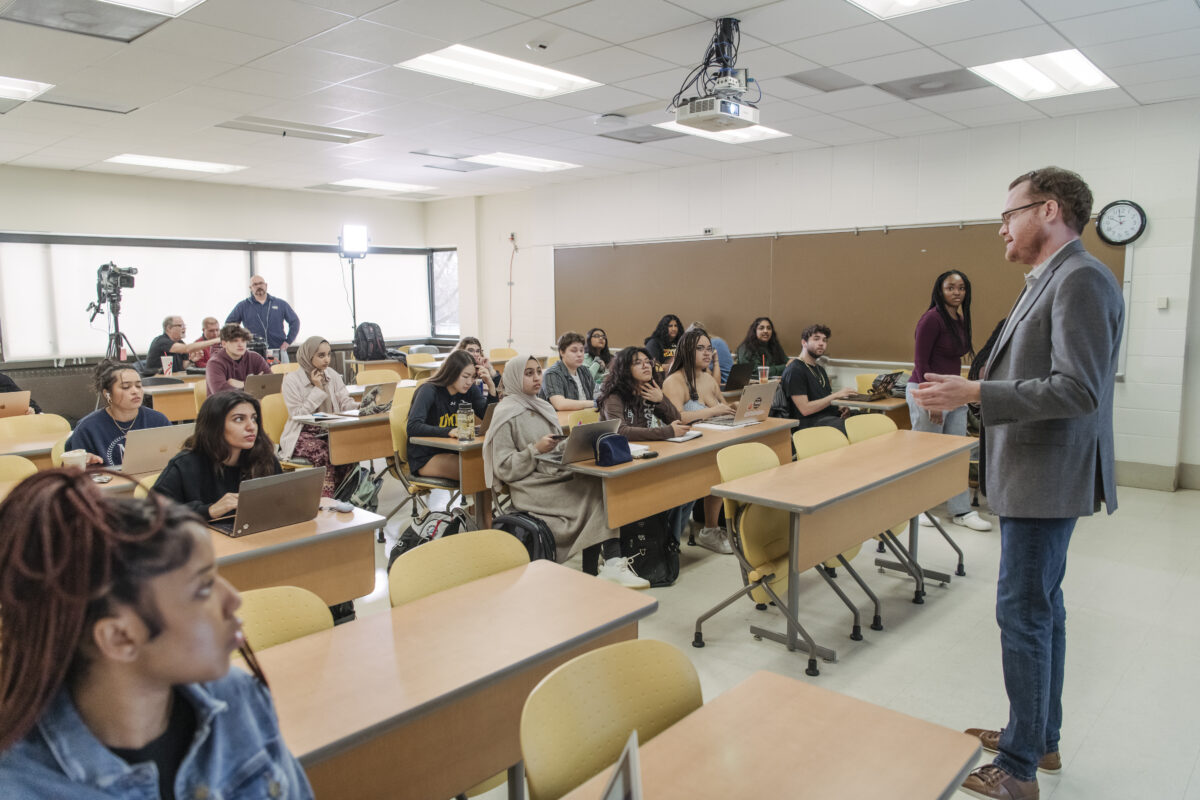
William Blake, a college professor, gives a lecture in a class full of students.
Blake’s “Women and Employment Laws in the Early 20th Century” class on laws regulating minimum wages and maximum hours for female workers on C-SPAN’s “Lectures in History” series. (Marlayna Demond ’11/UMBC)

Blake is the only UMBC faculty to publish in The American Political Science Review since Nicolas Miller, professor emeritus of political science, published “Pluralism and Social Choice” in 1983.

Blake’s co-authors for the journal article are Joseph Francesco Cozza, assistant teaching professor of political science and associate director of the Politics, Law, and Social Thought program at Rice University; David A. Armstrong II, associate professor of political science at The University of Wisconsin–Milwaukee; and Amanda Friesen, Canada research chair in political psychology at Western University in Canada.

Watch Blake’s “Women and Employment Laws in the Early 20th Century” class on laws regulating minimum wages and maximum hours for female workers on C-SPAN’s “Lectures in History” series. Enroll in his POLI 220: The Constitution and American Democracy summer course.

Nancy Kusmaul, social work, receives “Outstanding Individual in Academia” award from the Congressional Research Institute for Social Work and Policy 

Nancy Kusmaul, associate professor of social work, a scholar and advocate for the rights of older adults and professional caregivers, received the “Outstanding Individual in Academia” award from the Congressional Research Institute for Social Work and Policy in March 2024 at a ceremony on Capitol Hill. Kusmaul’s work is informed by her 10 years of experience as a social worker and over a decade of novel scholarship. 

As co-chair of the Committee on Aging for the Maryland Chapter of the National Association of Social Workers, Kusmaul helps advance programming for seniors, professional development for social workers in the aging field, and inform policy and legislation. In 2019, Kusmaul served as a  Health and Aging Policy Fellow at the office of U.S. Senator Ron Wyden and the Centers for Medicare and Medicaid Services learning about how Congress and the executive branch create policies that affect care for frail older adults. 

Social work advocacy and policy

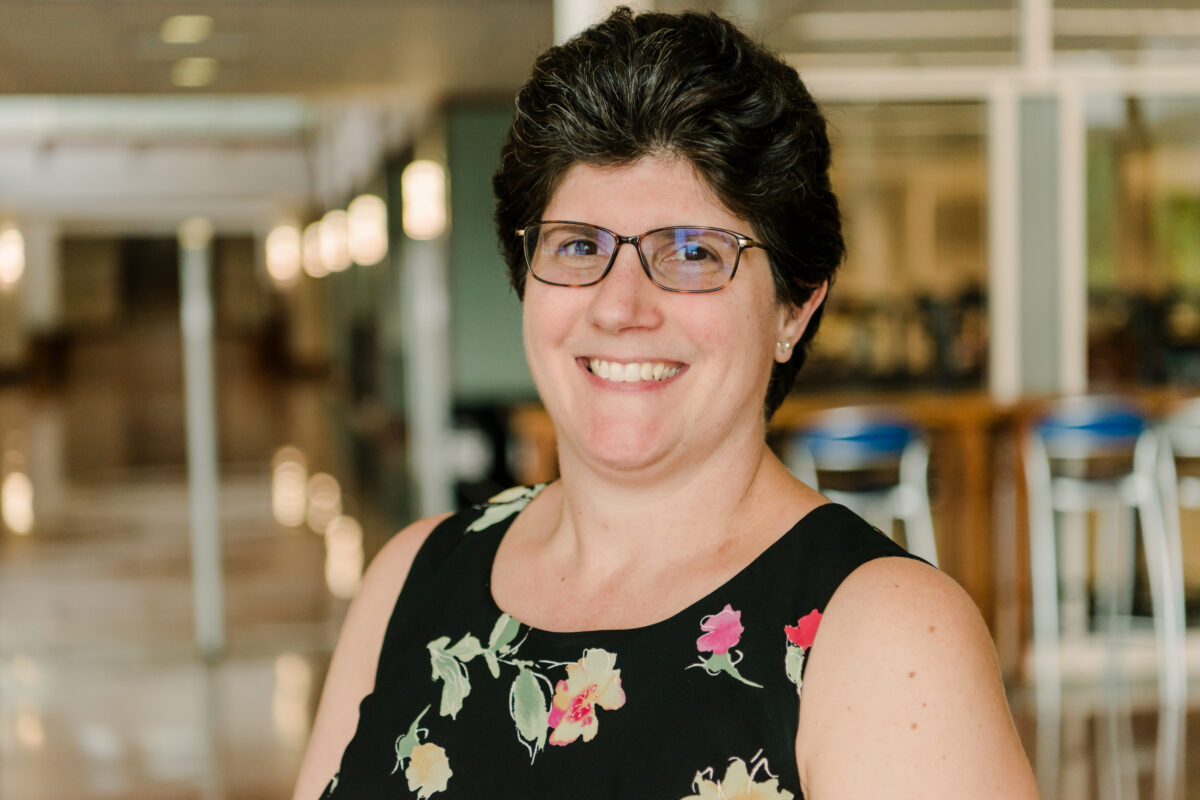
An adult with short black hair, brown rimmed glasses, and a short sleeve black blouse with flowers stands inside a cafeteria with chairs in the background
social work
Nancy Kusmaul (Marlayna Demond ’11/UMBC)

“During my time as a nursing home and hospital social worker, I witnessed the day-to-day impact of policy on practice, when families had to choose between the best of less-than-desirable options. As a scholar, I answer questions and promote policies to improve those options,” says Kusmaul. Her research and advocacy focus on improving nursing home care and organizational culture as well as the understanding of trauma experiences on direct care workers, care recipients, and their families.

 “Advocacy is a central tenet of social work, and this award recognizes my time, collaboration, and leadership in this area on behalf of older adults and their families,” says Kusmaul who recently published “Let’s cut out the ageism and the notion of getting ‘too old’” in the Baltimore Sun.

Kusmaul’s first textbook, Aging and Social Policy in the United States, is one of the first textbooks designed to provide students with an in-depth understanding of the conditions and policies at the local, state, and federal level that affect the rights and interests of senior citizens.

Measuring nursing home care

Her work continues in the classroom and the “lab” as a co-investigator in a new interdisciplinary research project with principal investigator Roberto Millar, M.A ’19, sociology, Ph.D. ’20, gerontology, a policy analyst advanced at The Hilltop Institute at UMBC, and co-investigator, Ian Stockwell, associate professor of information systems. For the first time, the researchers will also combine data from the Centers for Medicare and Medicaid Services’ Care Compare database and results of the Maryland Family Satisfaction Survey. The survey assesses the experiences of family members with loved ones in Maryland nursing homes and, Kusmaul’s research, offers a unique approach to measuring quality of care.

“There are no national measures of nursing home quality that consider the experiences of family members,” she explains. “When we think about what quality is and the outcomes we’re measuring, we have to think about the different perspectives of what is good nursing home care.”

Halaevalu Fonongava’inga Ofahengaue Vakalahi, president and chief executive officer of the Council on Social Work Education, who attended the March event in D.C., said, “This award is absolutely well-deserved because Nancy is a champion of all things aging and gerontology. There could not be anyone more fitting for this award!”

Learn more about UMBC’s School of Social Work.

The Mellon Foundation awards UMBC’s Gender, Women’s, and Sexuality Studies department $100,000 as part of its ‘Affirming Multivocal Humanities’ initiative

UMBC’s Gender, Women’s, and Sexuality Studies (GWST) department has received a $100,000 grant from the Mellon Foundation to implement its Advancing Gender and Sexuality Studies in Community project. UMBC is one of 95 public colleges and university programs leading research on race, ethnicity, gender, or sexuality to receive funding from the Mellon Foundation’s $18 million “Affirming Multivocal Humanities” initiative.

“[The] initiative champions the scholarship and teaching taking place in these disciplines—those that are too often undervalued and even undermined in American society today,” says Elizabeth Alexander, president of the Mellon Foundation. “We are proud to support colleges and universities in the United States advancing deep research and curricular engagement with the stories and histories of our country’s vastly diverse racial, ethnic, and gender identities.”

Advancing GWST

The Advancing Gender and Sexuality Studies in Community project broadens three programs. The UMBC LGBTQ+ Oral History Project, the Korenman Lecture series, and social change-skills development workshops. “This Mellon funding enables our students, faculty, and staff, to further expand our pedagogical and community-building work around critical sexuality studies,” says Vrushali Patil, chair and professor of GWST. “It also enhances how GWST helps realize UMBC’s goal of inclusive excellence.”

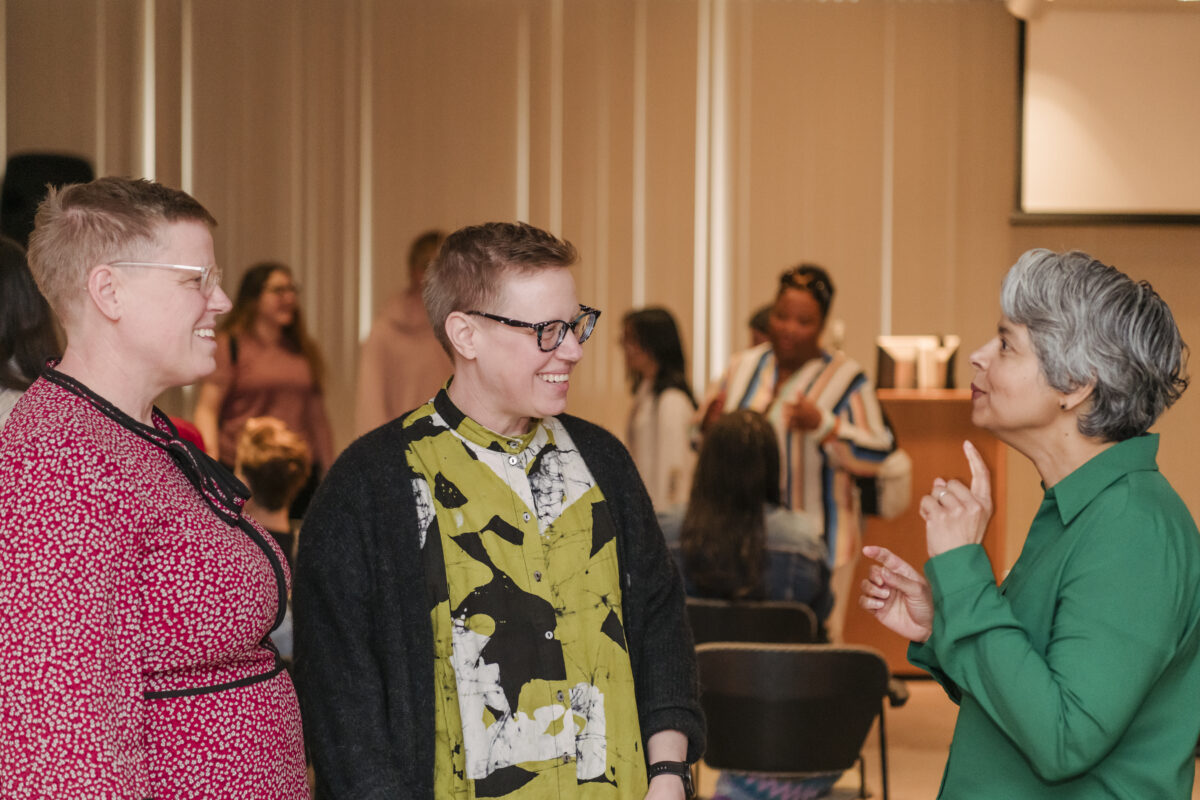
Three adults inside a lecture room smile as they talk to each other gender women's and sexuality studies
(l-r) Kate Drabinski, Emily Drabinski, president of the American Library Association, and Vrushali Patil. (Maryland Demond ’11/UMBC)

The oral history project trains undergraduate students on oral history interview skills with community members such as the Charm City Kitty Club, a queer femme cabaret; Prettyboi Drag, a queer of color drag king troupe in the Baltimore and Washington, D.C. region; as well as queer UMBC community members. It is archived in the UMBC Albin O. Kuhn Library Special Collection.

“Students are building the oral history archive I wish I had as a researcher in Baltimore queer history,” says co-principal investigator Kate Drabinski, principal lecturer in GWST. “The grant will pay for more basic equipment and training.”

The annual Korenman Lecture series brings scholars, activists, and artists to campus for talks on cutting-edge topics in GWST and includes student workshops on related topics. Over the next three years, GWST will host three additional Korenman Lectures focused on transgender sexual politics, reproductive justice, decolonizing health, and sexuality and the carceral state.

The third program includes six social justice workshops for faculty and students. They will explore approaches to organizing such as running for political office, identifying social justice issues, zine making, and social media for social justice. 

“The Affirming Multivocal Humanities grant provides an incredible opportunity to expand our ongoing work of challenging gender, sexuality, and race-based systems of oppression,” says Carole McCann, principal investigator and professor of GWST.

Additional GWST faculty participating in the grant: María Célleri, assistant professor; and Kathryn Kein, lecturer; and Courtney Cook, visiting lecturer. 

Learn more about UMBC’s Gender, Women’s, and Sexuality Studies.

CAHSS dean establishes a $400,000 education abroad scholarship  

CAHSS students, are you ready to study abroad? Kimberly Moffitt, dean of the College of Arts, Humanities, and the Social Sciences (CAHSS), has established the CAHSS Dean’s Education Abroad Scholarship.  

The scholarship guarantees $100,000 per year for the next four years to help offset the financial costs of studying abroad. Undergraduate and graduate students with at least one major in CAHSS, and who need additional financial support to study abroad can apply for awards ranging from $1,500 – $5,000. The inaugural round of scholarships have been awarded to 24. 

Power of education abroad

Joseph Patarini ’25, environmental science and geography, is one of the CAHSS Dean’s Education Abroad Scholarship recipients. “Studying abroad is important to me because gaining a diverse global perspective is paramount to solving today’s top environmental issues. By getting outside of our comfort zone and exploring new academic opportunities we can deepen our understanding of global interconnectedness,” says Patarini, who will study in Morocco and Spain in summer 2024., “We can learn from new, diverse perspectives to enhance our problem-solving skills, contributing to a more holistic and adaptable approach.”

This grant makes it possible for me to study abroad and make the most of my undergrad experience,” says Ria Smith ’25, dance, CAHSS Dean’s Education Abroad Scholarship summer 2024 recipient to Italy. “I really appreciate how the College of Arts, Humanities, and Social Sciences is showing real commitment to the value of international exposure.”

For additional eligibility details contact the Education Abroad Office at educationabroad@umbc.edu. Scholarship applications for the 2024 – 2025 academic year are due September 10, 2024.

Mellon Foundation grants CAHSS $750K to establish Global Asias Initiative 

Kimberly Moffitt, dean of the College of Arts, Humanities, and Socials Sciences, and co-pi Tamara Bhalla, associate professor of American studies and director of the Asian American studies minor, have been awarded a $750,000 grant from the Mellon Foundation to establish the Global Asias Initiative. The initiative will support the rethinking of Asian American issues on campus in a global, diasporic, and collaborative framework through community-engaged, public-facing scholarship and teaching.

“The impact and influence of the Asian diaspora in this region makes it clear that our world has more to offer in providing valuable opportunities for our students, while also creating additional partnerships with the greater Baltimore community,” says Moffitt.

Two college students stand by a table while talking to a professor who is sitting down at the Global Asias launch
(l-r) Emily Yoon and students at the Global Asias Initiative launch workshop.
(Abnet Shiferaw)

UMBC’s existing Asian studies program and Asian American studies minor will grow into a more expansive Global Asias program that better serves and represents UMBC’s Asian American community, interested students, and beyond. This includes launching an undergraduate community-based research fellowship in Global Asias and the conversation series “Reframing Global Asias,” which invites prominent leaders, scholars, and community members in the field to present and discuss key issues, possibilities, challenges, and new research.

“Together,” says Bhalla, “we will create a forum for engaging in difficult yet productive intellectual conversations in Asian American studies, Asian diaspora studies, and Asian studies.” 

A group of seven adults stand side by side for a picture inside in a hallway with windows in the background
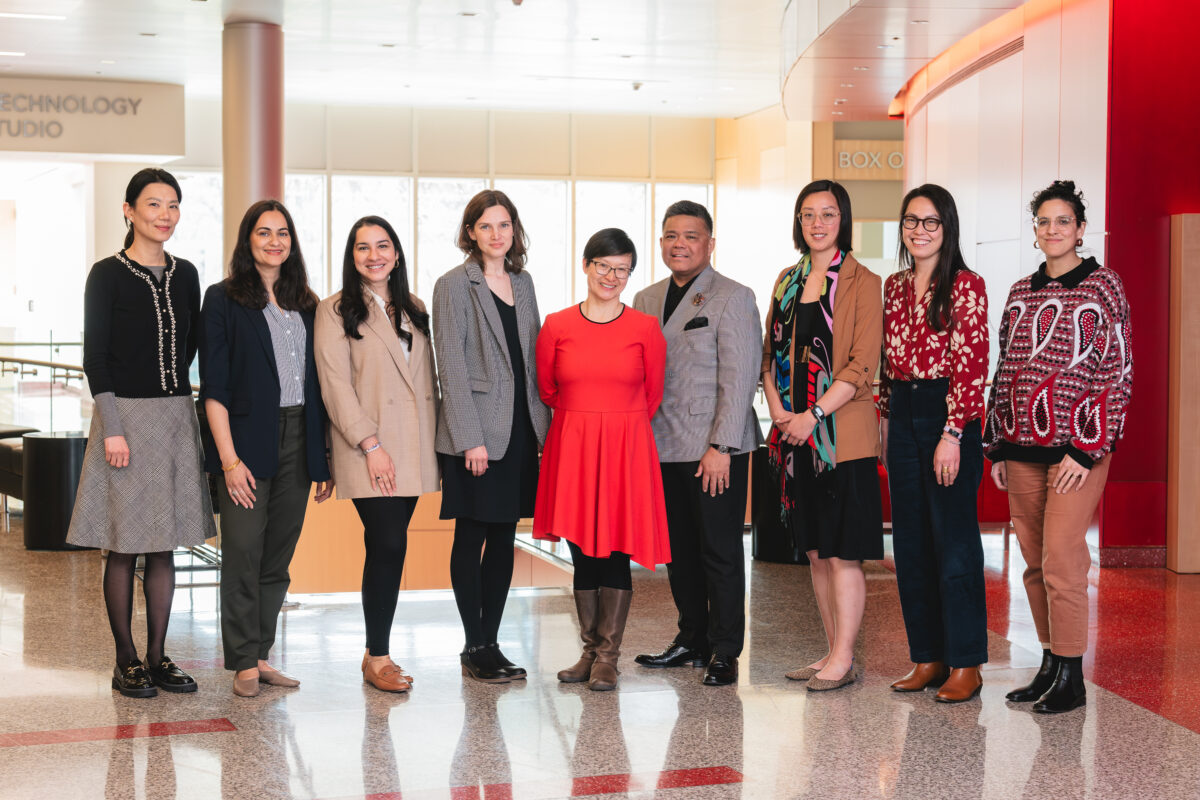
Global Asias Advisory Board, AY2023-2024. (l-r) Tamara Bhalla, Noor Zaidi, Meredith Oyen, Fan Yang, Theo Gonzalvez, Emily Yoon, and Priya Bhayana, project manager for the Global Asias Initiative. (Abnet Shiferaw)
Faculty across UMBC are collaborating to bring the Global Asia Initiative to fruition along with community partners:
  • Meredith Oyen, associate professor of history and director of the Asian studies program
  • Shin Yon Kim, Asian studies lecturer
  • Fan Yang, associate professor of media and communication studies
  • Emily Yoon, assistant professor of English
  • Noor Zaidi, assistant professor of history
  • Christopher Tong, associate professor of modern languages, linguistics, and intercultural communication
  • Theo Gonzalves, former American studies chair and professor, curator of Asian-Pacific American history at the Smithsonian National Museum of American History
  • Robbin Lee ’13, visual arts and media and communications studies, director of partnerships and mobilization at UpSurge Baltimore

Learn more about the Global Asias Iniatiave and Asian studies program.

Urban development simulation helps students learn how to balance growth, equity, and environmental sustainability 

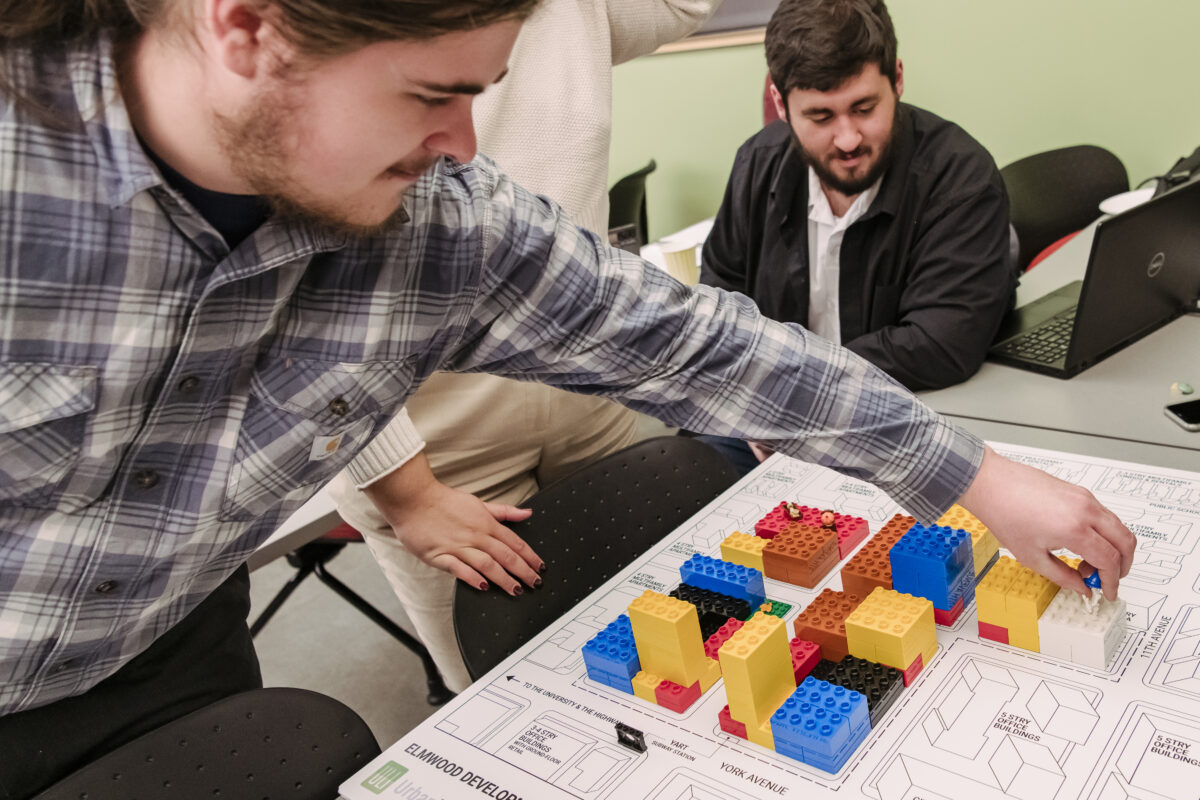
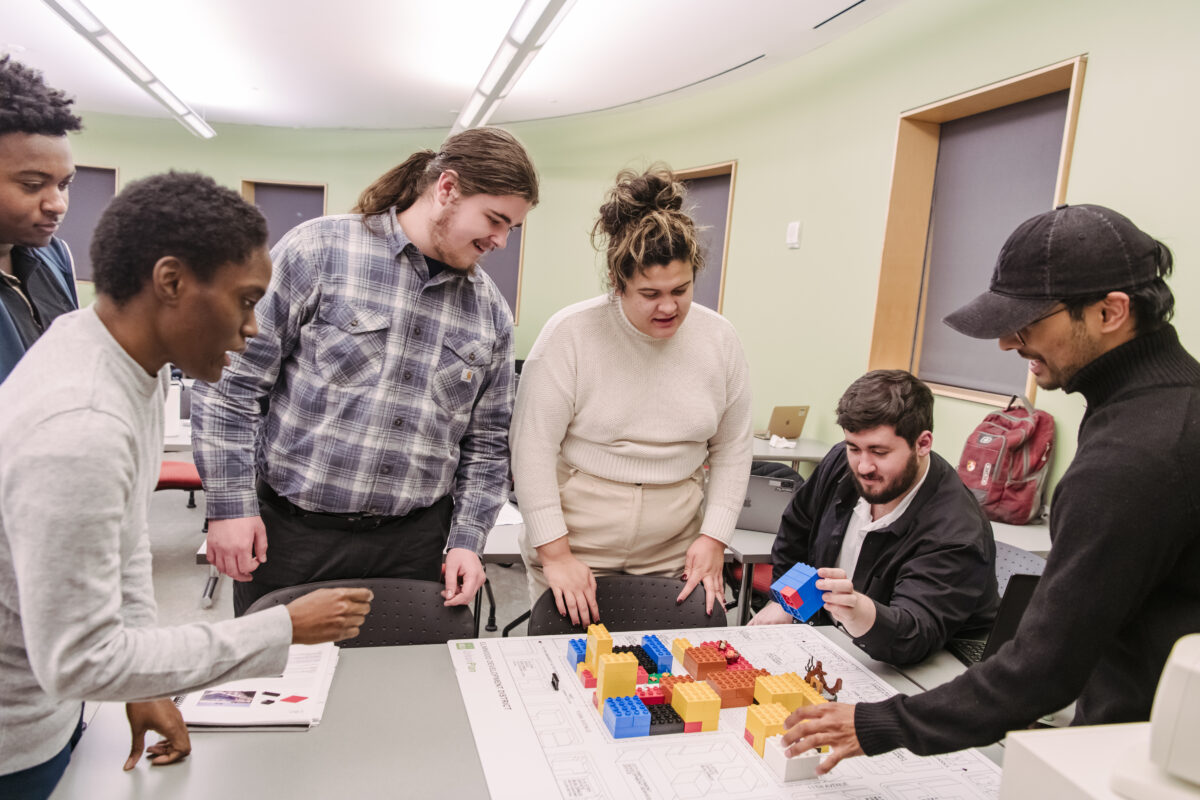
Urban development firms Future Roots and Team Elle Woods are competing to win the City of Yorktown’s Elmwood District urban redevelopment project. The teams hover over their LEGO-built cities moving black, blue, red, and orange bricks representing new parking garages, low and high-rise office buildings, retail spaces, housing, and historic buildings. The site planners, financial analysts, marketing directors, environmental and equity directors, and community liaisons are mapping out neighborhood layouts that will entice former residents to return, draw professionals, and bring businesses to the once-thriving neighborhood.

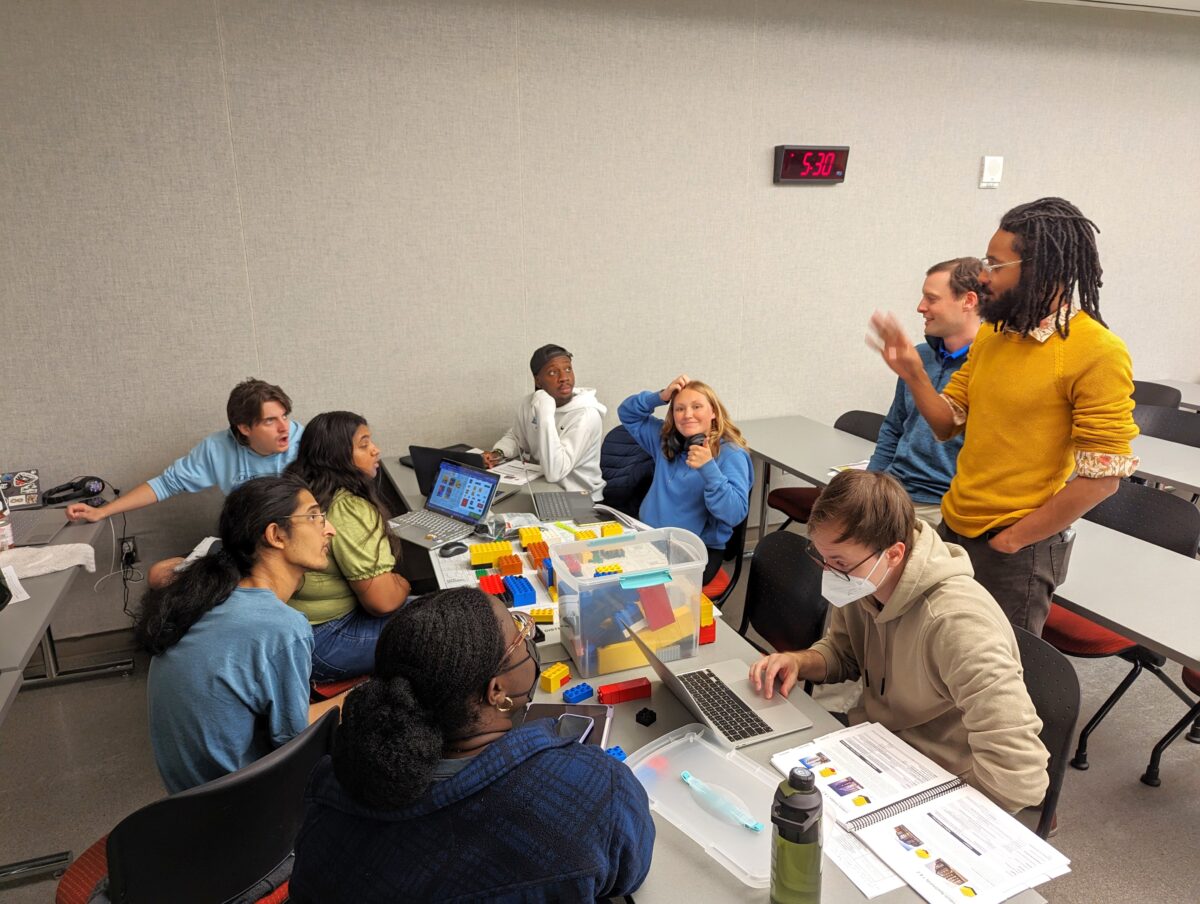
The firms’ offices are on the first floor of UMBC’s Performing Arts and Humanities Building. This is POLI 443 Urban Policy Analysis where two groups of students, seven on each team, spend six weeks developing a hypothetical urban redevelopment plan based on their understanding of urban policy, problems, and solutions. The teams then compete for the winning bid—that is, the green light of industry experts who’ve come to campus to judge their proposals.

A classroom of college students sitting at long grey tables working on their laptops.
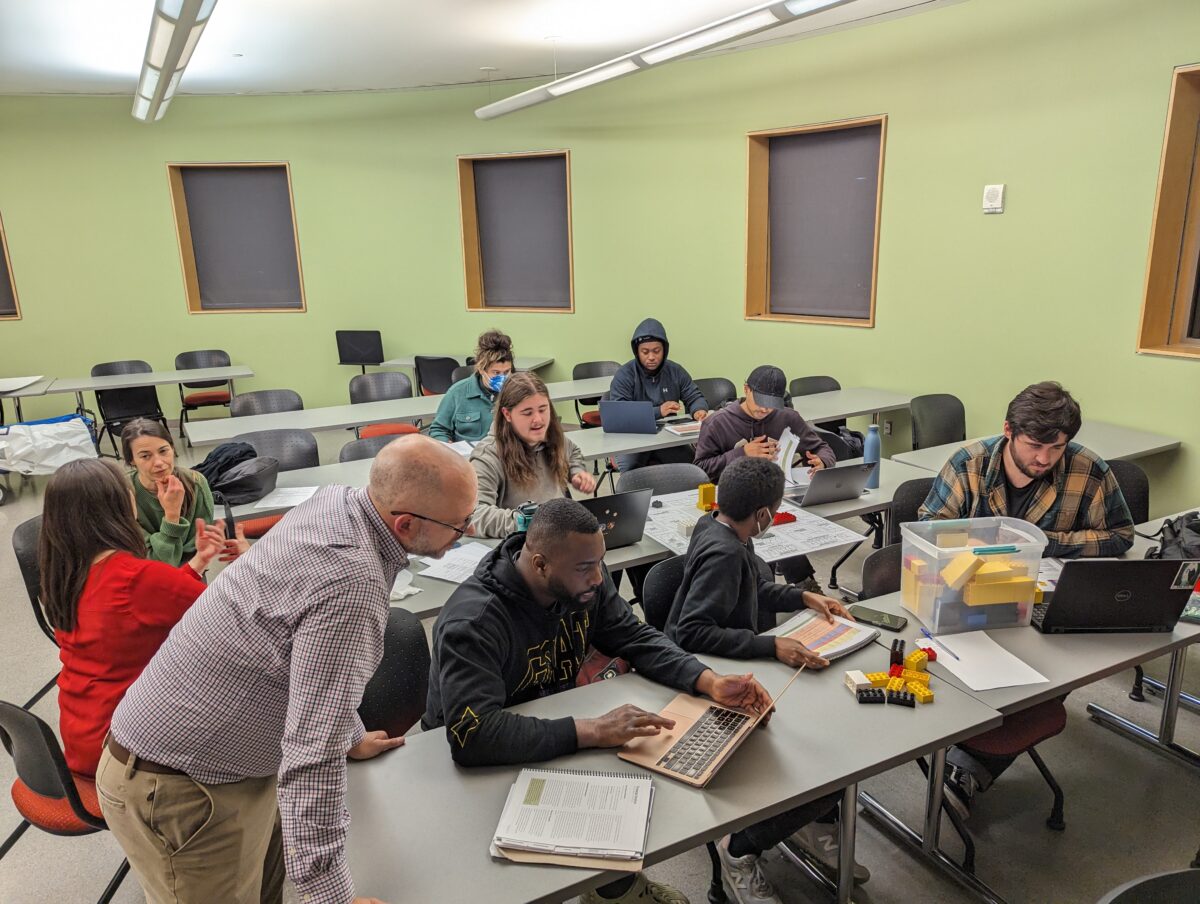
Eric Stokan (standing) with students during the semester as they brainstorm city designs. (Image courtesy of Stokan)

Building a vision

“I could lecture students about the ethical, financial, structural, and environmental issues cities grapple with in the land redevelopment process, but simulations create an entirely different learning process,” says Eric Stokan, associate professor of political science. Always looking for ways to make community development concepts more engaging, Stokan worked for several years on developing an urban development class simulation.

Around this time, Ghadeer Mansour ’13, political science, senior associate at the Urban Land Institute (ULI), reached out to her former political science professor, Carolyn Forestiere seeking a faculty member who might be interested in ULI’s UrbanPlan simulation curriculum program. ULI is a nonprofit global network of professionals in every real estate development and land use sector, focusing on decarbonization and net zero, increasing housing attainability, and education. The UrbanPlan exercise requires students to design a realistic land use redevelopment plan, including a 3-D city model, that addresses private and public sector needs and wants.

Three people dressed in business clothing stand around a table analyzing a LEGO-built urban development neighborhood.
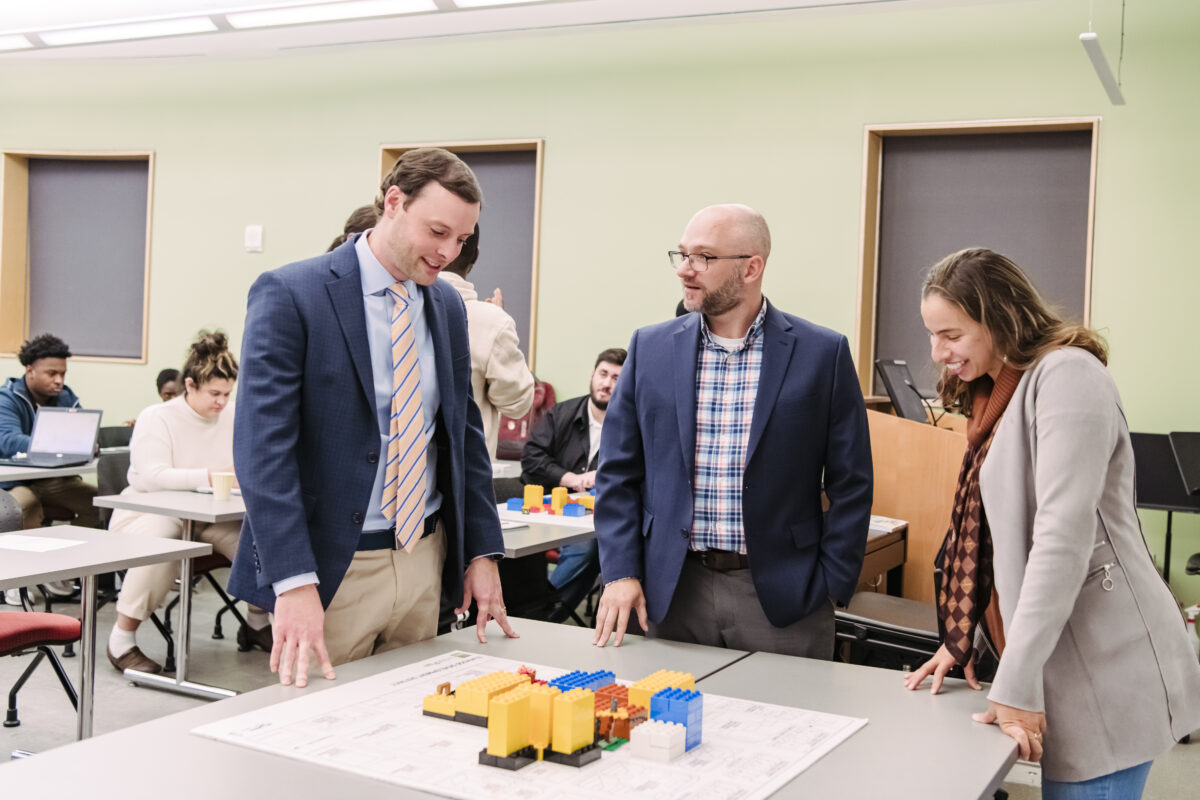
(l-r) Perry Mahle, a project manager at the Whiting-Turner Contracting Company and co-chair of the Urban Plan, with Stokan and Mansour. (Marlayna Demond ’11/UMBC)

Forestiere suggested Stokan to Mansour. “ULI had thought of everything a student needs to understand urban development. They had a whole step-by-step manual with tabs for the history of the town, design guidelines, site plan, roles, letters from residents, a glossary of terms, and a presentation checklist,” says Stokan. He first completed a condensed version of the simulation as a participant followed by a training tailored to educators adopting the simulation into their classroom.

“The simulation gives students a critical take on how to better balance equity and economic growth, and what that means for affordable housing,” says Stokan. “They have to confront those trade-offs and understand it’s not an all-or-nothing thing. They have to be able to balance growth, equity, and environmental sustainability.”

Balancing the books

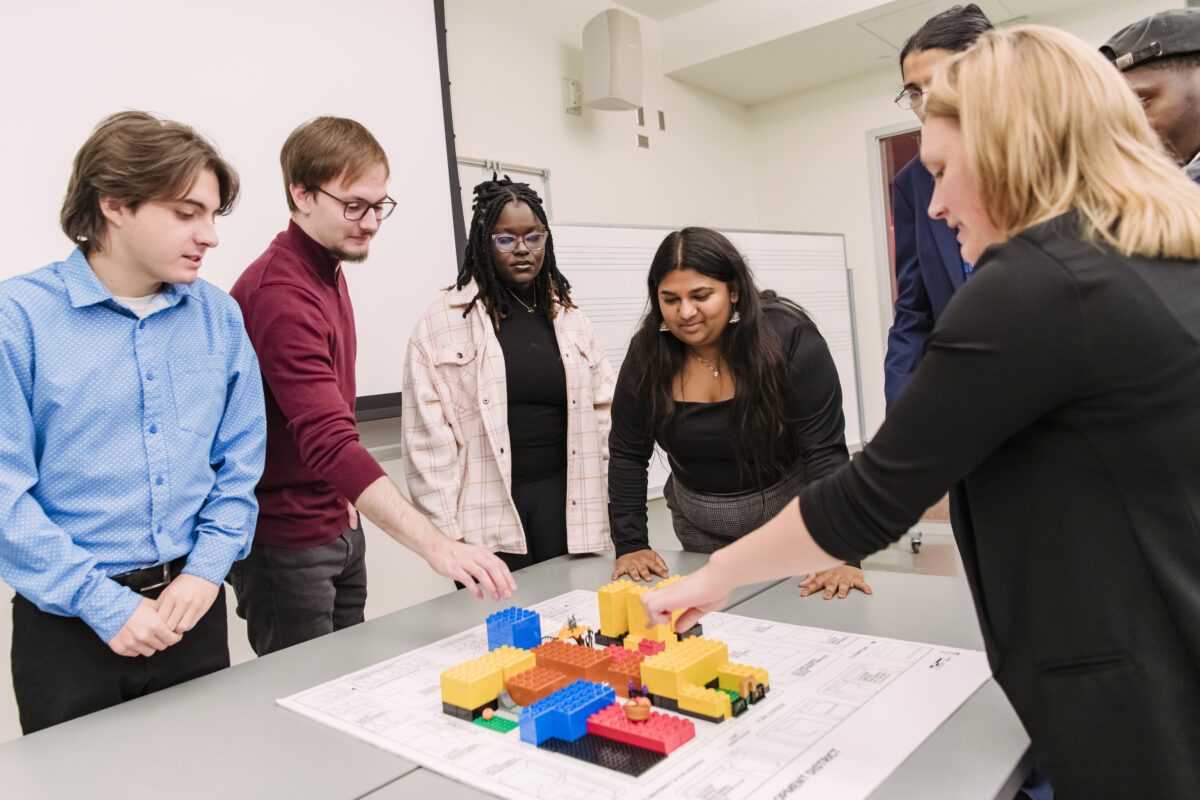
Cooperation, teamwork, and compromise are necessary for sustainable development. International student Florian Dambacher, listens intently to Alex Schultz ’25, political science, the environmental and equity director; Sam Kennedy ’26, social work, the neighborhood liaison, and Meghna Chandrasekaran ’24, political science, the site planner as he calculates the expenses. His job is to ensure the team’s ideas for creating a sustainable, economically vibrant, distinctive district stay within the city’s budget requirements and profit projections while ensuring the designs encourage cross-generational interactions that maximize the surrounding commercial, educational, and cultural resources. 

A group of college students pointing at a colorful LEGO-built city.
Florian Dambacher (in red) with Team Elle Woods. (Marlayna Demond ’11/UMBC)

“It was a bit daunting at first. You have all these different requirements. You have the city that wants something from you, the investors you have to answer to who have interest groups in the community that have demands, needs, and wants,” says Dambacher. Today he is the student, but when he returns home to Technische Universität Dortmund in western Germany, Dambacher plans on using this teaching tool with his high school students. He feels this kind of simulation can be a powerful tool in any subject. “Teaching the theoretical side of a topic may be enough, but having a practical aspect has a more lasting impact on students,” says Dambacher.

Accessibility in motion

With two internships under his belt, one at the Frederick County Transit Planning Department and the other at the Maryland Transit Administration Planning Department, Travis Martin ’25, political science, was more than ready for his role as site planner. His previous experience proved indispensable as he brainstormed ideas with Aurora Quezada ’24, the neighborhood liaison, and Suhaib Mirza ’25, political science, environment and equity director.

A college student works on a LEGO city layout.
Travis Martin (left) works on Future Roots’ redevelopment map. (Marlayna Demond ’11/UMBC)

“A well-functioning transit system gives people the tools they need to be successful, to build a sustainable life,” says Martin, who enjoys exploring and analyzing transportation systems when he visits new cities. In the real world, he notes, there’s a lot more paperwork and sometimes years of deliberation before a development decision is made. The simulation made it possible for Travis to experience the entire proposal process. “Transportation is a social justice issue for me, not everyone is fortunate enough to have access to it.”

Defending the vision

On the day the industry professionals arrive to judge their projects, Team Elle Woods and Future Roots inspect every colorful block of their city model making sure it reflects their upcoming proposal. Stokan and Mansour are excited. This is what they have been looking forward to since they first connected. “Professor Stokan has been so welcoming and open about the whole process so that in many ways, students are leading the process themselves,” says Mansour. “Then we bring in professionals who do this planning work for their day jobs, and they mentor the students and help think through the trade-offs and issues they face as urban planners.”

A group of college students stand in front of a class presenting a power point
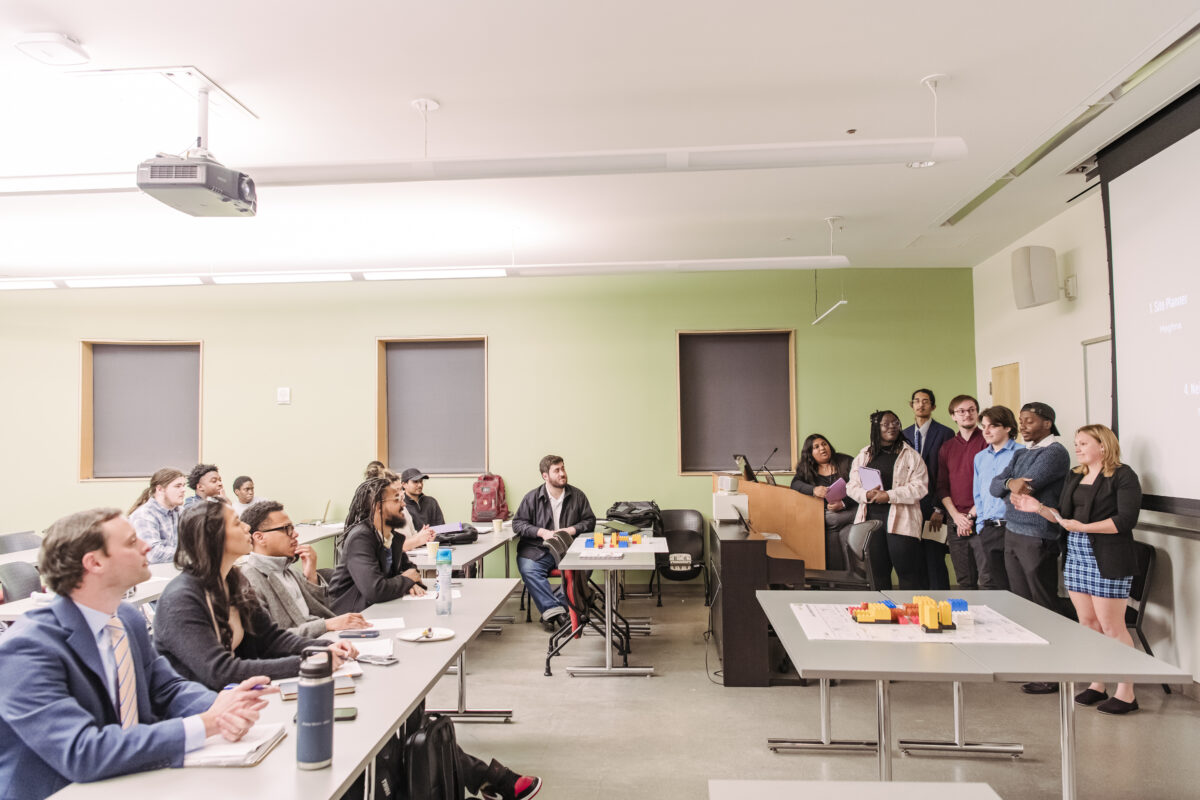
Team Elle Woods presents to the hypothetical city council. (Marlayna Demond ’11/UMBC)

Perry Mahle, a project manager at the Whiting-Turner Contracting Company, and Rose Dalay, operations and leasing specialist at SparkFlex, co-chairs of the UrbanPlan simulation, walk around the LEGO cities, chatting with students from both firms.

“Beyond meeting the metrics or asking the questions that the curriculum provides. I always try to ask questions to encourage students to evaluate their final decisions,” says Brennan Murray, assistant managing director of business and neighborhood development at the Baltimore Development Corporation. “Like in the real world, when industry professionals are presenting projects, you are going to get questions that call your thinking, your process, and your solutions into question. How students respond on the fly is a lesson in itself.”

Two adults talk with a group of college students in a classroom
(r-l) Brennan Murray (in yellow) and Perry Mahle guide students during the semester. (Image courtesy of Stokan)

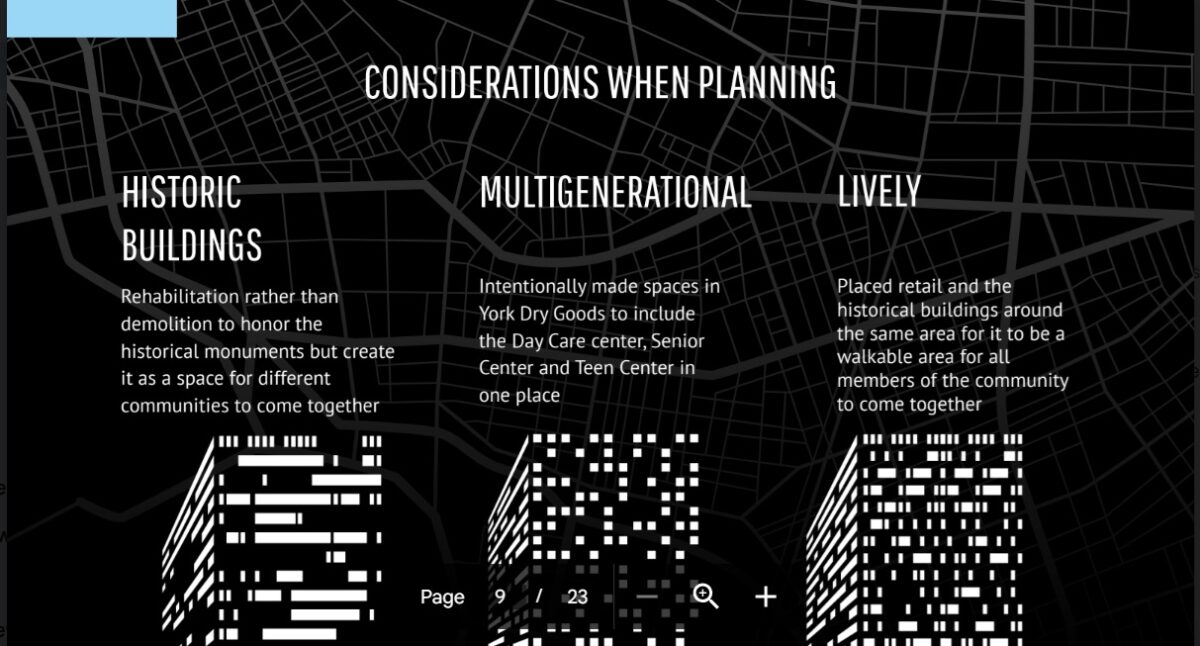
The two student firms stand before the council explaining their vision statements, site plan, and financial model. Team Elle Woods’ multimillion-dollar investment centers around multigenerational living, youth job development, and walkability.

Left: Team Elle Woods’ redevelopment plan. Right: Future Roots’ redevelopment plan.

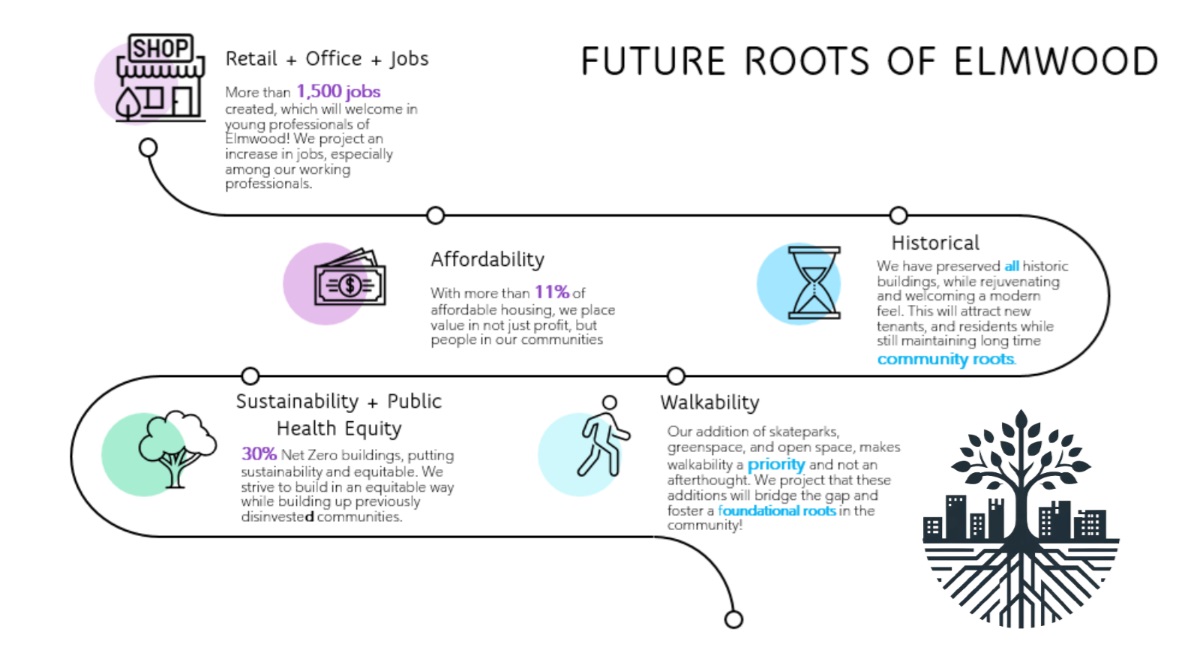
Future Roots’ plan is geared more toward walkability, integration of essential services, historic preservation, and environmental sustainability. The council demands a clear cause and effect for each item on the financial statement. They hone in on the long-term benefits every decision would have on the area’s multigenerational community.

Team Elle Woods won the bid on many grounds, but most importantly because their finances stayed in the green. Future Roots, while presenting a compelling case, resulted in debt. Martin, the transportation planner for the team, contested the decision, but ultimately he said, “The simulation was fun and made me feel like I was doing something important.”

Role vs. real-life

As the class prepared to celebrate the end of their project, Shanika Freeman ’24, individualized studies, reflects on what she describes as an eye-opening experience that will help her in her work as a leader in Baltimore City. She is well aware of the impact real estate development can have on a city. Freeman, who grew up in Baltimore City, says the real estate design choices historically driven by segregation—favoring white communities and ostracizing Black ones—have been linked to an increase in crime, incarceration, and recidivism.

Freeman is working on dismantling such inequalities as a member of the Baltimore County Public Library’s diversity, equity, and inclusion team. So when she was given the role of marketing director, Freeman initially didn’t want it. She was weary of the role marketing has played in the negative portrayal of urban neighborhoods.

A group of college students move LEGO blocks on top of a city map.
Shanika Freeman (left) with team Future Roots. (Marlayna Demond ’11/UMBC)

“I was put off by my role because I’m more into social justice, people over profit. Marketing and finance aren’t my thing. Having to shift my focus and my personal biases was really difficult, to be honest,” says Freeman. But she didn’t give up. She leaned in. “Once I dug deep into it, I got excited about it and came to understand that without money the city can’t build; if we can’t build, we can’t help more people. It’s a collaborative effort. I learned a lot about myself as a person and also about a career path that I might take in the future.”

The Urban Plan simulation will be a standalone class in the Honors College in fall 2024 and fall 2025. For more information, contact Eric Stokan: estokan@umbc.edu.

Dean Moffitt interviewed about media and Black hair and body politics

Kimberly R. Moffitt, dean of UMBC’s College of Arts, Humanities, and Social Sciences, speaks about the inspiration for and journey of her career in an interview with mastersincommunications.com, which offers research-based data on graduate programs in media and communication studies nationwide along with insights from leaders in the field.

Moffitt shares that one of the key inspirations for her work in media and communication studies is her children. Her research and discourse on colorism, her Black hair syllabus website, and her criticism of Disney’s programming have come from observing how her children and other children of color are perceived and talked about in media. She also analyzes the major challenges with feminism and her identity as a womanist.

“I do not consider myself a feminist. I do embrace and consider myself a womanist, as Audre Lorde discusses it, however. I believe in seeing the uplift of African Americans in this nation,” says Moffitt. “I think it takes all of us to make that happen, and I am not really interested in privileging or prioritizing my own existence as a Black woman over that of a Black man.”

Leadership and communication

The scholarship that fueled Moffitt’s career paved a path to leadership as a dean during a worldwide pandemic and global calls for social justice. Moffitt credits her skills and knowledge of media and communication in helping her navigate these challenges, with grace and patience.

“The beauty of being in a discipline like communication is that we have space to engage a set of theoretical frameworks and concepts that other disciplines cannot,” says Moffitt. “Some of that is because we are a much younger discipline than most, but it is also because we are dealing with a number of contemporary issues that allow us to speak back to society about things as they are currently going on.”

Learn more about Dean Moffitt’s additional work with the Mellon Foundation-funded Global Asias Initiative. 

Résumés in hand, 2,000+ hopeful and prepared Retrievers attend the 2024 Career Fair

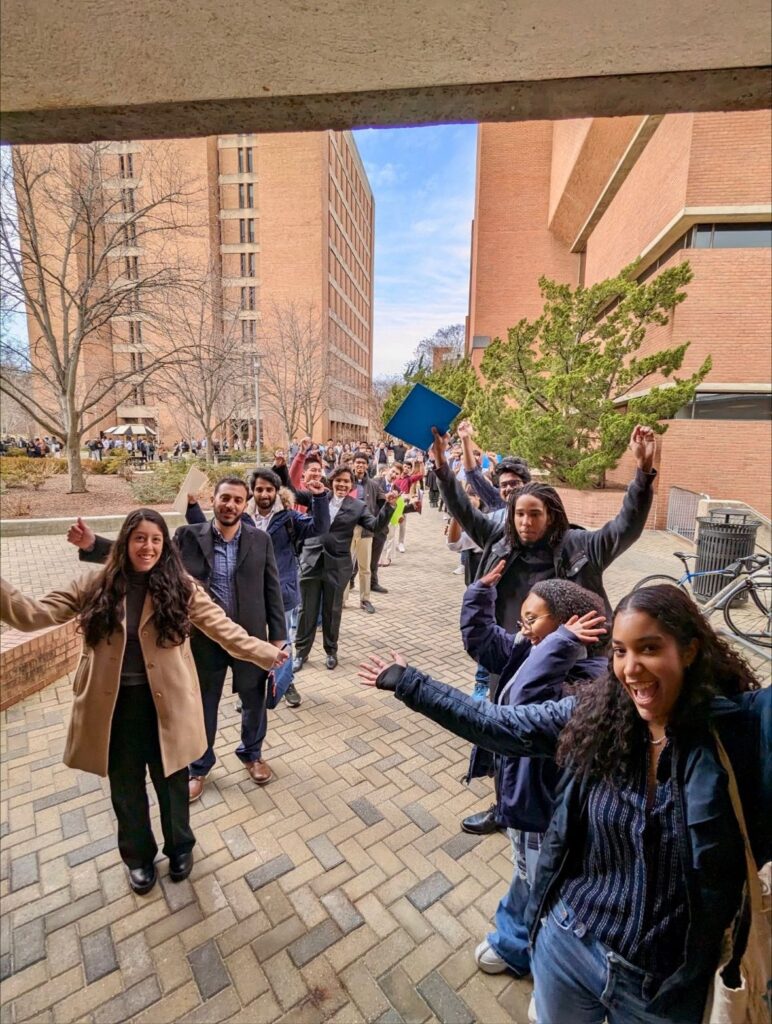
On a perfect 55-degree sunny February day, hundreds of undergraduate and graduate students across all colleges stood in a line that began at the RAC and wrapped its way to Sherman Hall. Instead of exercise gear, Retrievers were dressed to impress with résumés in hand, ready to land a summer internship or a job with one of the 180-plus employers across multiple industry sectors at UMBC’s Spring 2024 Career and Internship Fair.  

“We are excited to help employers develop a strong talent pipeline and diverse future workforce, shaping the leaders and innovators of tomorrow,” said Paige Bauder, associate director of employer relations and recruitment programs at UMBC. 

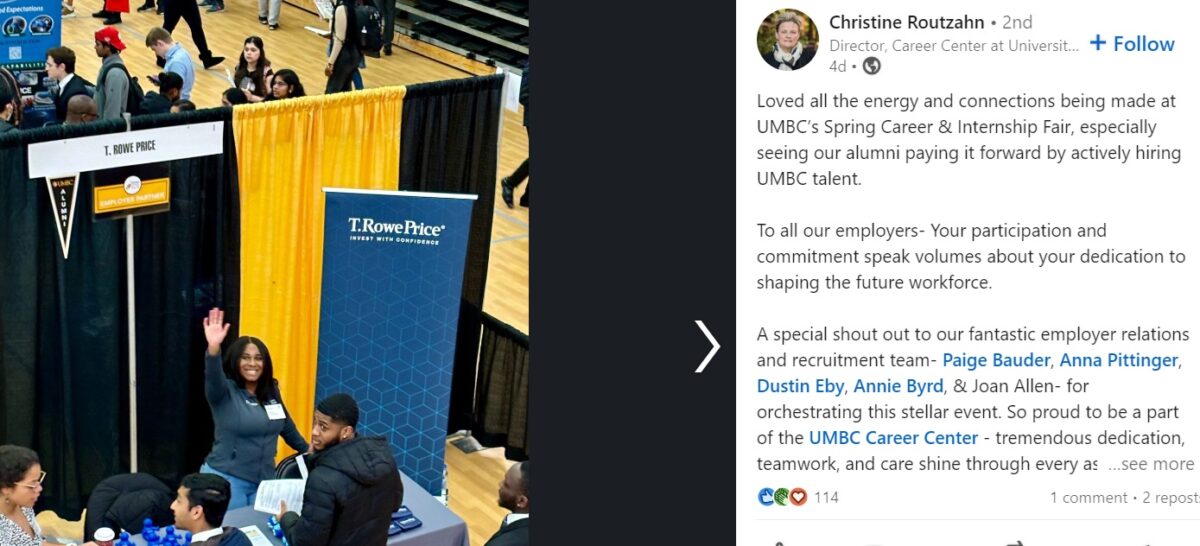
A LinkedIn post of college students at a career fair
Image courtesy of Christine Routzahn, director of UMBC’s Career Center.

The leading edge

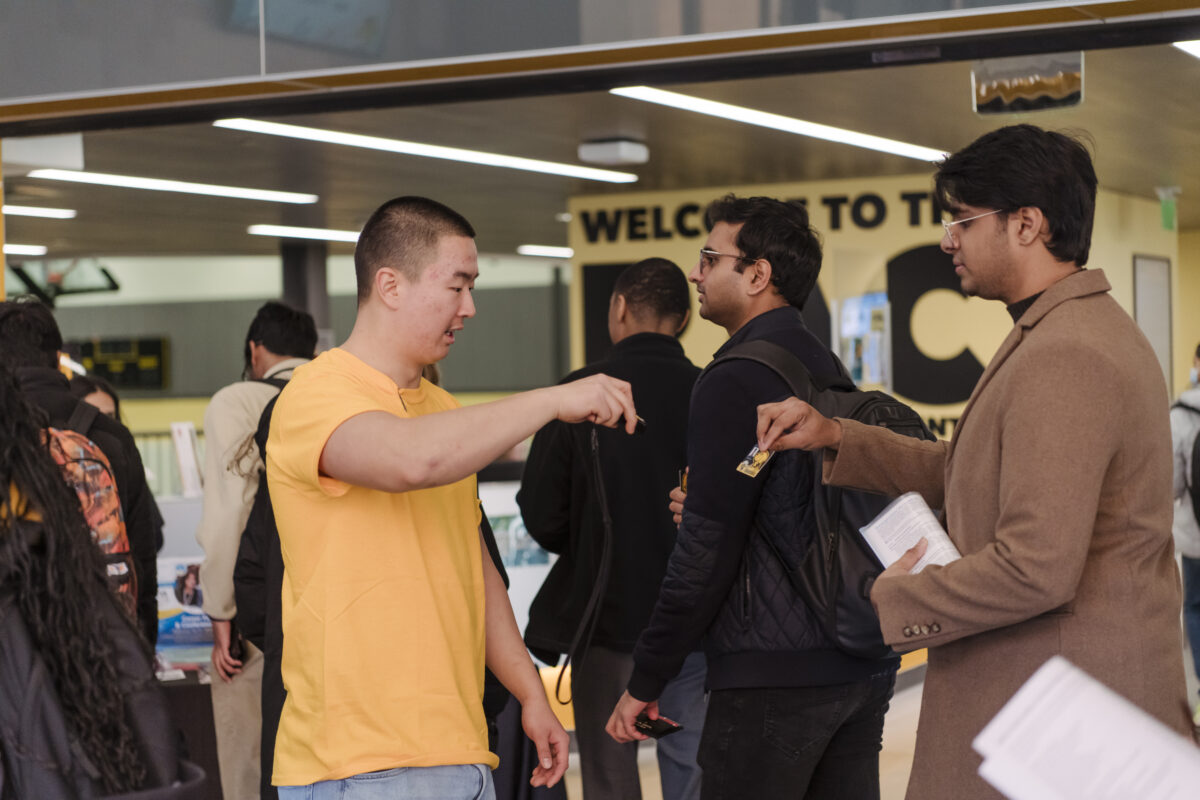
“Give strong handshakes. Maintain eye contact,” said Leon Tang ’26, information systems, in a booming voice, as he scanned IDs as a volunteer at the event. 

A person wearing a gold colored t-shirt holds a digital scanner for students to scan their plastic IDs
Leon Tang welcoming Career Fair attendees. (Marlayna Demond ’11/UMBC)

“Some people might come in nervous. It’s over 180 companies, so it can be pretty hard,” said Tang. He currently has two internships, one as a business technology intern at Agile Care Enterprises, based at bwtech@UMBC, and another as a research assistant in the information systems department. “It’s a good way to tell everyone to be calm and be confident. It’s the little things that can go pretty far in obtaining something.” For the nearly 2,200 Retrievers that made it through the door that day, this was sage advice.

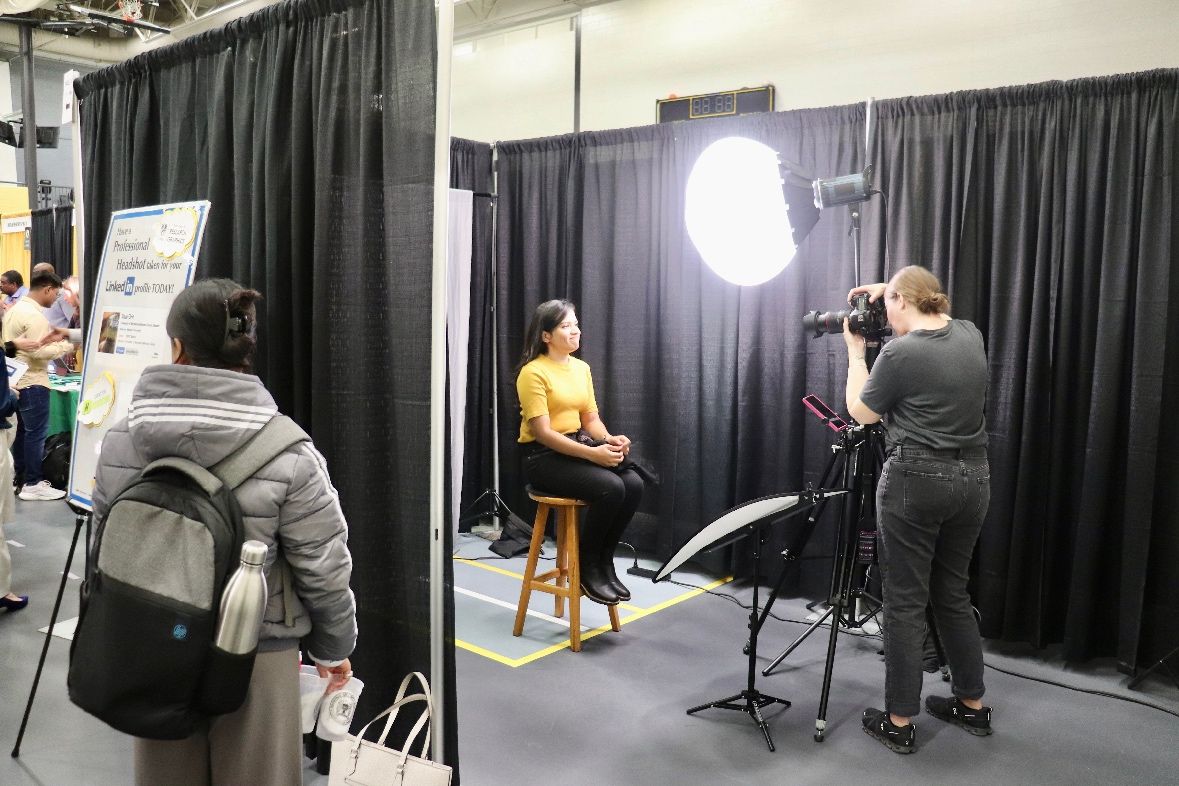
A professional headshot is one of those little things. After making it past Tang, Bhargavi Gudapati, a current master’s student in information systems, headed straight back to grab the 10th spot in a line that, over the next four hours, would consistently have dozens of excited and grateful students waiting for their free headshot. Gudapati, an international student from India, has attended every career fair since she arrived in 2022. She wants to get ahead of the steep competition of international students looking to launch the next phase of their career in the U.S. 

A student sits on a stool while a photographer takes their headshot at the UMBC RAC
Spring 2024 Career and Internship Fair headshot station. (Image courtesy of Christine Routzahn)

“It’s incredibly important to get to know employers in person instead of only on their online portal,” says Gudapati. “You want to know what they require and the current technology they are using.” 

One of those employers, Ed Belsinger ’90, M.S. ’93, mechanical engineering, is a newbie to UMBC’s career fairs. He proudly wore his UMBC sweatshirt and a smile that became a beacon of friendliness in a sea of students seeking opportunities. Belsinger is the director of product development at RPM Tech, a company that turns an idea into a prototype and a prototype into a fully manufacturable product. Because RPM does all the engineering and design in-house with a full shop and lab, it can offer students a wide range of expertise. 

Belsinger notes that RPM is currently in a growth mode and has three internships available as well as full-time positions. “As an alum, I said, ‘This is a great school—we have to go there.’ Whether it’s an internship or someone right out of college, we’re looking for students with curiosity, who want to learn, are willing to do new things, to be challenged, and be part of a team.”

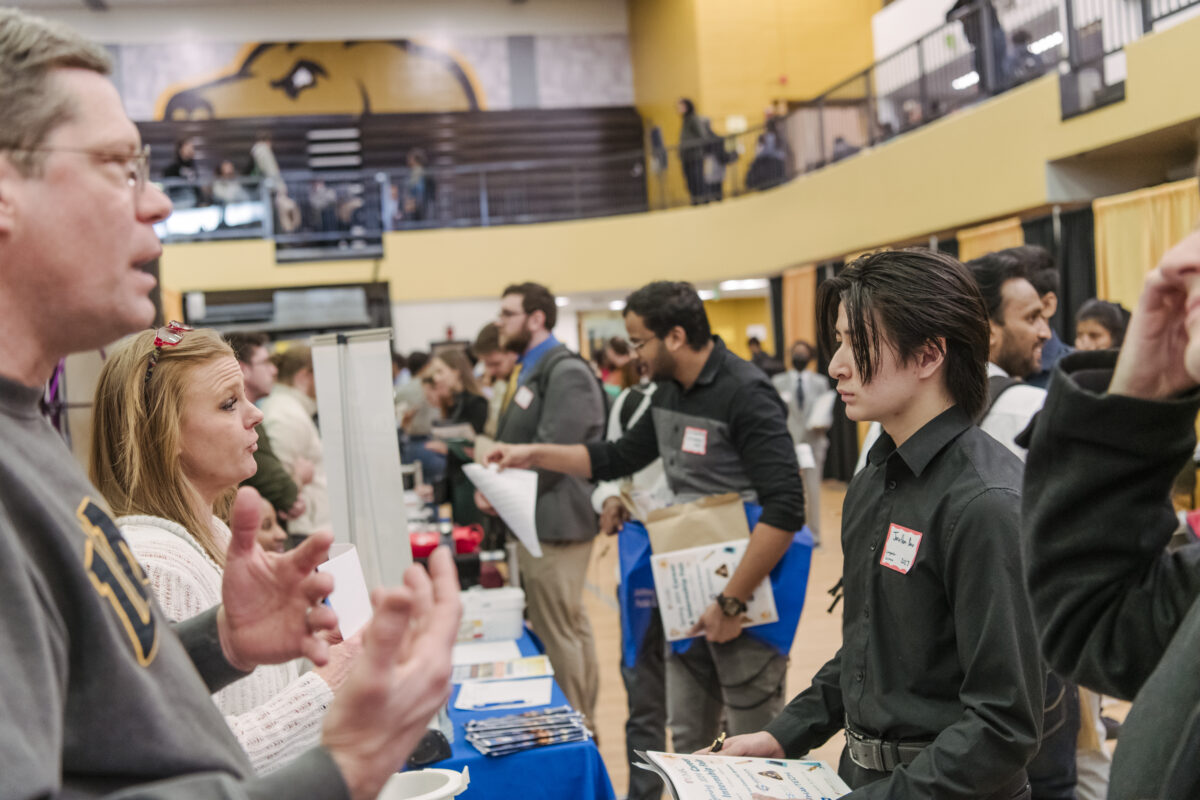
Students at a career fair talk with employers
(l – r): Ed Belsinger (in grey) and Jonathan Dao (in black). (Marlayna Demond ’11/UMBC)

Hoping to grab one of the RPM internships is Jonathan Dao, computer science, a first-year student waiting in line to speak with Belsinger. “I saw tech in the name and wanted to learn more. I want to see if I can start early to have a competitive advantage,” said Dao. “I think first-year students should definitely give the career fair a shot. Come in with confidence, try rehearsing how to present yourself, and dress well.”

Part of the team

Sekinat Dosunmu ’24 agrees with Dao’s approach. After spending her first year of college remote, she has made it a point to attend every career fair in person. Toward the end of the day, she lined up at the FBI table, ready to discuss what the FBI had to offer someone like her with a global studies major, an Africana studies minor, and certificates in tech and intercultural communication. As she stepped forward, a recruiter immediately welcomed her.

While waiting to continue talking with Dosunmu, other recruiters shared that the FBI welcomes all majors, including the arts and humanities. They noted that the most important skill the FBI is looking for is how someone approaches and solves a problem in a team environment.

The artists approach

Solving problems creatively is the bread (or blood) and butter of C.C. Smith ’24, theatre, formerly known as Dracula in UMBC’s fall 2023 production of Dracula: a Feminist Revenge Fantasy, Really. That role earned him an audition for a film later on in the day, so Smith is hurrying through the fair.

Later in the spring, UMBC’s Career Center hosts boutique career fairs, one of which is focused on creative careers, and on March 7, it will host the CAHSS Career Connection Social for arts, humanities, and social science majors, but that doesn’t stop Smith from checking things out. As an actor, Smith explains, you never know when someone is looking to do a commercial. “This is my first time here. I would like to see more performing arts employers in this larger career fair, especially with how good the arts programs are here,” says Smith. “As a senior, it’s still important to be poking around this fair.” 

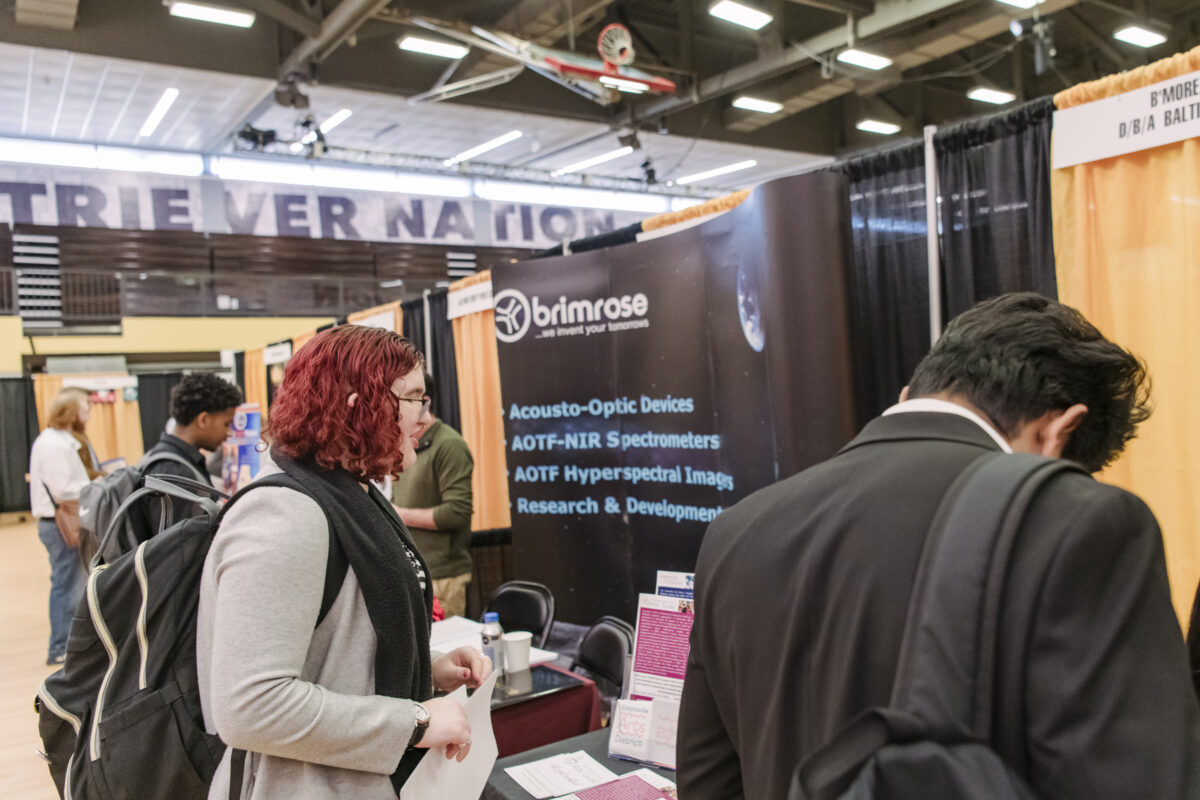
Luna Siesko ’25, visual arts, and Alexander Schobitz ’22, visual arts, agree with Smith that UMBC students excel in the arts, and would like local employers to know about that. Siesko, a photographer and videographer at commonvision, UMBC’s design shop, used her skillset to bring personally designed business cards and résumés to the fair. Siesko is unsure what she is looking for but hopes that by speaking with some of the employers, like the folks at the Baltimore County Arts Guild, she can get a sense of how to best move forward. 

College students at a UMBC career fair, wearing backpacks, stand in front of tables speaking with employers
Luna Siesko at the Baltimore County Arts Guild table. (Marlayna Demond ’11/UMBC)

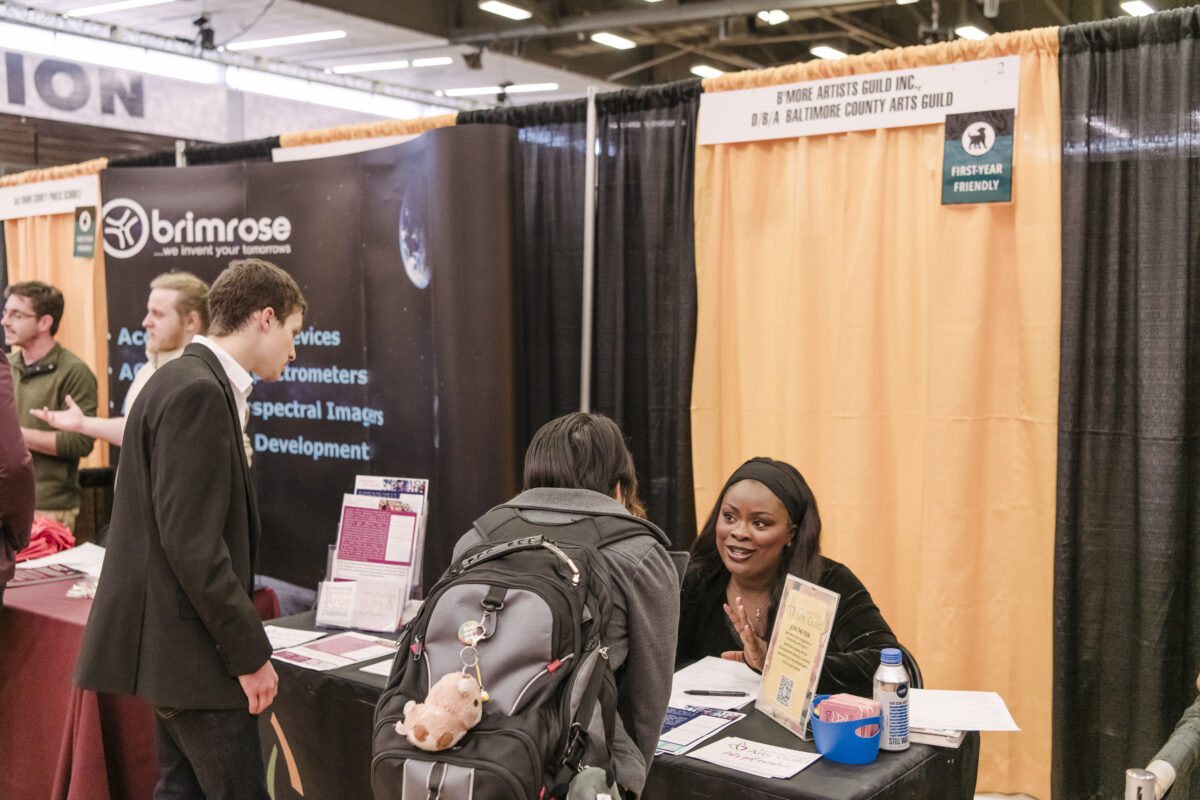
“We’re a small non-profit five minutes from UMBC. We want to make sure that artists feel seen and heard and know there is a place for them to work,” said Gloria Fajimolu, program and events manager at the Baltimore County Arts Guild, a new employer at the Career Fair. “We’re very welcoming. If a student doesn’t get the internship or the job, they can still be a paid instructor. If they are in animation, we will pay them to teach animation classes to the community.”

A person sits at a table speaking with students at a UMBC career fair.
Gloria Fajimolu, program and events manager at the Baltimore County Arts Guild. (Marlayna Demond ’11/UMBC)

As a recent alum, Schobitz has one goal—to get a job in animation. He is grateful UMBC gives alumni access to the career fairs and Handshake, a job listing app. “I apply to about 10 jobs per day. I use sites like Indeed and Handshake to find jobs and apply,” says Schobitz. “While I was a student, I used UMBC’s résumé services and made a lot of appointments. I’m still trying. I won’t give up.”

The end and beginning

A long line of students stand outside the UMBC RAC in between tall brick buildings waiting to enter a Career Fair to find internships
UMBC students lineup for the Spring 2024 Career and Internship Fair.
(Image courtesy of Routzhan)

Back at the headshot line, Cristian Castro, M.S. ’24, cybersecurity, joined the still-growing line as the last wave of students filed in. Castro is from Colombia and is looking to find a company to sponsor him to work in the U.S. “The Career Fair is a very good opportunity to see what’s out there. A professional photo is important in a LinkedIn profile,” says Castro. He also found some job leads earlier this year while representing UMBC as part of the Society of Advancing Chicanos/Hispanics and Native Americans in Science. “When it comes to what happens after graduation, every detail helps.”

Follow the Career Center on myUMBC and RSVP to the CAHSS Career Connection Social on Thursday, March 7, to network with alumni and employers in the arts, humanities, and social sciences.

For the third time in five years, UMBC is named a Fulbright Top Producing Institution

Within just a few months of living in Piątek, a small town in central Poland, Leah Michaels, M.F.A ’19, intermedia and digital arts, has already traveled to Romania, where many recipients of the Fulbright U.S. Student award placed throughout Europe gathered at a media literacy conference. She has also had an opportunity to research Polish film at Poland’s Film Archive and connect with a local genealogist who helped her find details about her Polish roots for a short documentary she is producing about her ancestry.

Michaels and nine other UMBC Fulbright student recipients researching and teaching English abroad this year helped propel UMBC, once again, to the elite ranks of a Fulbright Top Producing Institution, as reported today in The Chronicle of Higher Education. The designation recognizes colleges and universities with the highest number of students selected for the Fulbright U.S. Student Program, the U.S. government’s flagship international academic exchange program. UMBC first received this designation from the U.S. Department of State’s Bureau of Educational and Cultural Affairs in 2019 – 2020 and again in 2020 – 2021. 

UMBC is one of 57 doctoral universities nationwide and three in Maryland to receive a Fulbright Top Producing Institution designation for Fulbright U.S. Students in 2023 – 2024.

A digital blue, gray, and white graphic of a shield and a globe with words written in white

More than 2,200 U.S. students from hundreds of colleges and universities are awarded Fulbright grants annually. However, only a few of these institutions are designated top producers yearly. In the last decade, UMBC students and recent graduates have received over 60 Fulbright U.S. Student Program awards in Africa, Asia and the Pacific, the Middle East, South America, and Europe.

“This achievement is a testament to your institution’s deep commitment to international exchange,” wrote Secretary of State Antony Blinken in a letter to President Valerie Sheares Ashby, congratulating her on UMBC’s Fulbright Top Producer designation, “and to building lasting connections between the people of the United States and the people of other countries.”

Mutual understanding

In partnership with more than 140 countries worldwide, the Fulbright U.S. Student Program offers unparalleled opportunities in all academic disciplines to graduating college seniors, graduate students, and young professionals from all backgrounds. Fulbright recipients play a critical role in U.S. public diplomacy, establishing long-term relationships between people and nations through graduate study, research, or teaching as English Teaching Assistants (ETAs). ETAs develop their own language skills and knowledge of the host country while teaching English to elementary, middle school, or college students.

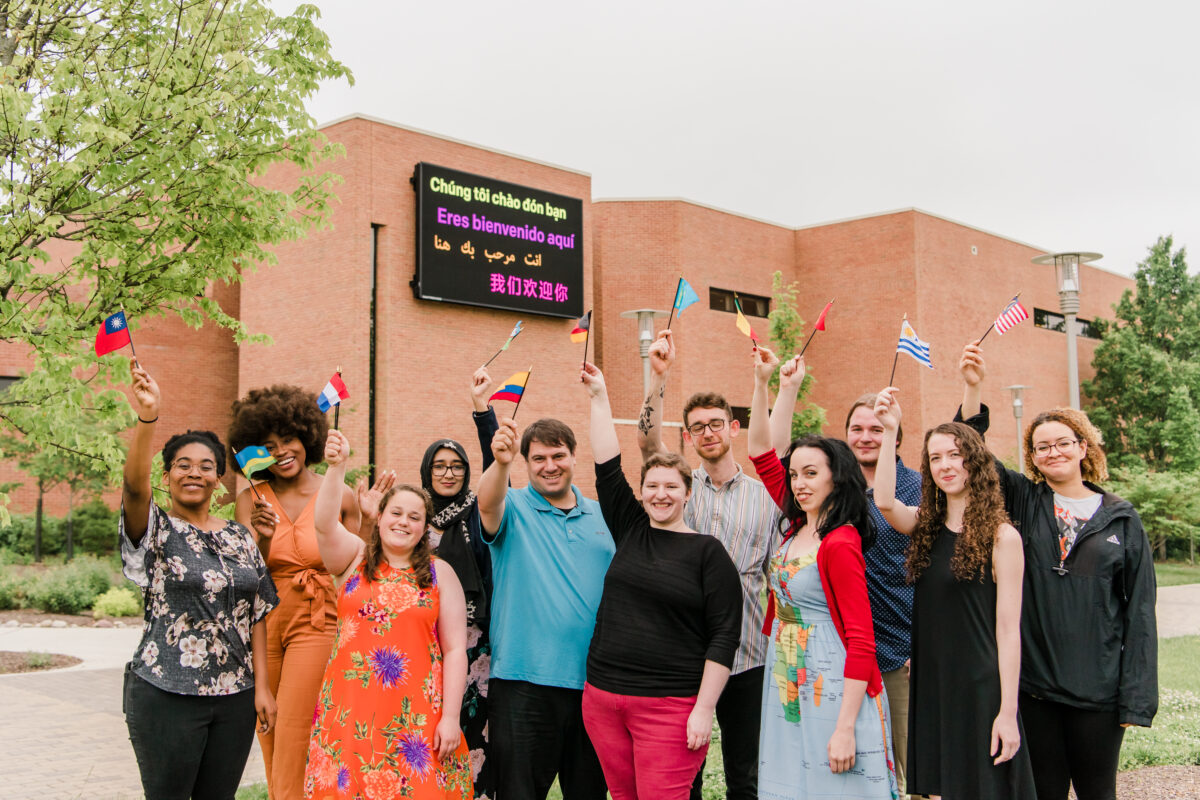
A large group of Fulbright students stand outside raising flags of different countries celebrating UMBC being a Top Producing Institution designation
2019 – 2020 UMBC Fulbright U.S. Student recipients. (Marlayna Demond ’11/UMBC)

“As a public research university, it is imperative that we provide students with opportunities for global engagement,” says David Di Maria, associate vice provost for international education. “Fulbright is among the most prestigious of these opportunities.”

While Michaels has flourished in Poland, her 2023 – 2024 Fulbright class peers have also settled into their placements, which generally start in September with the new school year. Paul Ocone ’22, individualized study, is conducting research at the Meiji University School of Global Japanese Studies in Japan, and eight ETAs are teaching English across Europe and Asia: 

  • North Macedonia: David Bullman ’22, ancient studies
  • Romania: Tiffany Powell, M.A. ’23, teaching English to speakers of other languages (TESOL)
  • Slovak Republic: Sianna Serio ’23, computer science
  • South Korea: Tasneem Mansour ’20, modern languages, linguistics, and intercultural communication
  • Taiwan: Nailah-Benā Chambers ’23, global studies; Kara Gavin ’20, English; and Milan Richardson ’23, bioinformatics
  • Turkey: Grant Clifton, M.A. ’23, TESOL

“Being named a Top Producing Fulbright Institution is a tremendous honor—it not only shows the world what we already know about our amazing students, but it also lets our current students know that the Fulbright is a realistic opportunity for them,” says Brian Souders, Ph.D. ’09, language, literacy, and culture, M.A.’19, TESOL, and associate director of global learning at the Center for Global Engagement (CGE). Souders has led students through the Fulbright application process as UMBC’s Fulbright Program advisor for the last decade.

For Michaels, the experience has been life-changing. “My home city has been incredibly welcoming. I learned Polish folk dances, made Old Bay pierogi from scratch with some of my students, and joined a school trip to an art gallery,” says Michaels.

The Fulbright family

The Fulbright experience also includes college and university faculty and staff, as well as artists and professionals from a wide range of fields, who can join over 400,000 Fulbright alumni. 

In October 2023, Renique Kersh, vice president of student affairs, and Souders traveled to Germany after receiving Fulbright International Education Administrator awards. Katherine Heird, director of education abroad and global learning, received the same award to travel to Taiwan in spring 2024. The award is geared to provide staff who support Fulbright applicants with a greater understanding of higher education worldwide. 

Many UMBC faculty members and staff have received a Fulbright U.S. Scholar award over the years. This year, Lynn Cazabon, professor of visual arts and director of the Center for Innovation, Research, and Creativity in the Arts, received a Fulbright U.S. Scholar award to work at Queensland University, Australia, to create a public artwork based on local communities’ responses to climate change. Cazabon received her first Fulbright award in 2015 to the University of Liepāja, Latvia.

Fulbright Scholars globally are also drawn to UMBC’s welcoming community. Shannon Sauro, associate professor of education, hosted Jules Buendgens-Kosten, a research assistant at the Institute of English and American Studies at Goethe-Universität Frankfurt, Germany. Buendgens-Kosten joined UMBC as the institution’s first Fulbright Scholar-in-Residence to teach and share their research on inclusive education in teaching English as a foreign language to students in UMBC’s TESOL master’s program. 

UMBC has also been selected as the only U.S. institution to host an orientation for newly awarded Scholars-in-Residence. Madison Pickard, M.A. ’24, modern languages, linguistics, and intercultural communication, graduate assistant, and CGE’s special programs coordinator, notes that UMBC was chosen for its emphasis, expertise, and dedication to inclusivity for all regarding disability and identity.

“Fulbright’s Top Producing Institutions represent the diversity of America’s higher education community. Dedicated administrators support students and scholars at these institutions to fulfill their potential and rise to address tomorrow’s global challenges,” said Lee Satterfield, assistant secretary of state for educational and cultural affairs. “We congratulate them and all the Fulbrighters who are making an impact the world over.” 

Read about more about past Fulbright cohorts at UMBC. This year’s Fulbright U.S. Student Program application cycle opens on April 2, 2024. Learn more about applying.

American Council of Learned Societies spotlights UMBC’s CoLab as an interdisciplinary leader

The American Council of Learned Societies (ACLS) has chosen UMBC’s Interdisciplinary CoLab for its “Undergraduate Spotlight” series. ACLS is a nonprofit federation of 80 scholarly organizations that has supported and amplified American scholarship in the humanities and interpretive social sciences since 1919. Over the last six summers, UMBC’s CoLab has provided students with an innovative team-based applied learning opportunity through a three-credit paid internship in narrative-based research. 

ACLS writes, “Unlike traditional group work in a college classroom, wherein majors from the same discipline are all trying to master the same material, CoLab projects require students to use their own skills and appreciate the skills of others.”

Professional research experience

CoLab gives interdisciplinary student teams a professional research experience while learning how to tell effective stories and create valuable public-facing results for community partners. “I wasn’t aware of the [Baltimore Immigration] museum prior to my internship,” shared CoLab alum Johanna Alonso ’20, English, about her team’s project “Baltimore: The Second Ellis Island. “I think the real benefit of the CoLab is that it exposes students to people, places, programs, and projects we may never have encountered otherwise.”

Co-directed by Carole McCann, professor and chair of gender, women’s, + sexuality studies, and Donald Snyder, a principal lecturer in media and communications studies, UMBC Interdisciplinary CoLab is a partnership between the Provost’s Office, the Dresher Center for the Humanities, and the Office of Summer, Winter, and Special Programs.

“ACLS is a very prestigious national academic organization,” says McCann, “so for it to highlight CoLab as an innovative program is a big deal.” 

After participating in the 2021 CoLab focused on BLM and Civil Rights Oral Histories, Deysi Chitic-Amaya ’23, media and communication studies, said, “I want to be able to approach future projects with a more open-minded perspective that may help to produce something new and innovative.”

Read more about students’ CoLab experiences and the application process.