We use cookies for analytics and, unless you opt out, advertising.
You can opt out of advertising at any time.UMBC uses essential cookies to run this site. With your permission we would also use analytics cookies (to understand how the site is used) and advertising cookies (to measure and target our ads on other platforms). Nothing else loads unless you accept. You can change your choice any time from Cookie Settings in the footer.Privacy Policy
EssentialRequired for the site to work (login, security, your cookie choice). Always on.
The increasing impact of global disasters on health systems has created a growing need for experts to help manage disaster risks and reduce their impact. In keeping with that demand, UMBC’s emergency health services (EHS) department has changed its name to the Department of Emergency and Disaster Health Systems (EDHS) to reflect the scope of research, teaching, and learning of emergency and disaster health systems covered in its programs. The new name also acknowledges the scholarship happening at the graduate level.
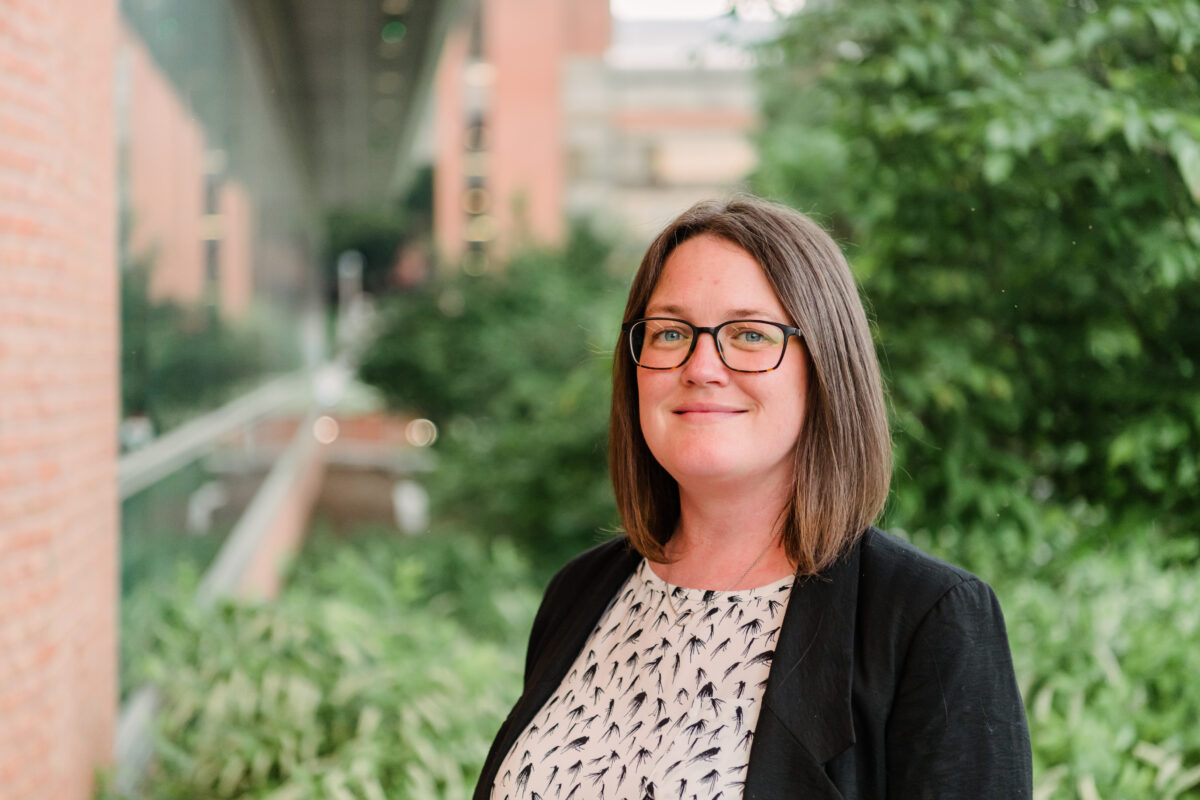
Lauren Clay, EDHS associate professor and department chair
“Our new department name signifies our commitment to emergency and disaster health education,” says Lauren Clay, associate professor of emergency and disaster health systems and department chair, who has received several grants from the National Science Foundation in recent years to specifically address the understanding and monitoring of food availability, acceptability, and accessibility during disasters. “We prepare leaders that are ready to tackle the complex and evolving hazards facing communities across the United States and the world,” explains Clay.
UMBC’s EDHS department is rising to the challenge by equipping students with the skills needed to pursue careers as emergency preparedness coordinators, community engagement specialists, emergency communications supervisors, or analysts. Undergraduate students can now enroll in classes that focus on disaster management in healthcare, public health, and emergency management organizations, in addition to emergency health services classes.
UMBC’s EHS department has a long history of preparing students to enter careers where they are ready to respond to local disasters like Ellicott City’s most recent floods and international disasters, like the Philippines’s Typhoon Haiyan. The EHS baccalaureate program began in 1980 with the goal of producing the most comprehensively educated individuals capable of performing tasks within the broad scope of the emergency healthcare field as leaders, managers, and providers.
The graduate program for emergency health services, the first in the nation, began a year later. It remains the largest program of its type available in the United States. Next year, the department is planning to offer several new graduate and undergraduate classes on a range of disaster health systems topics.
“The department has offered emergency health services and disaster management programs for decades. The former name did not fully capture the breadth of those offerings,” explains Clay. “We wanted to make sure that students and our colleagues know about our programs that prepare students to work in various professions addressing emergency and disaster health.”
Noor Zaidi, assistant professor of history, received a National Endowment for the Humanities (NEH) fellowship to research and write Translations of Zaynab: Gender, Sectarianism, and Citizenship in Shi’a Islam. The book will analyze how the seventh-century figure, Zaynab bint Ali, granddaughter of the Prophet Muhammed, has been used in 20th-century political contexts.
“It is my great pleasure to announce NEH grant awards to support 260 exemplary humanities projects undertaken by scholars, higher education institutions, and organizations of every size,” stated NEH Chair Shelly C. Lowe (Navajo) in the NEH press release. “This funding will help preserve and expand access to community histories, strengthen the ability of small museums and archives to serve the public, and provide resources and educational opportunities for students to engage with history, literature, languages, and cultures.”
Zaidi, a 2017 UMBC postdoctoral fellow, is a scholar of the Middle East and South Asia. She specializes in the history of gender, sectarianism, and Shi’a Islam in national and transnational spaces. Her research explores “sites of sectarianization” through the 20th century, tracing the development and evolution of pilgrimage to two female shrines in Syria and Pakistan and prisons in Iraq as sites of memory and identity construction. Based on oral interviews, fieldwork, and archival research in Syria, Pakistan, and Iraq, Zaidi’s work explores the physical and imaginative spaces in which identity is made and contested and shows how transnational narratives become embedded in local contexts.
Thrilled and so grateful to receive an NEH fellowship this year!! None of us ever have any success without the support of others, and my colleagues @UMBC (and mentors elsewhere) have been so steadfast and encouraging, in the face of attacks on humanities, the global landscape 1/2 https://t.co/LBd6M1D0mU
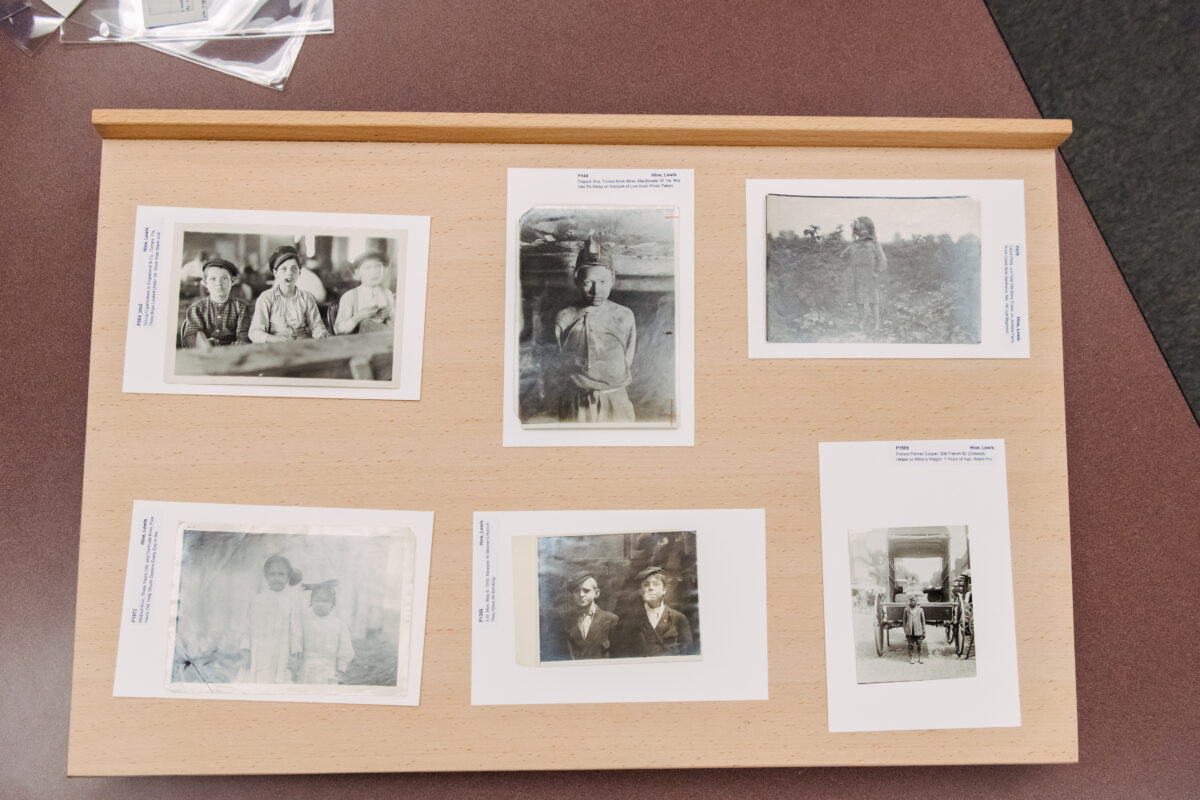
A nine-year-old stands at the mouth of a coal mine covered in coal dust, wearing a small headlamp. A woman holds her baby on her lap as she packs boxes in a warehouse along with her 5-, 8-, and 12-year-olds. These are just two of thousands of evocative black-and white historical photographs handled by Special Collections interns Meredith Power ’21, history, a public history graduate student, and Gabe Morrison ’23, anthropology. Along with library staff members, these two worked diligently to ensure that the images of the families and children who lived through these harrowing work conditions are accessible to the public for research and learning.
Fine motor skills
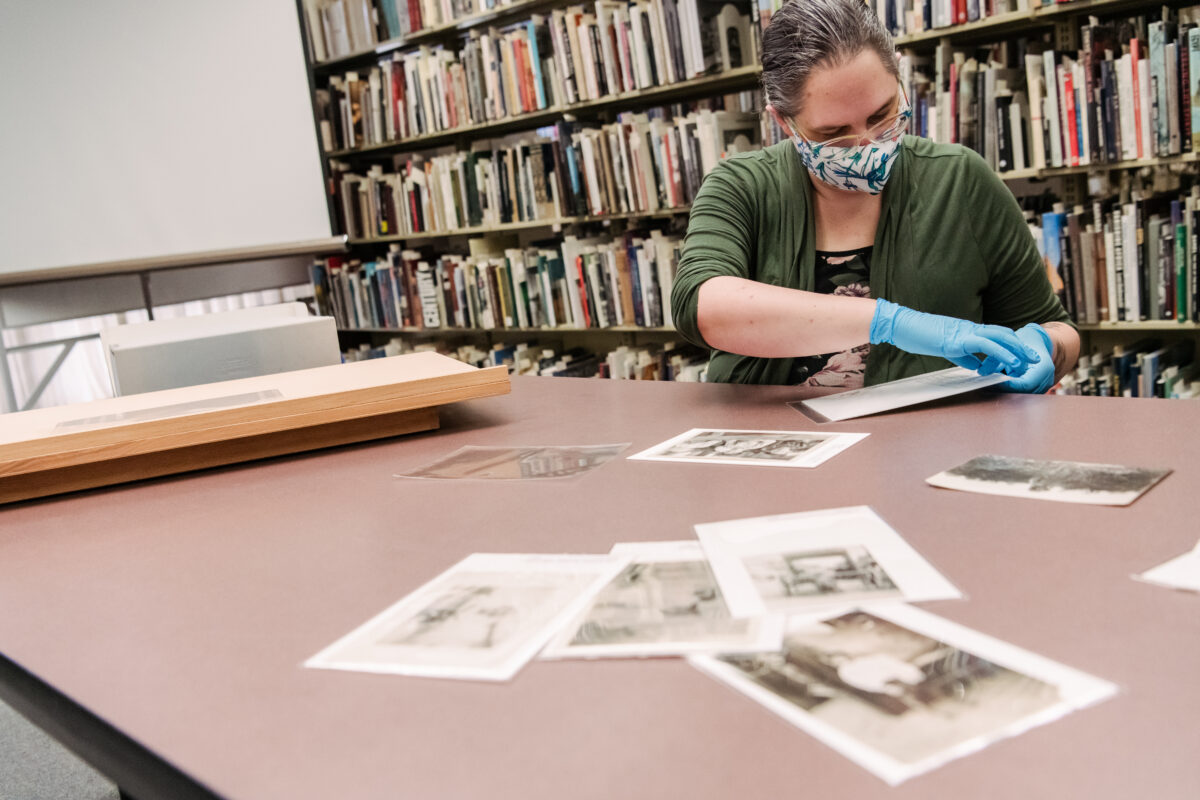
“Photos from the early 1900s were developed on fine photographic paper that is prone to crinkling around the edges, ripping, and fading,” Power says. Wearing blue nitrile medical gloves, they rehouse photos from their cellophane sleeves to museum-grade mylar sleeves, keeping them from further discoloration, tears, wrinkles, and sticking to the sleeves.
“They’re very delicate,” Power says. “You need good eye-hand coordination to pick up the photos from the corners, remove them from whatever packaging they are in, and slide them into the mylar sleeve.”
Power puts the historical photos into a mylar sleeve. (Marlayna Demond ’11/UMBC)
This process is second nature for Morrison, who has been working at Special Collections for over a year. He has worked with securing the Lewis Hine photos as part of his public humanities minor, as well as the Maryland Folklife Program Collection, the Coslet-Sapienza Fantasy and Science Fiction Fanzine Collection, and the George Cruikshank illustrations and papers.
“I had to learn how to properly handle photographs and manuscripts and how to catalog them according to the Library of Congress classification system,” Morrison says. For both Power and Morrison, developing greater patience and manual dexterity and embracing working through hundreds of documents alone in a quiet space surrounded by stacks of materials was well worth the effort to broaden access to these historic documents.
“The value of this project is ensuring people understand that this resource exists,” says Power, “to help these photos live beyond a heavily controlled and restricted space on campus into a digital space where more people are able to access the information.”
Digital accessibility
Protecting delicate, historic documents includes digitizing them. The digitizing process is another lesson in precision and patience. Power begins the process by taking a photo out of the mylar sleeve—making sure to only touch the corners—along with a small rectangular white piece of paper describing the photo. They gently place the photo underneath a camera, delicately straightening the image before the camera snaps the picture and sends it to a computer where Power edits it using Adobe Lightroom.
A small collection of the 5,400 photographs that were digitized and rehoused in more protective plastic sleeves. (Marlayna Demond ’11/UMBC)
“It’s an elaborate setup with lights at 45-degree angles, and the camera pointed straight down at a small white stand where I place the image,” explains Power, who would work on digitizing for six to eight hours at a time. “Once I take the image, I edit the size and angle of the photo. The metadata is then added into an Excel spreadsheet, which includes noting if there was a corner missing or if the photo had adhesive stuck to it.”
Digitizing rare books, something Morrison has spent months working on, requires using a special book scanning machine with raised sides, like hands cradling the book open, and small snakelike bean bag weights to keep the pages flat without using his fingers. “I make sure I’m not blocking any text or any important image. And then I press a button, flip a page, press a button, flip a page for hours on end until I finish digitizing that book,” Morrison says, smiling. “So, it’s not the most exciting work, but I find digitization specifically important because it’s a process that helps preserve documents too fragile to be in public circulation. Digitally, you can share it with a broader audience.”
Workforce skills
Both Power and Morrison brought many special collections skills to their public humanities internships. Archaeology camp inspired Morrison to learn about how to study and take care of important and fragile objects. He worked at the Montgomery Parks Archeology Program throughout high school, where he met a friend who introduced him to UMBC’s Special Collections. “I’ve always had an interest in historic things, in the preservation of artifacts,” Morrison says, who plans to apply to a master’s program in library and museum studies after graduation. “I think Special Collections has helped me realize I want to do archival work.”
Power found their footing working full time in the conservation rooms at Baltimore’s Walters Art Museum. “I was the administrative assistant in the Conservation Division and was around a lot of conversations on handling art objects and special collections materials, but I did not work with the materials directly,” says Power. “Working with the Hine Collection was a great opportunity for hands-on experience working with physical items and digitization.” These skills have also come in handy for Power, whose master’s degree focuses on 14th-century religious women hermits in Yorkshire, England. In 2022, Power had the opportunity to visit parish archives in Yorkshire to read through medieval-primary source documents.
For Power, history isn’t just books, dates, and lists of events. They say that there are a lot of living materials out there, whether that’s parish churches or photographs from the early 20th century, like the Hine collection. There is a connection between public history work and the people who lived before us. “It’s important to continue to help students remember that history is not dead and dusty. It’s alive,” says Power. They feel that the connection element is essential, and sometimes it gets lost. “Special Collections prove that these events really happened. They can inspire students to visit those places. To stand in that space where it happened and say, ‘Yeah, I was here too.’ I love that.”
Sonya Squires-Caesar, a doctoral candidate in UMBC’s language, literacy, and culture program, has been interviewing communities who use susus to save money for big-ticket items like homes, farms, or everyday needs like transportation and bills. Susu, a word thought to come linguistically from West African languages, is an informal structure of communal savings where individuals agree to give an equal amount of money to one pool. Members then decide the frequency of when someone receives the entire amount.
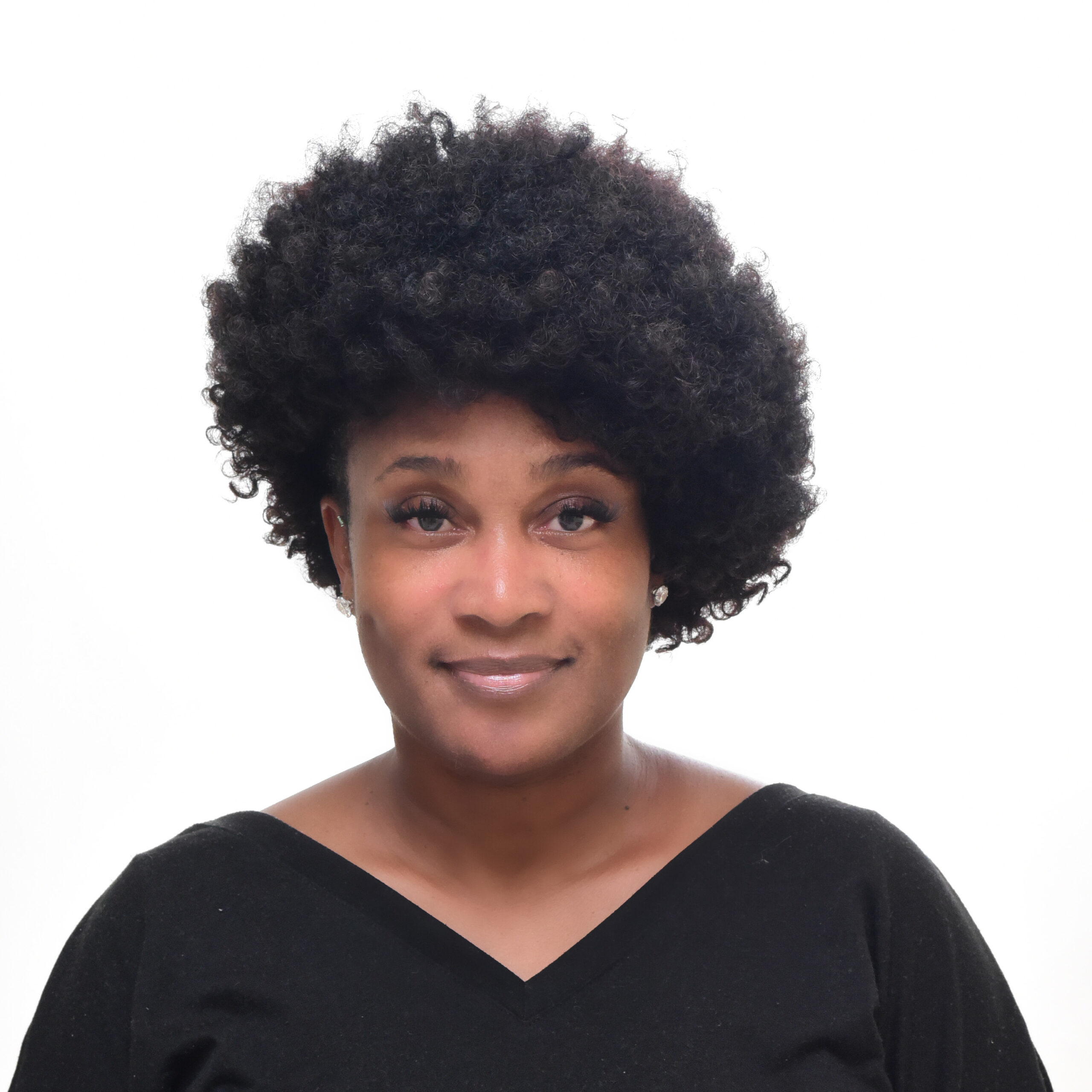
Headshot courtesy of Sonya Squires-Caesar.
“I remember my mother planning her spending around when she would get her payment,” says Squires-Caesar, whose family is from Barbados. Squires-Caesar explains that susus—or rotating savings and credit associations (ROSCAs)—can be a way for people to access larger sums of money without the barriers formal banks and finance systems pose to people without high levels of disposable income.
“While there is a significant body of ROSCA research, it tends to focus on groups living in poverty or with minimal or no access to formal financial instruments,” says Squires-Caesar. “My study differs by focusing on middle-class and upper-middle-class immigrants who opt to use this informal, unregulated financial tool in the U.S. alongside mainstream financial services such as banks, credit cards, investments, etc.”
Squires-Caesar, the Dresher Center for the Humanities’ graduate student research fellow for fall 2023, is interested in studying the evolution of susus from the transatlantic slave trade to today. She explains that for centuries people have pooled their resources for individual and communal needs.
Honoring African indigenous knowledge
Susus are a cultural practice rooted in African indigenous knowledge, a term for how various African cultures orally passed a range of information, customs, and beliefs from generation to generation. “In African indigenous knowledge, the act of learning is thought to be a fully engaged journey to ‘find one’s face,’” says Squires-Caesar, “which is considered the path to discovering your roots, revealing your spirit, and determining the ‘fire in your belly’ or core elements that matter most to you.”
Squires-Caesar “found her face” when she aligned her research path with her authentic identity. “Western research methods couldn’t guide mine. I felt I was trying to fit a square peg into a circle,” explains Squires-Caesar. “I found my face when I realized the methodology that my project needed had to model the community I was looking to understand.”
Researching what’s below the surface
Squires-Caesar’s approach to understanding financial literacy is less about the stock market and credit and more about what is intangible. She calls it the iceberg effect.
Squires-Caesar, in orange, with students. Some students she interviewed for her dissertation have formed a new intergenerational ROSCA savings club.
“On top of the iceberg are tangible things like bank accounts and credit cards,” explains Squires-Caesar. “You can see, touch, feel, and measure them, but beneath the iceberg are the processes that may not have official rules and regulations and where the general public may not know they are happening, like susus.”
During the four years she managed a community college financial literacy program, Squires-Caesar met many students surviving from month to month. Through ethnographic research, she found students were using non-traditional ways to make ends meet, like getting cash advances from bingo halls to pay for bills and groceries. The data also showed that some students were overwhelmed by the idea of saving.
To shift that thinking, she created a microsavings project for her students to take them through the process of saving—a few cents here, a few dollars there, which grows over time.
These stories about the complexities of susu communities have inspired Squires- Caesar, as part of her Dresher Fellowship, to decorate physical masks as three-dimensional representations of financial identity, of “finding face.”
Social, cultural, and scientific advancements have helped people live longer. Not only are people living longer, but they also have fewer children than at any previous time in human history. This shift will present a unique situation where there will be more older adults outnumbering infants and teenagers in about four decades. How will the world take care of this burgeoning population?
Christine A. Mair, associate professor of sociology and gerontology and director of UMBC’s Center for Health, Equity, and Agingin the department of sociology, anthropology, and public health, examines the presence or absence of family and non-family ties. Mair seeks to document how social integration and support (or lack thereof; e.g., “kinlessness”) shape mental health, physical health, end-of-life experiences, and other aspects of well-being especially cross-nationally.
“Many of these older adults will also be unpartnered due to never marrying, divorce, or their eventual widowhood. These three intersecting trends of high longevity, low fertility, and low partnership will culminate to produce a growing population of people who are both unpartnered and childless. This group is sometimes referred to as ‘kinless,’” Mair explains to Lynn Pasquerella, president of the American Association of Colleges and Universities and host of The Academic Minute, a daily show featuring faculty from colleges and universities worldwide speaking about their cutting-edge research.
For centuries, media has portrayed Arab culture as misogynistic and homophobic, leaving little room for the possibility that queer Arab communities exist and thrive. Adding to this sense of erasure is the belief some Arab communities have in thinking that homosexuality is not inherently Arab but something the Western world brought to the Arab world. However, the reality queer Arabs and those in the diaspora live is much more positive and complex.
“My research looks at how Arab people experience and narrate their queerness in unexpected ways. For example, Arabs may be in same-sex relationships but might not claim gay or lesbian identities,” Shomali explains to Lynn Pasquerella, president of the American Association of Colleges and Universities and host of The Academic Minute, a daily show featuring faculty from colleges and universities worldwide speaking about their cutting-edge research. “Many queer Arabs might not check off Western benchmarks of LGBT identity, like being ‘out.’ Some of the existing Arabic terms for queer people have negative connotations and are also not popular.”
Learn more about Mejdulene Bernard Shomali’s research:
She is currently a 2023-24 Society for the Humanities fellow at Cornell University, where she is working on a project called Palestine Matters: Aesthetics, Embodiment, and Pleasure in Palestine and also teaching a seminar called “Feeling Free: Radical Aesthetics and Political Affects.”
Her essays on gender and sexuality in transnational Arab culture include:
For centuries, books have been the primary method of documenting spoken and written languages. This method has given us insights into the formal and informal uses of language within communities and those outside the community. However, books and even tape recordings haven’t always captured the intricacies and uniqueness of a language. Advances in technology have broadened the scope and quality of language documentation and preservation, but these digital tools have also created a skills gap between researchers and communities.
UMBC’s Renée Lambert-Brétière, associate professor of modern languages, linguistics, and intercultural communication, is working on bridging this gap through a collaborative and community-engaged research project with Innu-speaking communities in Quebec, Canada, that seeks to democratize access to digital tools involved in the documentation of their language.
“Mobilizing methodologies of linguistics, digital and public humanities, this research makes an important contribution to current developments in language documentation research and constitutes a major step in broadening the tools for language preservation within the Innu speech communities,” Lambert-Brétière explains to Lynn Pasquerella, president of the American Association of Colleges and Universities and host of The Academic Minute, a daily show featuring faculty from colleges and universities worldwide speaking about their cutting-edge research.
Lambert-Brétière’s book, À la recherche d’un signe perdu: Jean-Baptiste de La Brosse, S.J., Éléments de languemontagnaise (1768) (Chemins de tr@verse, 2018), is the first edition of the grammar of the Innu language written in Latin in 1768 by the Jesuit Jean-Baptiste de La Brosse. It offers a unique testimony on the state of this nomadic language in the middle of the eighteenth century. Her research has appeared in peer-reviewed outlets that include the Journal of Language Diversity, Anthropological Linguistics, Journal de la société des océanistes, and Annual Review of Cognitive Linguistics.
Banks, large corporations, small businesses, non-profit organizations, and individuals alike lend and loan money to make more money, spur corporate growth, buy property, start a business, and help those in need. Funding prosperity and goodwill can be one outcome of financial investments. However, it’s not all good news. Today, we often hear about financial mismanagement, embezzlement, and money laundering, sometimes leading to bankruptcy and/or government bailouts—But financial fraud is not a modern story.
UMBC’s Amy Froide, professor of history, teaches courses in British history and European women’s history between 1500-1800 and researches social, economic, and gender history. During a research trip to the U.K., Froide found documents about the Charitable Corporation’s financial disaster of 1732, which she wrote about inThe Conversation.
“The Charitable Corporation was notable in having a high proportion of female investors—35 percent of the funders in the 1700s were women,” Froide explains to Lynn Pasquerella, president of the American Association of Colleges and Universities and host of The Academic Minute, a daily show featuring faculty from colleges and universities worldwide speaking about their cutting-edge research. “When the financial scandal came to light, it was these women who led activist shareholders to call for government compensation.”
UMBC’s Academic Minute takeover week
Froide joined five UMBC scholars this fall in UMBC’s firstAcademic Minute Takeover Week, featuring the latest research in media and communication studies; modern languages, linguistics, and intercultural communication; language, literacy, and culture; and history. This series is republished on NPRpodcasts and Inside Higher Ed.
The goal of the rule was to create greater transparency in the prices that hospitals charge to patients and payers. In theory, this data should help the public make the most informed decisions about where to receive their care, as reported by The New York Times with data support from Morgan Henderson, principal data scientist, and Morgane Mouslim, advanced policy analyst, at The Hilltop Institute at UMBC.
“Hospitals have been required to post this data for almost three years, and most hospitals are posting something,” says Henderson, a co-author of the paper along with colleagues from the University of Texas Medical Branch (UTMB) at Galveston, Rice University, and business entrepreneur Mark Cuban. “However, very little attention has been paid to the extent to which the prices appear to be accurate.”
Secret shoppers, different prices
The new cross-sectional study compares 60 U.S. hospitals’ online cash prices with their over-the-phone cash prices for vaginal childbirth and brain magnetic resonance imaging (MRI). The data was collected between August and October 2022 from “secret shopper” phone calls to 20 top-ranked hospitals as well as 20 safety-net hospitals (which accept patients who cannot pay) and 20 non-top-ranked, non-safety-net hospitals.
The study found that the online prices hospitals are required to post were missing for 47 percent of hospitals for childbirth and 10 percent for MRIs, said Merina Thomas, a doctoral student at UTMB at Galveston, who was the lead author of the paper.
“Among those hospitals where prices were available online, the online price often did not match the prices provided over the phone,” Thomas said toutmb Health. “For example, a hospital might have an online price for an MRI of $2,000 but give a phone price of $5,000, or an online childbirth price of $20,000 but a phone price of $10,000.”
This research is among the first to attempt to investigate the validity of hospitals’ pricing transparency data relative to other pricing benchmarks. “While this study doesn’t explicitly assess the accuracy of these price transparency data files,” says Henderson, “by comparing them to telephone-based price estimates, we demonstrate that something (either the accuracy of the price transparency data, or the accuracy of telephone estimates, or both) isn’t working.”
The paper was authored by Thomas; Peter Cram, professor of internal medicine at UTMB; Cuban; James Flaherty, UTMB medical student; Jiefei Wang, assistant professor of biostatistics and data sciences at UTMB; Henderson; and Vivian Ho, professor of economics at The Baker Institute of Public Policy at Rice University.
Doctoral students diligently work through coursework to become doctoral candidates. But, the process of writing a dissertation sometimes overshadows the joy of moving closer to earning a Ph.D. Family and work responsibilities can pose additional barriers to completing a dissertation.
Ramon Goings, associate professor of language, literacy, and culture, notes that over 40 percent of doctoral students who enter a program and do not finish recognize the dissertation process as a major contributing factor.
His research found that once students finished their classes, projects, and presentations, the structure that had scaffolded their progress throughout the program did not continue during the dissertation process. “In my research, I sought to unpack the beliefs and skills that propel doctoral students to finish their dissertation in one year or less. What I found can be broken down into what I call the 3P Formula. People + Process = Product,” Goings explains to Lynn Pasquerella, president of the American Association of Colleges and Universities and host of The Academic Minute, a daily show featuring faculty from colleges and universities worldwide speaking about their cutting-edge research.
UMBC’s Academic Minute takeover week
Goings joined five UMBC scholars this fall in UMBC’s first Academic Minute Takeover Week, featuring the latest research in media and communication studies; philosophy; modern languages, linguistics, and intercultural communication; and history. This series is republished on NPRpodcasts and Inside Higher Ed.
Revolution. Is it a right or a duty? The answer is more of a grey area. Those for and against a revolution have complex reasons for holding their ground. Some point to defending structural systems thought to be the reason for progress and prosperity. Others fight against laws that have legalized inequality and injustice. Centuries of revolution have not clarified this question.
UMBC’s Mike Nance, associate professor of philosophy, studies Johann Benjamin Erhard’s understanding of the right to revolution, which the German philosopher wrote about during the height of the French Revolution (1789 – 1799). Nance, along with James A. Clarke, senior lecturer at York University in England, is translating a volume of Erhard’s Writings on Revolution for Oxford University Press.
“Erhard argues that the right to revolution can be sustained, but only under conditions of what we would call structural injustice,” Nance explains to Lynn Pasquerella, president of the American Association of Colleges and Universities and host of The Academic Minute, a daily show featuring faculty from colleges and universities worldwide speaking about their cutting-edge research.
Nance joined five UMBC scholars this fall in UMBC’s first Academic Minute Takeover Week, featuring the latest research in media and communication studies; modern languages, linguistics, and intercultural communication; language, literacy, and culture; and history. This series is republished on NPRpodcasts and Inside Higher Ed.
COVID forced employees away from traditional offices to home offices, making working from home no longer the exception. Before the pandemic, work-from-home proponents advocated a more flexible work week/space to give employees a better work-life balance. Has this proven to be true? As some employers try to find incentives to bring their teams back to cubicles and open-plan workspaces, the argument about which setup gives a better work-life balance continues.
UMBC’s Elizabeth Patton, associateprofessor of media and communication studies and author of Easy Living: The Rise of the Home Office (Rutgers University Press, 2020), is very familiar with this argument. “Through my research, it has become evident that the issue of balancing work and life, and the integration of work into the home, has a deep-rooted history and continues to be a challenge we face today,” Patton explains to Lynn Pasquerella, president of the American Association of Colleges and Universities and host of The Academic Minute, a daily show featuring faculty from colleges and universities worldwide speaking about their cutting-edge research.
UMBC’s Academic Minute takeover week
Patton joined five UMBC scholars this fall in UMBC’s first Academic Minute Takeover Week, featuring the latest research in philosophy; modern languages, linguistics, and intercultural communication; language, literacy, and culture; and history. The episode was republished by NPR podcasts and Inside Higher Ed.